REVIEW · 2022-11-08
A Little to the Left
Finding the one right arrangement hidden in the mess
Introduction
You pick up scattered household objects and set them down — by size, by colour, by count — until you find the hidden order and the arrangement clicks into place. A cat occasionally undoes your work. A gentle tidying puzzle, made by Max Inferno and published by Secret Mode in November 2022.
I write this from the Steam review pool. The label is 'Very Positive': 92% of 9,496 English reviews, 15,691 across all languages (snapshot 2026-07-03). The Guardian and NME gave 4/5, Metacritic sits at 75. By the numbers it looks less like a split than near-unanimous praise.
But inside that 92% runs a small, recurring complaint — and it collides head-on with the developer's own store tagline: 'multiple solutions make for intuitive and satisfying puzzle design.' That gap, between the banner and the feel, is what I'll read the pool around.
 A Little to the Left — Steam store
First Impressions
Read the helpful and recent reviews together and the positive vocabulary barely moves: satisfying, relaxing, cozy, and 'I couldn't stop.' Most single out the hand-drawn art and the small sound of an object settling into its place.
What stands out is how often reviewers who name themselves ADHD or autistic call it 'a game made for me.' 'For the type who starts organising at 3am' — the game turns the urge to tidy itself into play, and the words of recognition run well past ordinary praise.
The qualified and negative reviews cluster elsewhere: short, 'buy it on sale,' half the achievements locked behind DLC, and a Daily Tidy you must run for 100 days to fully complete. The complaints target volume and achievement design, not the puzzles themselves.
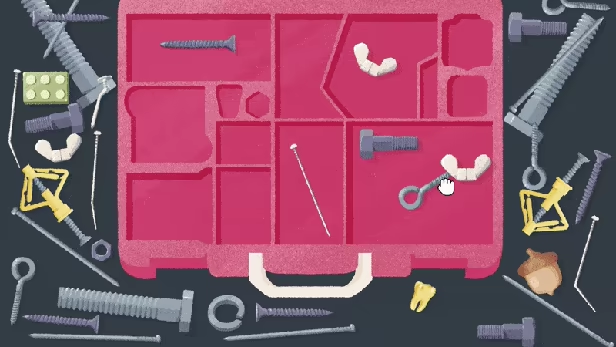 Tidying a cluttered desk — Steam store
Putting the Mechanics into Words
What the positive side calls 'intuitive' rests on one thing: the verb is subtracted down to one. Pick an object up, put it down. In Puzzlebyrinth terms everything else rides on a single point — observation resolution.
The game never states the answer in words. Your job is to find the hidden rule among the objects: order by size, by colour, by count. It's the 'look at the board before you draw a line' structure of The Witness, moved onto a pile of household clutter — verb minimal, observation maximal.
Where Unpacking was a story of what to place in a home, this is a sorting puzzle about what order the objects are hiding. 'Satisfying' here isn't the joy of building an arrangement; it's the small click of finding an order that was already there.
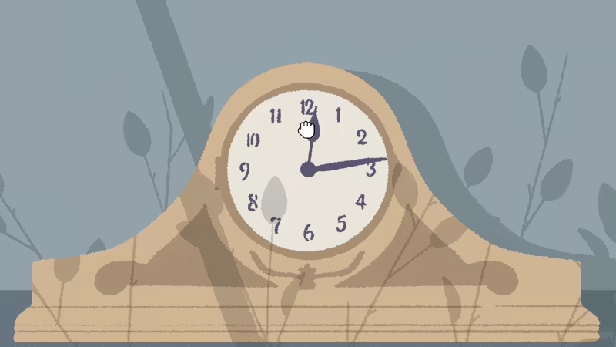 Finding and arranging a hidden order — Steam store
Design Craft
The craft the helpful reviews single out is the wordless hint system and the 'Let It Be' skip. Hints reveal themselves in stages, as pictures, and you choose how much to see. Get stuck, no penalty; skip, no scolding. The learning curve is handed to the player.
The developer sells 'multiple solutions,' and some levels genuinely accept several arrangements. For the positive side that reads as permission to tidy freely — the source of the calm. One subtracted verb, caught by several exits: on paper, a lovely design choice.
How far that 'multiple solutions' banner is actually felt, though, is the single most divisive point in the pool — as the next section shows. A thin gap runs between the intent and the feel at the desk.
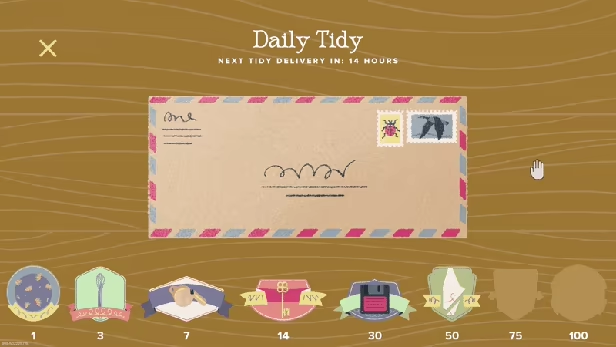 The daily tidy delivery — Steam store
The Texture of Difficulty
On average the difficulty is low. As reviewers say, most levels resolve pleasantly in seconds. The trouble isn't the average — it's the outliers, the occasional level whose answer narrows to one exact point, where the feel suddenly changes.
The users' 'relaxing' game is what the outlet Siliconera called 'obtuse': objectives unstated, hints wordless, so at the hard spots you feel you're hunting one obscure solution — not as freeform as the tagline promises.
To me it's a question of kind, not amount. Most levels just ask you to raise your observation resolution. A few, having let you find the order, then demand near-exact placement — the grammar slips from sorting to alignment. The reach the developer opened with 'multiple solutions' quietly narrows back to one, and that drop is where opinion splits.
 The seasonal puzzle archive — Steam store
Sources
This piece was written by reading the Steam store page's user reviews as of 2026-07-03. No review text is quoted directly; typical claims are reconstructed.
- Steam: A Little to the Left (Very Positive, 92% of 9,496 English reviews; 15,691 across all languages)
- Read via WebFetch: helpful and recent reviews on both sides, including complaints about Daily/DLC achievements and 'buy it on sale' price notes
- Press: Siliconera, plus The Guardian (4/5), NME (4/5), Metacritic (75)
Closing
Steam reads 92% positive; my design-critique score is 8.0. The core 'observe and arrange' verb is clear, and the forgiving curve — wordless hints, 'Let It Be' — is a model for the cozy-puzzle form. The marks come off where the promised 'freedom of multiple solutions' thins, at the hard spots, into one exact alignment.
The gap between 92% and my 8.0 is probably a difference in what's measured: reviewers score whether it felt good, I watch whether the design holds its line to the end. The idea and the calm, cat-filled world are real. Warmly recommended for anyone who wants the pleasure of finding order in a mess; outside its reach for anyone chasing the clarity of a hard-won solve — and the split itself says so honestly.
 A Little to the Left — Steam store
Where are you with this game?
Press one and the game goes on your shelf. You can see it on your account page.
Reactions (no login)
Anonymous • one of each per visitor per day
Read next
Related reviews
Lost in Play
A hand-drawn point-and-click adventure told entirely without words. The siblings Toto and Gal make their way home through fifteen scenes built out of a child's imagination, picking things up, combining them, and solving a different little minigame in almost every room. From Happy Juice Games.
Machinika: Museum
A first-person puzzle box in which you scan alien devices of unknown origin delivered to a museum, peer inside them and reprint their missing parts until they run again. A short piece from Littlefield Studio that opens seven machines one at a time, with the touch of science-fiction archaeology.
The Past Within
A point-and-click adventure playable only by two people at once: one stands in the Past, the other in the Future, and every puzzle is solved by describing aloud what only your own screen shows. The past is drawn in 2D, the future in 3D. Rusty Lake's first co-op-only game.


