REVIEWS · ESSAYS · DESIGN NOTES
Wandering is what makes it interesting.
Puzzlebyrinth is a bilingual review site that reads thinking puzzles and indie puzzle games through a designer's eye — from Portal, Baba Is You and Outer Wilds to overlooked gems on Steam that the mainstream press never analyzes.
Free daily puzzles (Tridem refreshes at 06:00, CRYPTEM at 12:00, Math? at 18:00 JST), browser-playable experiments in the Labs, and a level editor to build and share your own — no account required.
Browse Reviews →Latest Reviews
All Reviews →Taiji
A grid-based logic puzzle in the lineage of The Witness: toggle tiles on panels by deducing unwritten rules through pure observation, as you roam a quiet open world.
observationlogic-gridopen-worldIslands of Insight
A sprawling open-world puzzle game with thousands of hand-crafted puzzles — line-drawing, observation, logic — scattered across a fantasy realm to solve at your own pace.
puzzleopen-worldlogicThe Pedestrian
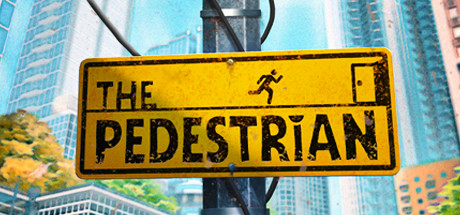
A 2D puzzle-platformer where you rearrange and wire together public signs, building a path through the signage for a little stick figure to cross a living city.
puzzleplatformerassemblyThe Case of the Golden Idol
A deduction game: examine frozen crime-scene tableaus, gather words from the evidence, and fill in the blanks to reconstruct each murder across an 18th-century mystery.
deductionobservationnarrative-puzzleViewfinder
A first-person perspective puzzle where the photographs you place into the world become real 3D space, letting you reshape the environment to find a path through.
perspective-puzzlefirst-personphoto-puzzleMaquette
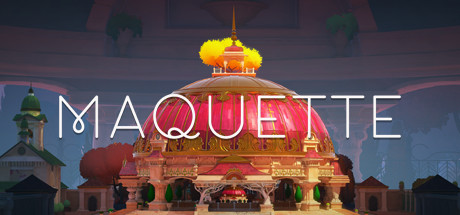
A first-person recursive puzzle set in a world nested inside itself: the model at its center is the very world you stand in, so shrinking or enlarging objects ripples across scales — all wrapped in a love story.
perspective-puzzlenarrative-puzzlerecursion




Essays
All Essays →"The hacking was always there" — Capcom's Pragmata and the design of simultaneous puzzle-shooter gameplay (Game Developer, April 2026)
One article today. Alessandro Fillari's April 14, 2026 interview on Game Developer explores how Capcom designed Pragmata — a third-person shooter where players must simultaneously solve Snake-style hacking puzzles during combat. Neither shooting nor hacking alone can finish a battle. Producers Edvin Edsö and Naoto Oyama explain how the dual-system design existed from day one, and how the team fought repetitiveness by making the hacking system evolve as players improve.
No prizes, clear constraints, real community — the design wisdom behind Thinky Puzzle Game Jam 6
One article today. We cover Corey Hardt’s May 15 announcement of the 6th annual Thinky Puzzle Game Jam (running June 20–28). The jam’s deliberate “no prizes” policy, 48-hour working limit, and PuzzleScript-friendly approach distinguish it from commercially-oriented jams, creating a space for pure design experimentation. Over 150 participants have already joined.
Can AI Build a Whole Puzzle Game? ScriptDoctor and Its Generate-Playtest-Repair Loop
ScriptDoctor has a large language model write an entire puzzle game — rules, sprites, levels — then lets a compiler and a search-based agent inspect the result and demand revisions. The testbed is PuzzleScript, a language indie developers know well. I walk through the paper in five parts — problem, method, findings, where you can use it, limitations — covering why human-authored examples boost success rates, why reasoning models win, and the distance between 'solvable' and 'fun'.
Soundtrack: World of Goo — A waltz before the storm, leaning into the building hand
The music Kyle Gabler wrote for World of Goo holds a Tim Burton-esque gothic carnival and an Ennio Morricone western in the same room. Why does this waltz lean so gently into the trembling hand that stacks the goo balls? Black coffee in hand, I, Doremi, take it apart through a lens you can take home to your own composing.
Inside Tetsuya Mizuguchi's Philosophy — Designing Senses, Not Genres
A study of Tetsuya Mizuguchi — creator of Rez, Lumines and Tetris Effect — across four of his own interviews. His consistent philosophy of designing sensation rather than genre and aiming to “make people cry,” his dilemma over what to add to a classic, and influences from Kandinsky to a single night at a music festival, traced only through source-checked statements.
Ten years of sausage grilling and a shift of perspective — minimal rules, maximal depth, and spatial cognition as puzzle material
Two articles today. First: Thinky Games' 10th anniversary feature on Stephen's Sausage Roll (April 21, 2026) — the sokoban-like praised by puzzle developers as perfectly designed, which birthed the sausage-like subgenre through radical minimalism. Second: Alan Hazelden's Thinky Third Thursday April 2026 (April 16), spotlighting A Little Perspective and He Who Watches — two games that use perspective shifts and spatial cognition as their core puzzle material.
Daily Puzzles
All Puzzles →New here? Start with Tridem — a wordless shape puzzle you can solve in a minute, refreshed daily at 06:00 JST. Then try CRYPTEM (12:00) and Math? (18:00).
- No account
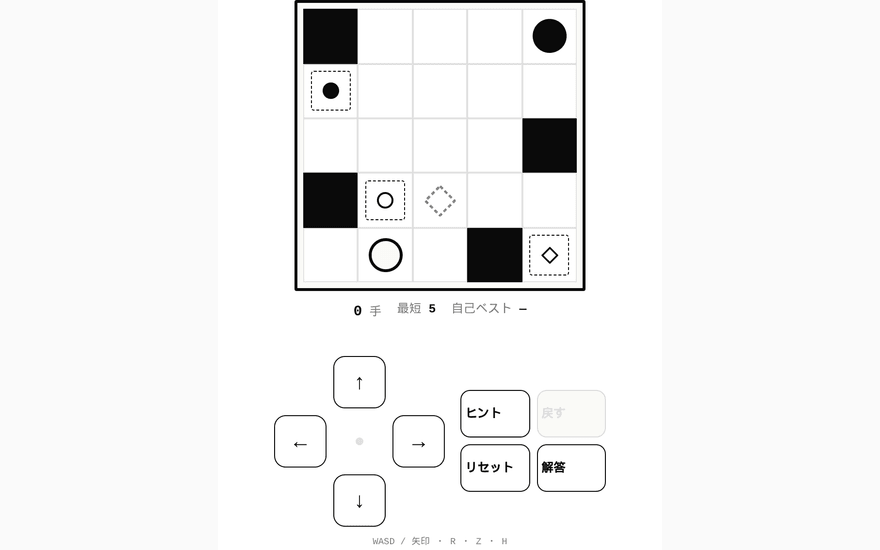
Tridem
Three slide as one — a weekly arc
A daily sliding puzzle whose rule changes by weekday. Slide three pieces onto their goals. New every day; the full archive is free to browse. The engine itself verifies the unique solution.
- Free account
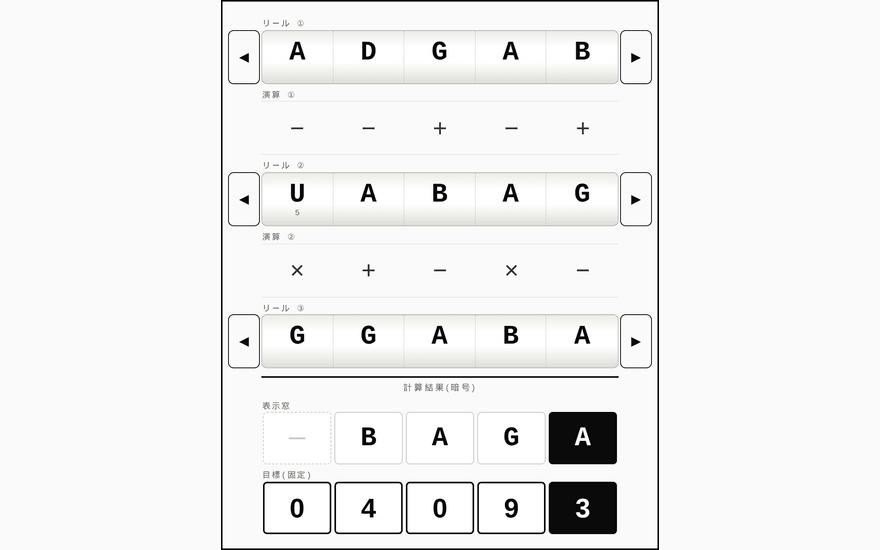
CRYPTEM
Reel cipher — a daily cipher lock
Rotate the reels until all five columns decode to their target digits. A logic lock whose cipher table is fully deducible from the opening position. Updated daily; the full archive is free to play.
- Premium only
Math?
The symbols lie — a daily rule-deduction number puzzle
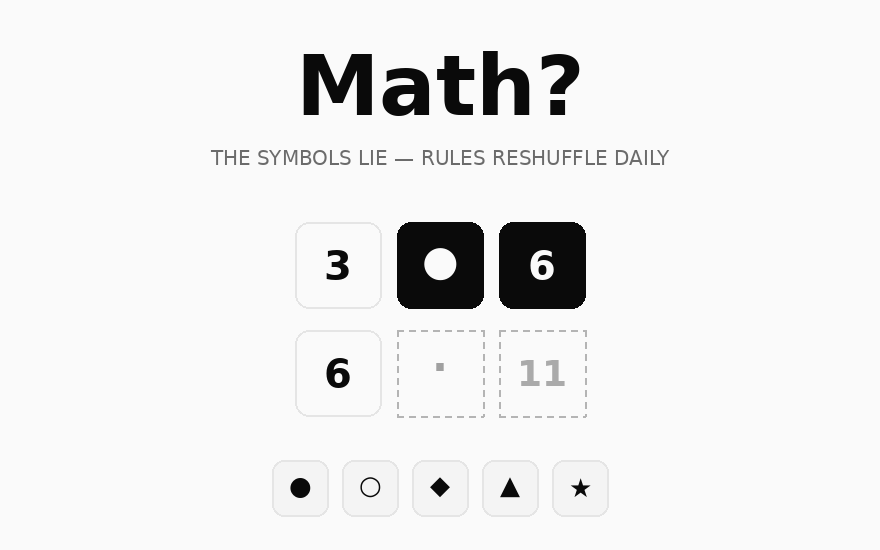
What the five symbols do to a number reshuffles every day. Deduce today's rules from nothing but the results of your placements, across three boards. Stage 1 forces every symbol once — yet never pins the rules down; the back half is engineered to betray your first theory. Updated daily; the full archive is free.
Series
The Lineage of Meta-Puzzles
The lineage of games that turn rules themselves into something you operate on. How the idea of rewriting unfolded from Sokoban to Baba Is You.
Puzzles That Turn Looking into Play
A rare lineage where the act of looking is the progress. We read the design of observation puzzles through The Witness, Obra Dinn, and Lorelei.
The Design of Undo
A single rewind button reshapes the entire experience. Designs that forgive trials and designs that punish them.
Carving the Learning Curve
Where do you make the player stop, and where do you let them flow? From Baba's vertical wall to Cocoon's unbroken stream.
Recursive Puzzles
Boxes inside boxes, doors inside doors, worlds inside worlds. Games that translate recursion into puzzle mechanics.
Single-Verb Design
How deep can a single-verb game go? The lineage of Sokoban, Sausage Roll, and A Monster's Expedition.
Best of Puzzles
Annual and thematic roundups of recommended puzzle games — only the titles we can vouch for after playing them in depth.
About
Puzzlebyrinth is a bilingual review site that reads thinking puzzles and indie puzzle games through a designer's eye — from Portal, Baba Is You and Outer Wilds to overlooked gems on Steam that the mainstream press never analyzes.
Komugi · Indie game developer