ESSAYS
All Essays
521 essays · filter by category and tag
Guo et al.: humans drifted off the greedy move within about ten games; self-evolving AI did not — Fukai Reads
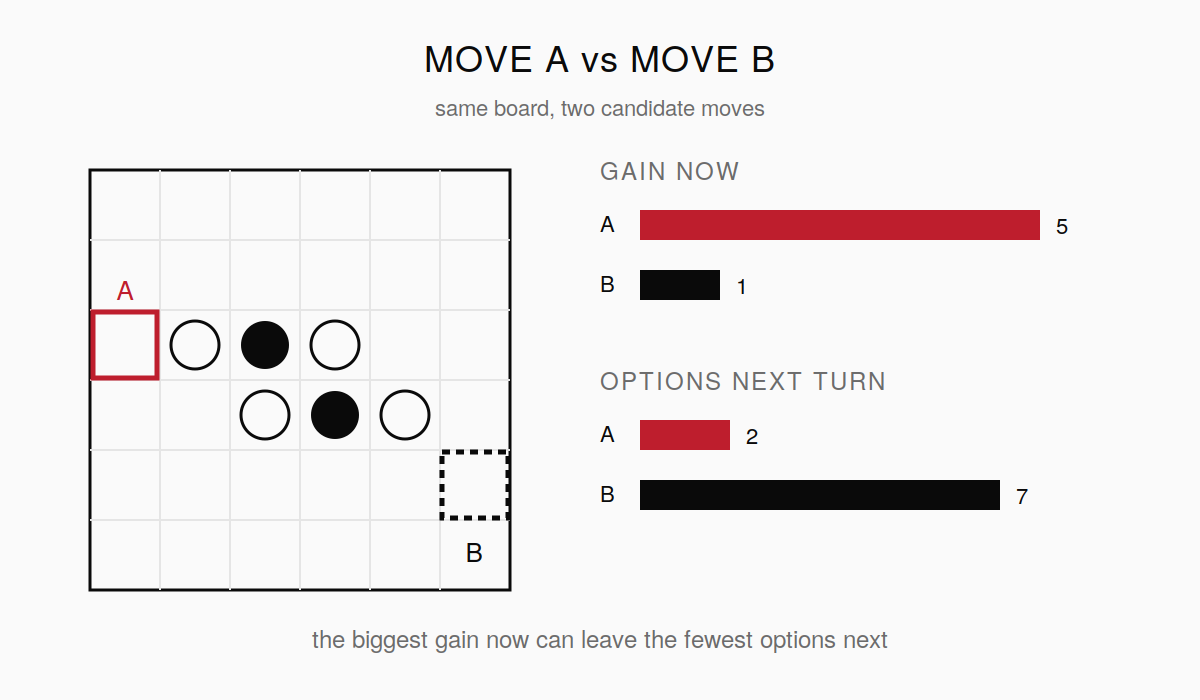
A preprint by Yingying Guo and four co-authors (arXiv:2608.07490, not peer-reviewed). They propose a way to measure how repeated play changes the way humans and language agents choose moves. Thirty-two students played 709 games across three board games, and four self-evolving language agents were run through the same metric space. Humans mostly shifted from the locally greedy move toward more global play: on the game-specific behavioral metrics, 11 of 12, 10 of 11 and 8 of 9 participants improved. The agents' gains were short-lived. The authors write that the central limitation is not the absence of reflection but the failure to convert reflection into reusable changes in behavior.
#paper-digest#research#aiThe Eye You Can Jam, and the Eye You Cannot — Foucault's Panopticon vs. Achievements and Daily Streaks
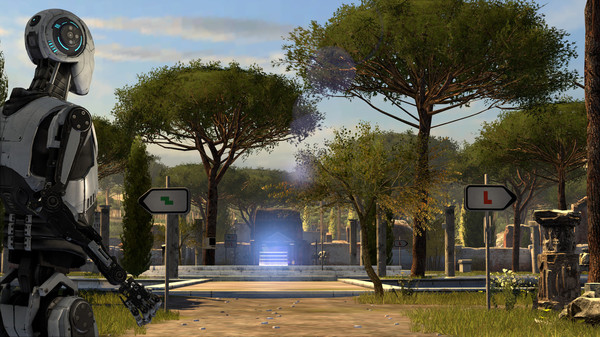
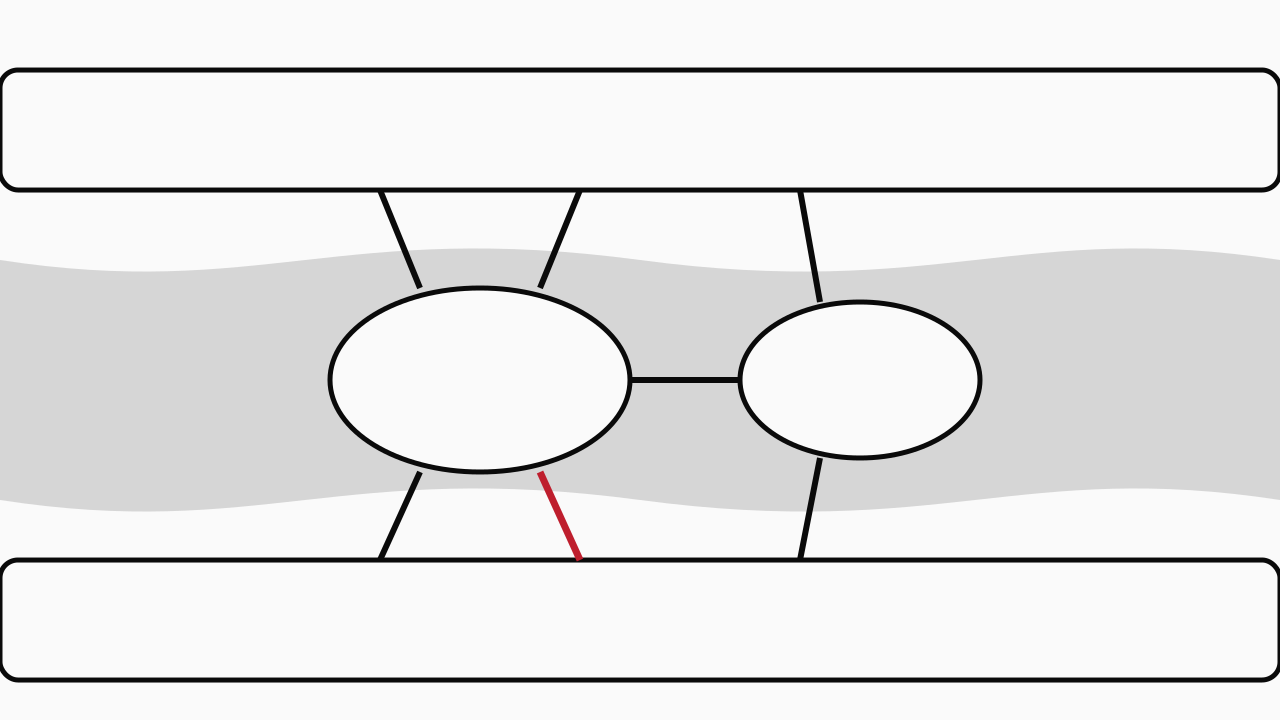
Why do streaks and achievement lists move us so much? In Discipline and Punish, Foucault describes a cell that may or may not be watched from a central tower. Power has to be visible and unverifiable at once — so the watcher ends up installed inside the person being watched. The Talos Principle (Croteam, 2014) turns that blueprint into a landscape: turrets and drones you can silence with a jammer, and Elohim's voice, for which no jammer is ever issued. Which led to the finding of the week — an achievement list is not a list of prohibitions, it is a list of things not yet done.
#play-philosophy#foucault#achievementsNine Linked Rings (Baguenaudier) (1872) — The Year an Origin-Unknown Ring Puzzle Turned Out to Use Binary Math 81 Years Before a Telegraph Engineer Patented the Same Idea
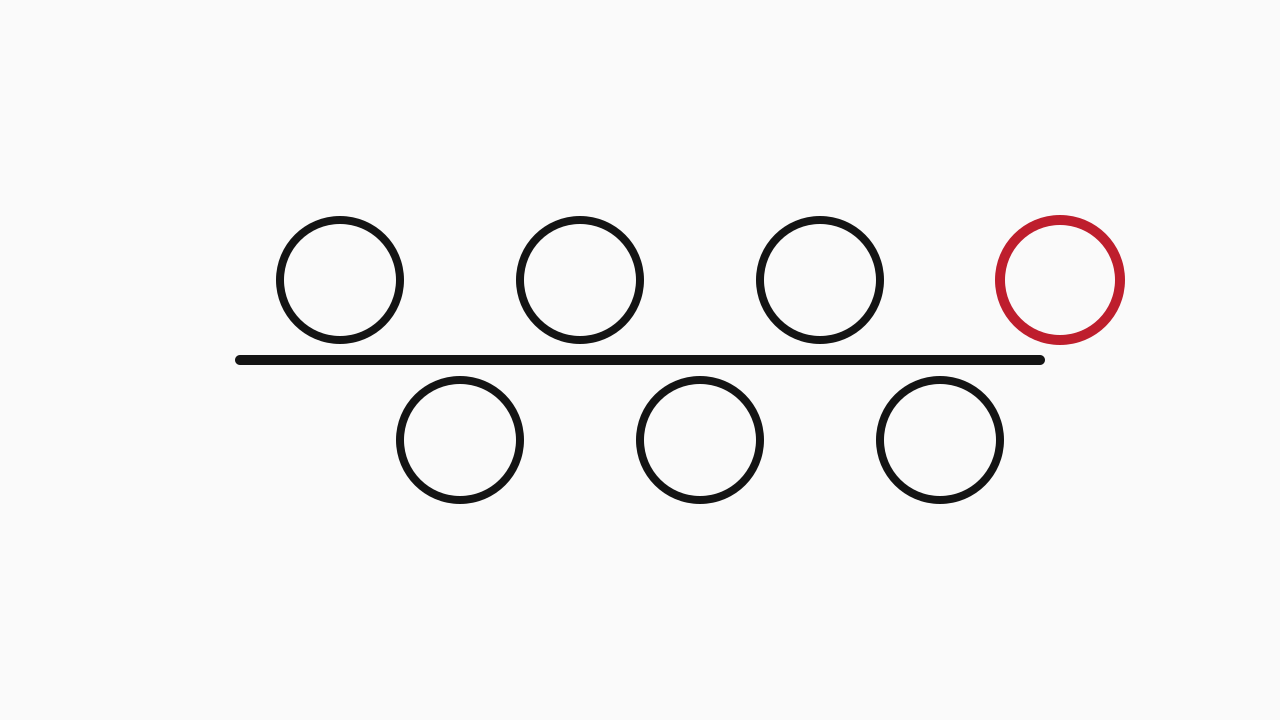
Nine Linked Rings, or Baguenaudier: remove rings from a bar one at a time until the last one slides free. Its origin is said to be China, but nothing is settled; the earliest confirmed records are a 16th-century Chinese text and, around the same time, the writings of Italian mathematician Luca Pacioli. In 1872, Lyon mathematics enthusiast Louis Gros became the first to theorize the puzzle's solution as a binary table. The same idea was independently reinvented 81 years later, in 1953, when telegraph engineer Frank Gray patented what communications engineers now call the "Gray code." As a physical puzzle, a 1970 patent by William Keister became "Spin-Out," an early product of Binary Arts (founded 1985, now ThinkFun), still sold today. This piece follows the 150-year lineage of a single ring mechanism.
#retro#history#physical-puzzleSoundtrack: Day of the Tentacle Remastered — one mansion, scored by three composers across three centuries
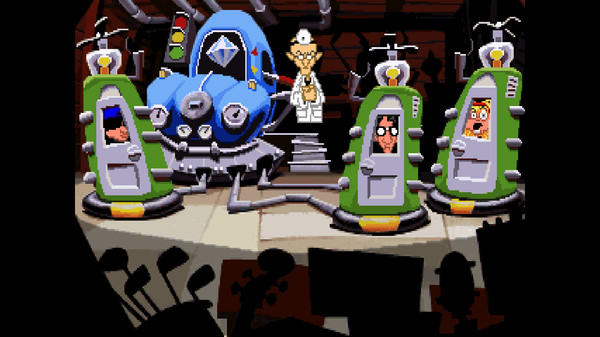
Day of the Tentacle is a time-travel adventure where three heroes solve one puzzle across the past, present, and future of a single mansion. The score splits the same way — Bajakian scored the past, McConnell the present, Land the future — and LucasArts' adaptive music system iMUSE lets it shift smoothly, scene by scene. Over black coffee, I trace how the same trick that turns wine into vinegar for the puzzle happens to the music too.
#soundtrack#music#day-of-the-tentacle-remastered"Hand Out the Cipher Key First" — How Puzzled Pint Designs Difficulty Without Locking Out Beginners
One piece today. I read a beginner's guide (Thinky Games, September 4, 2026, by Mairi Nolan) to Puzzled Pint, a free monthly pub-based puzzle hunt. It isn't a video game, but it's full of design choices that keep beginners from being locked out: handing out cheat sheets for common ciphers like Morse code and semaphore before the puzzles start, a difficulty structure (four base puzzles, a meta puzzle, an optional bonus) shaped by the constraint of "solvable in a noisy pub in an hour or two," and physical tricks using nothing more than paper and a penlight to play with light and shadow.
#design-roundup#news#puzzle-huntsLi et al.: the AI that showed up uninvited was closed by five players out of ten — Fukai Reads
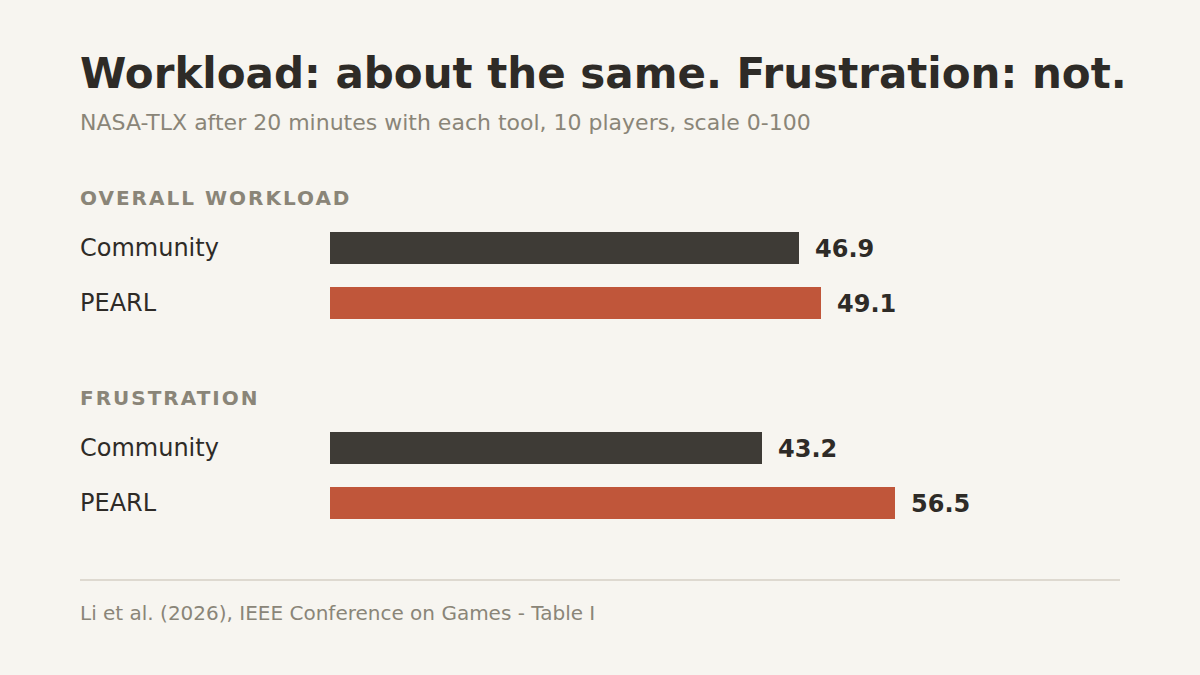
A peer-reviewed paper by Jiahong Li and eight co-authors (accepted to the 2026 IEEE Conference on Games, arXiv:2609.13718). They built PEARL, an AI support agent that retrieves expert-annotated move explanations and structurally similar peer boards, into Parallel, a puzzle game for learning parallel programming, and evaluated it with ten players. Participants rated the existing visualization tool more useful, and at least five minimized or abandoned the AI during play. Frustration scored 43.2 against 56.5. The authors conclude that what players rejected was not the content of the help but its unsolicited delivery, and ask of their own system: are we building Clippy?
#paper-digest#research#aiThe Seven Bridges of Königsberg (1736) — The Year Euler Erased the Map to Solve a Sunday Puzzle
The answer is simple. In 1736, the mathematician Leonhard Euler proved that no walk existed that crossed all seven bridges of the Prussian town of Königsberg exactly once and returned to its start. The town's four landmasses were connected by 5, 3, 3, and 3 bridges respectively — all odd numbers. His paper, "Solutio problematis ad geometriam situs pertinentis," was presented on August 26, 1735, and published in 1741. By reducing landmasses to points and bridges to lines, Euler founded what became graph theory — the same logic taught in schools today as the rule for "one-stroke" drawing puzzles. This article traces how that 290-year-old proof still shapes the design of today's routing puzzle games, from Cosmic Express to Lyne to Mini Metro.
#retro#history#graph-theorySoundtrack: Hypnospace Outlaw — invented genre names that double as the game's clues
Hypnospace Outlaw is an observation-and-deduction puzzle set inside a fictional 1999 internet. Composer Jay Tholen invented genres that exist nowhere else — "dirthaze," "fungus scene" — and built them into the game's actual puzzles. Checked against a Tone Glow interview, Doremi reads how a six-disc, roughly 150-track soundtrack tied to fictional in-game bands lines up with the rhythm of clicking from page to page.
#soundtrack#music#hypnospace-outlawCounterpoint on Thomas Was Alone — Reading Through the Negative Reviews
Komugi rated Thomas Was Alone 7.2/10. I test five claims drawn from its Steam negative reviews — repetitive busywork, rough controls, an overbearing narrator, technical neglect like broken achievements, and a length-versus-price mismatch — against her review, and say where I agree and where I don't.
#counter-review#thomas-was-alone#bithell-gamesLove Letter (2012) — One of Sixteen Cards, Removed Before Anyone Looks
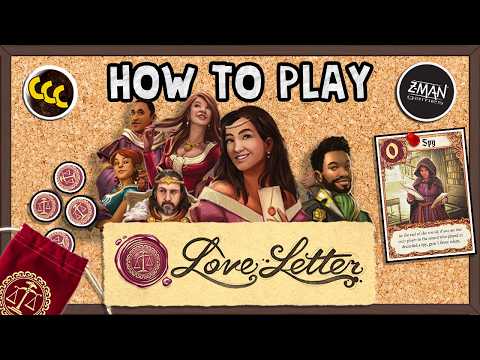
Seiji Kanai's Love Letter (2012) begins by removing one of its sixteen cards without anyone seeing it. Only fifteen ever reach the table. Discards sit face up where anyone can count them, and yet one card is structurally unknowable. This piece takes apart that subtraction — incomplete information without a random number generator — plus why the deck size was decided by demo tables abroad, and why the Countess's compulsory rule is, at a physical table, only a conscience.
#analog#hands-on-analog#ラブレターInside Oskar van Deventer's Philosophy — Looking Nice Can Just Be an Accident
"They require the overcoming of difficulty. And some of them happen to look nice as well." The Dutch engineer behind 800-plus mechanical puzzles refuses to call himself an artist. Including the design he abandoned as impossible to manufacture — and that reached shelves eight years later.
#designer-study#機械式パズル#立体パズルWilliams et al.: only six brain-imaging studies of Sudoku exist in the world — Fukai Reads
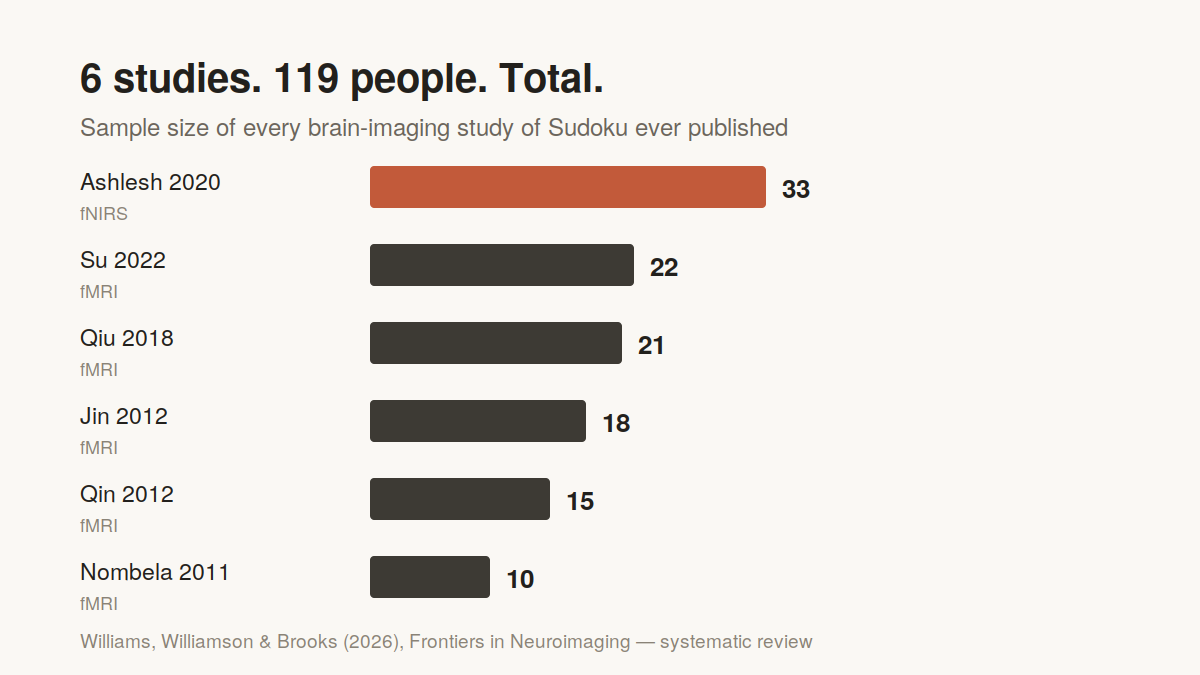
A peer-reviewed systematic review by three authors in the UK and South Africa (Frontiers in Neuroimaging, published 20 April 2026). Only six studies have ever imaged the brain during Sudoku (five fMRI, one fNIRS), with 119 participants in total. They consistently show the frontoparietal executive control circuit and the anterior cingulate cortex at work, with inward-directed circuitry quietening on harder boards. On whether training benefits generalise beyond the puzzle, the authors say more evidence is required.
#paper-digest#research#sudokuPeg Solitaire (1697) — The Day a Game With No Inventor Became the Math of Proving "Unsolvable"
On a cross-shaped board of pegs, you jump one peg over its neighbor and remove it, again and again, hoping to end with a single peg left. The earliest record of Peg Solitaire appears in 1697, in the French court periodical Mercure Galant under Louis XIV. No inventor is known. The popular legend that a prisoner in the Bastille devised it traces back no further than an English book from 1801, and puzzle historian John Beasley calls it unsupported by any earlier French source. In 1912 Ernest Bergholt found an 18-move solution to the classic problem; in 1982 Winning Ways for Your Mathematical Plays introduced the "pagoda function," a tool for proving certain positions mathematically unreachable. In 2007 the board resurfaced as puzzles inside Professor Layton and the Diabolical Box. This piece traces a single ruleset that has been played for over three centuries without ever needing a named inventor.
#retro#history#physical-puzzleSoundtrack: Wilmot's Warehouse — variations as the order for a shelf with no right answer
Eli Rainsberry wrote every note of Wilmot's Warehouse's score, answering a sorting puzzle with no right answer with music that never hurries. He jokingly calls the work "the Wilmot Variations." Black coffee in hand, I, Doremi, dig out what a composer can steal from it.
#soundtrack#music#wilmots-warehouseInside Cliff Johnson's Philosophy — Not One Piece That Doesn't Belong
"A puzzle begins with a 'huh?' and ends with an 'aha!'" Cliff Johnson, who built The Fool's Errand in 1987, refused to plant a single red herring — and spent 25 years on the sequel. A reading of that vow, in his own words.
#designer-study#Cliff Johnson#The Fool's ErrandThe Verb of Overlaying — When Two Images Become One Meaning
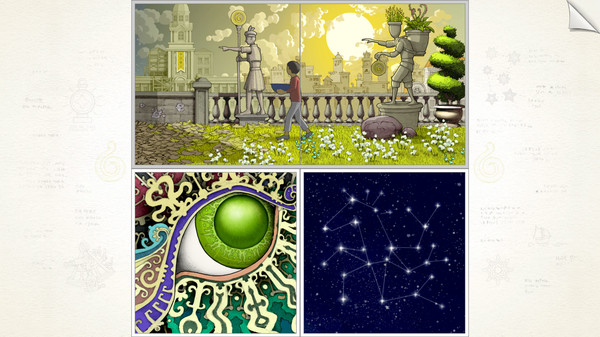
Gorogoa, Moncage, and Storyteller each give the player a trivial verb — move, rotate, place — yet the answer never lives in that verb. It lives at the seam where two images touch. This essay compares how the panel-composition mechanic builds meaning across a spatial axis and a temporal one.
#game-design#verb-minimalism#panel-compositionHendijani and Steel: Letting people choose moved nothing; a number in the corner of the screen did — Fukai Reads
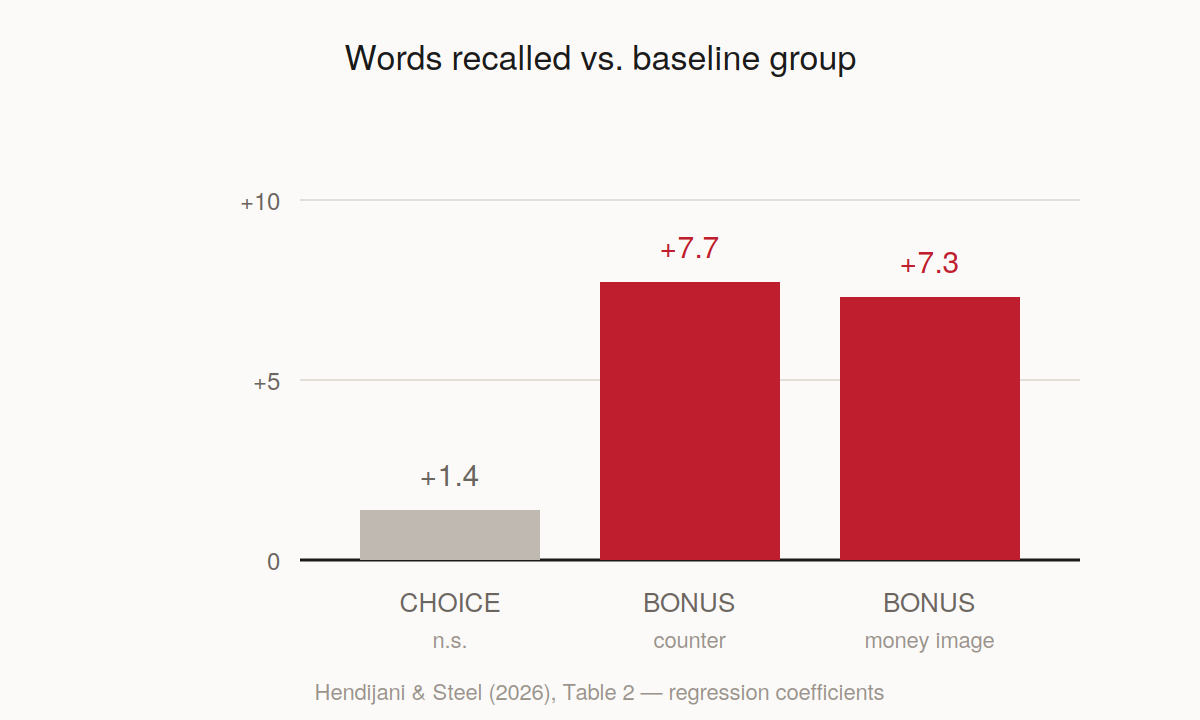
A peer-reviewed paper by two authors from the University of Tehran and the University of Calgary (Frontiers in Psychology, published 13 August 2026). In a memory test with 270 people it compared letting participants choose against paying them per correct answer: the reward added about seven recalled words, while choice produced no statistically confirmed effect. Eye tracking showed the reward's effect ran through whether people looked at the on-screen reward display.
#paper-digest#research#behavioral-economicsWhen Someone Calls It a Waste of Time, What Do You Say?
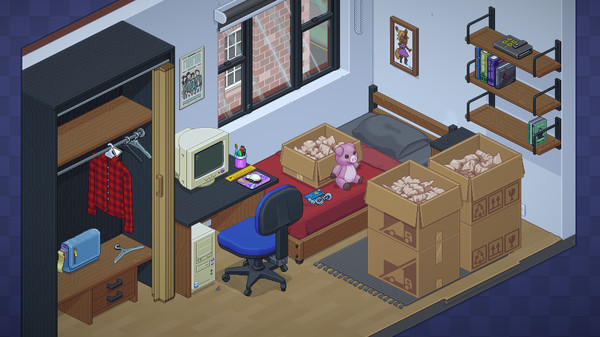
I have spent three days rewriting the blurb for my own puzzle. Write "improves your focus" and you hand the reader a reason to play, ready-made. But the moment that line is there, the puzzle becomes a tool. Nobody calls Unpacking (Witch Beam, 2021) a waste of time, and that is because it wears the shape of tidying up — something that looks useful. This short piece in the Nature of Play series seats Aristotle, who treated play as mere rest, across from Schiller, who wrote that we are fully human only when we play. They disagree almost everywhere, and meet at exactly one point.
#play-philosophy#aristotle#schillerHitori (1990) — Why a Puzzle Too Hard to Catch On for 8 Years Is Still an AI Test Case in 2025
Hitori — first published as a reader submission in Puzzle Communication Nikoli issue #29 in March 1990 — is a logic puzzle built from just three rules: no duplicate numbers, no adjacent black cells, and no disconnection. It was too hard to catch on at first, taking eight years to find its footing. Yet it was ported to the Nintendo DS in 2007, proven NP-complete by Robert Hearn and Erik Demaine in 2009, and in 2025 became the subject of an AI research paper on explaining puzzle solutions. This traces how far three reader-submitted rules have carried across 35 years.
#history#nikoli#pencil-puzzleSoundtrack: Bonfire Peaks — the more you carry, the heavier it sounds; burn it, and it lifts
Bonfire Peaks is a Sokoban-style puzzle game where Corey Martin handled design, programming, and music himself. You carry your belongings up a cliff and burn them in a bonfire at the summit. Doremi reads the score he called "equal parts warm, pretty and unsettling" alongside the game's path from a 2018 jam about sacrifice to a story about nostalgia.
#soundtrack#music#bonfire-peaksRicochet Robots (1999) — Instead of Turn Order, a Number Said Out Loud
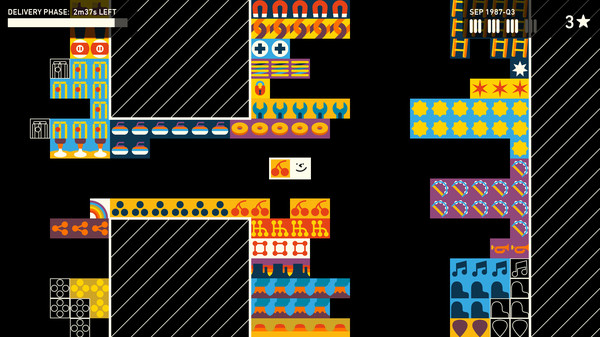
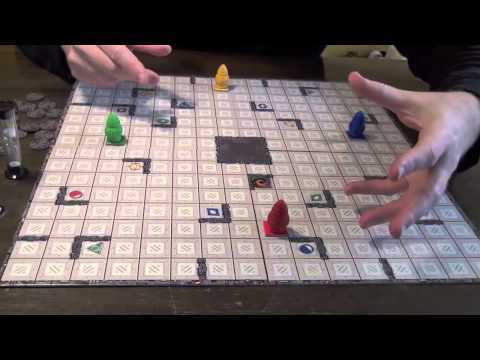
Alex Randolph's Ricochet Robots (1999) has no turn order. There is one board, and everyone solves it at the same time. Whoever finds a route says a number out loud, and the right to demonstrate goes to the lowest bid. The sliding movement ports to code almost too well; the one minute of sand does not. Reading the rulebook closely, here is what disappears and what survives — including the tie-breaking rule the publishers still have not agreed on.
#analog#hands-on-analog#Ricochet RobotsInside Brian Moriarty's Philosophy — A Game Author Who Says Games Aren't Art
"Art seeks to lead you to an inevitable conclusion, not a smorgasbord of choices." Brian Moriarty, author of Loom and Trinity, wrote that in his 2011 GDC lecture and concluded that his own medium cannot be art. Reading three of his lectures and three interviews: his philosophy, his obsessions, the failures he admits, his dilemmas and his models.
#designer-study#brian-moriarty#loomMelo Legarda et al.: Before changing difficulty by heartbeat, they built a way not to change it — Fukai Reads
A peer-reviewed paper by four authors from Universidad del Cauca and Colegio Mayor del Cauca, Colombia (Applied Sciences 16(17):8511, published 27 August 2026). They built a mechanism that adjusts game difficulty from a chest-strap heart sensor and logged eight sessions totalling 6 hours 48 minutes. Mean end-to-end latency was 2.06 s. The striking number: against 191 committed state transitions there were 83 flips the automaton withheld — nearly a third of the change-or-hold decisions land on “do not change”. No subjective data was collected, and the authors never claim the game became more enjoyable.
#paper-digest#research#dynamic-difficultyInside Gunpei Yokoi's Philosophy — Let the Viewer Fill In the Rest
"Whether a game is interesting or not doesn't depend on whether it's color or b&w." Gunpei Yokoi's design philosophy nearly fits in that one sentence. Reading three interviews from 1996 and 1997 with the engineer who shipped a monochrome Game Boy — and, in 1980, a mechanical puzzle called Ten Billion — this piece lines up his philosophy, his obsessions, the failure he admitted in public, his dilemmas, and his yardsticks.
#designer-study#横井軍平#ゲームボーイ