DESIGNER-STUDY · 2026-09-17
Inside Oskar van Deventer's Philosophy — Looking Nice Can Just Be an Accident
Gear Cube / Over the Top 17×17×17 / Arch Burr / Hanayama Cast Twist
"That is not art, it is a puzzle!" — his words, not ours
In 2019 a puzzle designer was invited as keynote speaker to Bridges, the international conference that links mathematics and art. His name is Oskar van Deventer, and the paper he submitted was titled "That Is Not Art, It Is a Puzzle!"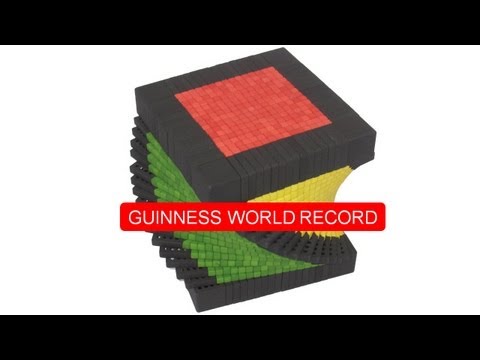 "Over The Top - 17x17x17" (OskarPuzzle / YouTube)
A man invited to an art conference, pushing back on the idea that his work is art. That alone made me want to read him.
Born in 1965. His day job is senior scientist at the Dutch research institute TNO; he holds a PhD in optics, more than 100 papers and over 80 patent applications (Wikipedia). Alongside that, he has been designing mechanical puzzles since he was twelve. He has over 800 designs, more than 70 of them mass-produced.
What I read today is the person, not the products. My only materials are texts he wrote himself and articles that quote him directly.
From age twelve, and he never quit the day job
His own site says he "started puzzle designing at the age of 12." That was 1978. He has never left his day job since. Researcher in networking and video by day, puzzle designer by night — for over forty years.
The turning point came in 2004, when his fellow puzzler George Miller introduced him to 3D printing, then still a rarity. You could check a shape without machining metal. The pace of prototyping changed.
He is not widely known in Japan. But if you have ever picked up a Hanayama Cast Puzzle, you may have held one of his designs: Cast Twist, released in 2013, is his (see our piece on Cast Twist).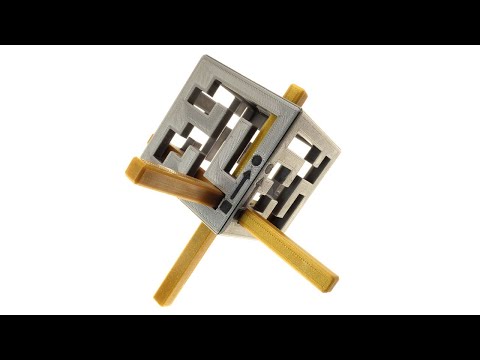 "Oskar's Cube 3.5x3.5x3.5 - Why the three-and-a-half?" (OskarPuzzle / YouTube)
Difficulty is the object; beauty is the leftover
The Bridges paper opens with a confession: "Although I have designed mechanical puzzles since 1978, I never considered myself an artist. After all, I was just enjoying myself with designing, making and solving mechanical puzzles" (Bridges 2019).
What moved him was meeting an art historian. "It was not until I met Rothstein that I realised that mechanical puzzles could also be considered a form of art." And: "It was an interesting experience to be interviewed by an art historian, because that's when I realized that puzzle design may be an art form like sculpture" (ibid.). The historian is Bret Rothstein — the paper spells it "Brett," but it reads as the same person.
Rothstein described mechanical puzzles as "the pursuit of difficulty," set against sculpture as "the pursuit of shape" (ibid.).
And here is how van Deventer places his own work: his designs "require the overcoming of difficulty. And some of them happen to look nice as well" (ibid.).
The order is explicit. Difficulty comes first; beauty is what falls out afterwards. The paper ends in the same posture: "I leave you to decide whether or not they are art" (ibid.). He will not rule on it himself.
Tabulating the kinds of motion, then filling in the blanks
There is a clear habit in his designing. He asks "can it be done?" not from a flash of inspiration but from a taxonomy of mechanisms.
Facing the classic six-piece burr, he writes: "This got me thinking, could I design a six-piece burr with all circular pieces?" (Bridges 2019). Out came Bulbous Burr and Arch Burr.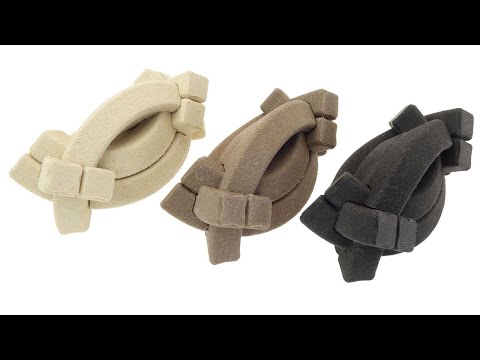 "Arch Burr - Is this a new twist on a classic six-piece burr?" (OskarPuzzle / YouTube)
The interesting part is that he does not stop there. The next step: "any mathematician knows that there are three types of continuous motion: linear, circular and helical. So could one make burrs with helices?" (ibid.). Candy Wrapper and Cold Fusion came out of that.
You can see the shape of the method. Enumerate the kinds of motion, then go after the cells that are still empty. It is less like waiting for an idea than like hunting for blanks in a table.
The same habit shows in the naming: Gear Cube, Gear Shift, Gear Ball, Geared 5×5×5. Find one mechanism, then move it onto other skeletons until it is a series.
He judged it impossible to manufacture, and dropped it
There is one failure he has put on the public record: a design called Snake Ball.
It starts with Oskar's Disks in 1986. His fellow puzzler Wil Strijbos suggested "that the two disks should go through each other all the way." Extending that line, Snake Ball arrived in 2004, prototyped by George Miller on his own machine.
And then it stopped. He writes: "We considered the puzzle impossible to mass produce at that time, so we abandoned the project" ("How it is made — Hanayama Cast Twist," his own site). The design existed. It could not be made. So he let go of it.
It restarted eight years later. In early 2012 that same art historian, Bret Rothstein, asked for a sample. From there a sample reached Teddy Sakamoto and Takeshi Onishi of Hanayama at IPP 2012, and Kyoo Wong, with a Chinese CAD specialist, "found a way to split the Snake Ball rings into three separate castable parts" (ibid.).
Eight years from abandonment to product. And the thing that restarted it was not a sales forecast but one researcher's curiosity.
Most of what he designs will never be sold
His FAQ states the commercial reality flatly: "Only a few percent of my designs are mass produced. The market for mechanical puzzles is limited."
3D printing is no picnic either. "3D-printing is an expensive process." He owns a machine, but "it takes a lot of time to feed and run the machine" (ibid.).
And the books? He told 3DPrint.com: "My sales are currently such that I am able to earn back my prototypes. Each prototype costs a lot of money to make." And: "I typically hover a bit above break-even, but not much."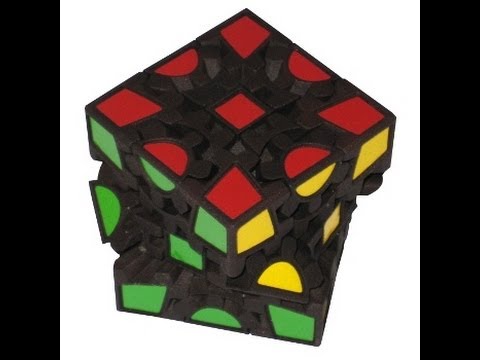 "Caution Cube - now mass-produced as Mefferts Gear Cube" (OskarPuzzle / YouTube)
Even his most famous object is no exception. Of the record-setting 17×17×17 Over the Top, he says: "I believe there are 6-8 assembled samples in the world. I haven't kept exact track" (ibid.). A thing built by hand from 1,539 parts was never going to be merchandise.
That is his dilemma. A few percent get made; the rest sit outside the economics. He keeps going anyway. For what it is worth, I found no statement of his lamenting any of this. Only the numbers, set down plainly.
He does not hide other people's names
What stays with me, reading his writing, is how often other people's names appear.
George Miller is the one who taught him 3D printing; the paper introduces him as "a fellow puzzle designer interested in art" (Bridges 2019). He is also the one who ran the Snake Ball prototype.
As co-designers he names Bram Cohen and Alexander Poddiakov (ibid.). Asked by 3DPrint.com about his favourite, he picked Sixth Sense and added: "It was invented by Bram Cohen. I did the detailed cadding and prototyping." Asked about his own signature work, he leads with someone else's credit.
The person who changed his mind was the art historian Bret Rothstein — and the person who dug up the abandoned design was the same man. For him, influence does not seem to mean distant masters. It means the name of someone within arm's reach.
Kizuki's reading — a man who hands the verdict over
From here on this is my own reading, one step beyond what he actually said.
I read him as a man who never keeps the verdict for himself. Whether it is art is left to the reader. The solution belongs to the solver. If someone else invented it, he says so before he says anything about his own favourite. If he judges it unmakeable, he lets go; if someone else finds the way, he writes their name down. The same habit runs through his prose, his objects and his credits.
And that fits the form he works in. Someone picks the thing up, turns it, gets stuck, gets it open. Through all of it the designer can do nothing. A man who is good at handing over the verdict made eight hundred objects that leave him no choice. That is how he reads to me.
Where to start
The easiest way to hold one of his designs is a Hanayama Cast Puzzle. Cast Twist is the piece carrying the eight-year story told above (our piece on Cast Twist / the Cast Puzzle lineage).
If you like moving mechanisms, start with the Gear Cube. If the Rubik's Cube lineage itself interests you, the inventor's own story is close by (our piece on Ernő Rubik).
And if the phrase "the pursuit of difficulty" appeals to you, the man who spread mathematics as entertainment should suit you too (our piece on Martin Gardner).
Sources
Primary sources used for this article:
・Oskar van Deventer, "That Is Not Art, It Is a Puzzle!", Bridges 2019 keynote paper (PDF, written by him) ↗ — not considering himself an artist, meeting Rothstein, "pursuit of difficulty" vs "pursuit of shape", the circular and helical burrs, and leaving the verdict to the reader
・Oskar van Deventer, "How it is made — Hanayama Cast Twist" (PDF, his own site) ↗ — Oskar's Disks (1986), Wil Strijbos's suggestion, the 2004 Snake Ball prototype, "we considered the puzzle impossible to mass produce at that time, so we abandoned the project", Rothstein's 2012 sample request, IPP 2012, and Kyoo Wong's three-part casting solution
・Oskar van Deventer's official FAQ (written by him) ↗ — "Only a few percent of my designs are mass produced. The market for mechanical puzzles is limited", plus his notes on the cost and labour of 3D printing
・Oskar van Deventer's official site ↗ — starting at twelve, his TNO career, the Guinness record, his shops and YouTube channel
・3DPrint.com, "Forget the Rubik's Cube - This Puzzle Designer Has Taken Shapeways by Storm" ↗ — earning back prototypes, hovering above break-even, the number of assembled Over the Top cubes, and his remarks on Sixth Sense and Bram Cohen
・Reality Escape Pod S8E9, "Mechanical Puzzles: Oskar van Deventer" (Room Escape Artist, 26 Nov 2024) ↗ — 800-plus designs since 1978, 70-plus mass-produced, and the episode's "pursuit of difficulty" framing
Secondary sources (used for fact-checking):
・Wikipedia, "Oskar van Deventer" ↗ — born 1965, senior scientist at TNO, PhD in optics, 100+ papers and 80+ patent applications, mass-produced designs such as the Gear Cube (2010, Mèffert's), and the 17×17×17 Guinness record period (2012–2016)
・Kastellorizo Puzzle Festival, "Oskar van Deventer" (2024) ↗ — started designing at twelve; hundreds of designs forty-seven years later
・Core77, "'Over the Top': Mind-boggling 3D printed 17x17x17 rubik's cube" (28 Jan 2011) ↗ — 1,539 pieces, 15 hours of assembly, unveiled in New York in February 2011
Images are thumbnails of the following YouTube videos; each was verified via oEmbed for title and channel:
・"Over The Top - 17x17x17" (OskarPuzzle) ↗ / "Oskar's Cube 3.5x3.5x3.5 - Why the three-and-a-half?" (OskarPuzzle) ↗ / "Arch Burr - Is this a new twist on a classic six-piece burr?" (OskarPuzzle) ↗ / "Caution Cube - now mass-produced as Mefferts Gear Cube" (OskarPuzzle) ↗
Reactions (no login)
Anonymous • one of each per visitor per day
Part of these series
The Designer's PhilosophyEpisode 63 of 63