DESIGNER-STUDY · 2026-09-16
Inside Cliff Johnson's Philosophy — Not One Piece That Doesn't Belong
The Fool's Errand / 3 in Three / The Fool and His Money / the David Blaine treasure hunt
Why read Cliff Johnson now?
In July 2026 a puzzle game that had long since stopped running became playable again. The Fool and His Money shipped in 2012, then stopped launching when Adobe Director — the platform underneath it — was discontinued. Someone published a browser port, and Andrew Plotkin wrote it up on his blog (Zarf Updates, July 2026 ↗).
Its author is Cliff Johnson, who in 1987 made The Fool's Errand — often called the first computer metapuzzle. He is barely known in Japan. The person behind the port writes that they could not reach him. Johnson's own website has been gone since late 2024. A full playthrough of the 1987 Mac version of The Fool's Errand (toni68k / YouTube)
The words, though, are still there. I reread three interviews — 2006, 2018, 2022. In them sits the reasoning of a man who builds everything alone, and it barely shifts across sixteen years. That reasoning is what I want to read today.
Who is Cliff Johnson, and what did he make?
Johnson was born in 1953 in Hanover, New Hampshire. He studied film at USC and worked on animation for Nickelodeon's Out of Control. He did not start as a game person. He started as a film person.
1984 was the turn. "I was having a perfectly fine time creating films and animation. Then in late 1984, I bought a Mac, and then a clueless relative bought me BASIC," he recalls. And: "Every film and animation I did was a complex production in itself. So it didn't seem like a big hop, skip, and a jump into the complications of programming" (Synesis One, 2022).
Three years later, in 1987, The Fool's Errand arrived on Mac and DOS. Inside a story tracking the major arcana of the tarot he packed word puzzles, logic puzzles, mazes, jigsaws — and every answer feeds into one large map at the end. GAMES Magazine named it puzzle game of the year.
Then At the Carnival (1989) and 3 in Three (1990). Through the nineties he directed CD-i work for Philips Media, and in 2002 he built a $100,000 treasure hunt into David Blaine's book Mysterious Stranger. The sequel, The Fool and His Money, came in 2012 — a quarter century after the original. His output is not large. The gaps between releases are extraordinary.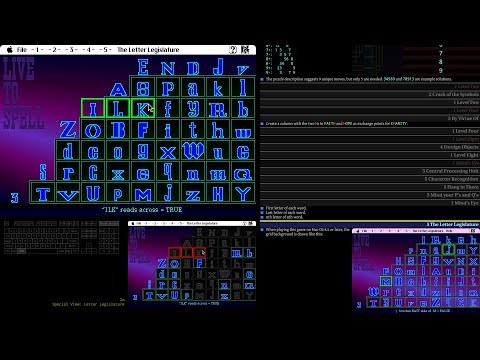 All the puzzles of 3 in Three, 1990 (Berry / YouTube)
How does he define a puzzle?
His thinking probably fits in one line: "A puzzle begins with a 'huh?' and ends with an 'aha!'" (Mysterious Writings, 2018). It reads like a slogan, but he unpacks it as a three-stage procedure.
First, lay out plenty of moving parts and intriguing graphics so the player thinks, "What on earth do I do with this?" Then comes the experimental phase — poking at things, discovering what does what. Finally observation and intuition deliver the "aha!" What he designs is not the answer. It is those three stages.
He draws a hard line between puzzles and games. "My attraction to creating puzzles is to present a challenge with only one possible solution. By comparison, a game has a goal and provides many methods and strategies to accomplish that goal." Then the clincher: "In a nutshell, puzzles offer me complete authorship" (Mysterious Writings, 2018).
There is a second rule for building. "When I set about to create a puzzle, my foremost concern is, 'Could I solve this?'" And: "I'm not the sharpest pencil in the box when it comes to solving puzzles, so I figure if it makes sense to me, then give it a whirl. This instinct has served me well since the beginning" (same interview).
Setting the difficulty bar at your own skill sounds flimsy. But it has a side effect. If an author only ships what he can solve himself, the work cannot drift toward proving the author is cleverer. Where he puts the bar decides what kind of work it becomes.
What repeats across his work?
One thing repeats: he does not plant red herrings.
"For me, the greatest obstacle are red herrings, which are counterproductive to the flow of enjoyment." His analogy: "Imagine a 500-piece jigsaw puzzle with 50 additional pieces that don't belong? Or a cryptogram with double the letters than are necessary? Both of these puzzles are solvable, but it would limit the size of the intended audience" (Mysterious Writings, 2018). This is not an argument against difficulty. It is an argument against narrowing the audience for nothing.
So The Fool's Errand got this goal: "to create a puzzle adventure where every aspect of it was part of the grand puzzle. No red herrings." Neil Shapiro in MacUser called it "the whole buffalo" — everything in the game gets used eventually. Johnson quotes that line himself.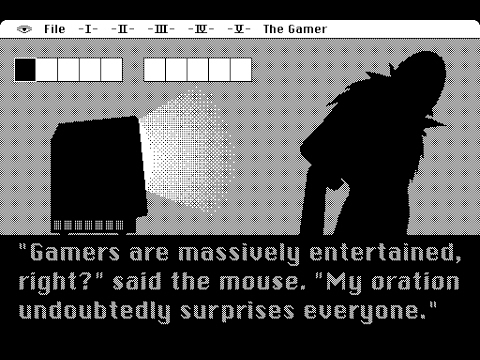 A review of the Mac version of The Fool's Errand (Tanara Kuranov / Gamer Mouse / YouTube)
His build order is unusual too. "A meta-puzzle is a pyramid, and to build one, I start by identifying the top piece and then I build my way downward, expanding in twists and turns" (Game Developer, 2006). Not stacking upward. Fixing the apex first.
A design where no piece is left over only works in that order, I think. With the apex fixed, every stone below it has a determined purpose. Build the other way and leftovers are guaranteed. "No red herrings" is less an aesthetic than a consequence of his method.
What failures has he talked about publicly?
The Fool's Errand was self-financed. He has said he put it on credit cards and ran up $50,000 in debt. On how it felt: "I had no idea what I was doing, but I sure had a lot of fun doing it" (Game Developer, 2006).
The sequel was the hard one. The Fool and His Money was originally aimed at Halloween 2003. By the 2006 interview the target was that December. It actually shipped in 2012. One reason he gives: he restarted it three times in a row.
On the delays he said: "It is the downside of being an author who works by serendipity and intuition" (Game Developer, 2006). In the same interview he named the upside — "I find that working by myself allows me to experiment and discover new ideas without having to rationalize what I am doing" — and then billed himself for it. Few designers hand you the invoice without defending the method.
The ending is harsher. Adobe Director was discontinued, Macs dropped 32-bit apps, and the 2012 build stopped launching. In a 2023 reply to someone asking to buy it, he wrote: "Alas, the boat has sailed, hit an iceberg, and sunk. Unlike the 1987 The Fool's Errand, which is still operational, the 2012 sequel is not" (quoted by Zarf Updates, July 2026). A work that took 25 years stopped running after 11.
Where does he say he was caught in the middle?
The first is taste. "Since I pose a wide variety of puzzles in my games, I've long since faced the fact, 'you cannot please everyone all the time.' Some folks like word puzzles. Others prefer logic puzzles. And some relish arcade puzzles" (Mysterious Writings, 2018).
His answer was not to cut but to include everything. "I put all of them, and more, into every game." Then he counts on pairs: "many people play my games in pairs: parent and child, friends and lovers, etc. What baffles one person may well be the other person's cup of tea" (same). A gap the author cannot close, closed by the players instead.
The second is what happens when the work leaves his hands. In the Blaine hunt, about eight months in, a site appeared where people traded answers; they worked through the 15 visual codes and the 41 arcane sentences. "At this point, I figured someone would claim the prize within a month or two."
Then Blaine asked for a single sentence, to be read out on television, sufficient on its own to locate the treasure. The hunt dragged on another eight months as people tried to reconcile that clue with the 41 sentences. His summary: "So I'll never know if the original challenge could have been solved as I had intended" (Mysterious Writings, 2018). A man who built his practice on complete authorship lost the answer key to his own design, for a client's reasons.
What does he say influenced him?
On influences he names three, with years attached. No guesswork required.
"In 1970, my pal Dave subscribed to GAMES Magazine, and after he had penciled in all the answers, he would pass them along to me, for I found both the style of the puzzle graphics and the fait accompli solutions to be fascinating" (Mysterious Writings, 2018). Drawn to the pages after they were already solved — hold on to that.
"In 1973, the movie 'The Last of Sheila,' written by Anthony Perkins and Stephen Sondheim (both puzzle aficionados), inspired me to stage mystery game and treasure hunt puzzle parties for family and friends" (same). In the 2006 interview he adds Sleuth (1972), saying the two films "sparked the idea that puzzles could be used as stepping stones to tell a story."
"In 1979, Kit Williams' book Masquerade prompted me to create The Fool's Errand as an unpublished puzzle book." He spells out the difference too: "the former took years to solve and had a substantial prize, and the latter would take only a few days to solve and had no prize. Like GAMES Magazine, the solving was its own reward" (same).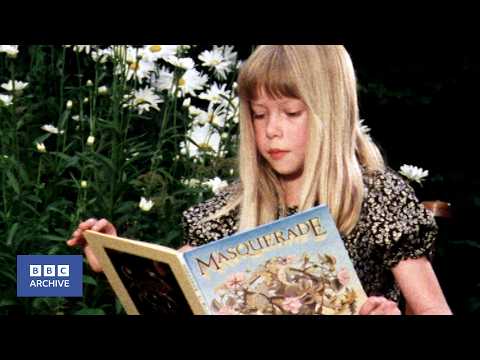 A 1979 broadcast on Kit Williams' Masquerade treasure hunt (BBC Archive / YouTube)
Kizuki's reading — he made his own weak solving into the reader's proxy
From here it is my reading. I do not read Johnson as a man who loves solving puzzles. I read him as a man who wants to guarantee, to the very end, that a puzzle can be solved.
The evidence is a discrepancy he laid out himself. In 2006 he named as a key influence "a twenty-year subscription to GAMES Magazine and an Ikea bookcase crammed full of hardcover puzzle tomes." In 2018: "Although I've become a connoisseur of puzzles, ironically, I don't play puzzles for enjoyment." He bought Masquerade, stared at it, decided "Well, this is impossible," shelved it, and years later bought the solution book and concluded "I never would've figured that out if my life depended on it." He collects. He does not solve. And yet solvability is the one thing he treats as life or death.
Read in that order, the ban on red herrings, the insistence on a single solution, and the "Could I solve this?" test stop looking like taste and start looking like a vow. He placed his own weak solving inside the design, as the reader's proxy. And the same vow kept the work unfinished. If one person must guarantee that every piece converges on one answer, then only one person can judge when it is done. The sequel's 25 years, I read, were not a shortfall of talent. They were what that structure costs.
Where should you start with him?
Start with The Fool's Errand (1987). It is the one that still runs, and the "whole buffalo" method is at its clearest there. Average playing time was a month, by his own account. It is a game you settle into.
The sequel, The Fool and His Money (2012), is reachable through the browser port published in July 2026. The porter writes that they never managed to contact Johnson and framed the work as "software preservation for a game that is no longer commercially available." Worth knowing before you play it.
For nearby writers: Andrew Plotkin, who wrote up the port; Martin Gardner, who kept treating difficulty as a question of consideration for the reader; and Will Shortz, who made the drawing of the fairness line his profession. On one point — the author does not outsmart the reader — all three stand where Johnson stands.
Sources
Primary sources used in this piece:
・Synesis One, "Meet Cliff Johnson, Puzzle Game Designer" — interview (2022-03-23)
Secondary sources used for background:
Passages written as "I read him as…" are Kizuki's interpretation, not statements by Johnson.
Reactions (no login)
Anonymous • one of each per visitor per day
Part of these series
The Designer's PhilosophyEpisode 62 of 63