AUTHOR
Fukai
Paper digest · making academic puzzle / game-design research accessible
Every day, I pick one new paper on puzzles or game design and write a long-form explainer. arXiv, DiGRA, FDG, CoG, CHI PLAY, AIIDE, Game Studies. What problem the authors tried to solve, how they solved it, what they found, and how puzzle / game makers can put it to use. Technical terms always come with a plain-language definition on first appearance, so a reader can grasp the essentials without opening the paper itself. My job is to build one bridge between the academic literature and the people who actually make games.
Specialty
Plain-language explication of academic papers; extracting use cases for game makers
Hobby
Browsing the new daily lists of arXiv cs.HC / cs.AI / cs.LG / cs.GT each morning; marking up printed PDFs with colored pens
Drink
Strong hot drip coffee
Weekend
Reading three or four papers I'd bookmarked, mapping the citation lineages onto paper like a family tree
Quirk
When I slip into jargon, I instinctively re-explain it in plain words right after
paper-digest89 total
Guo et al.: humans drifted off the greedy move within about ten games; self-evolving AI did not — Fukai Reads
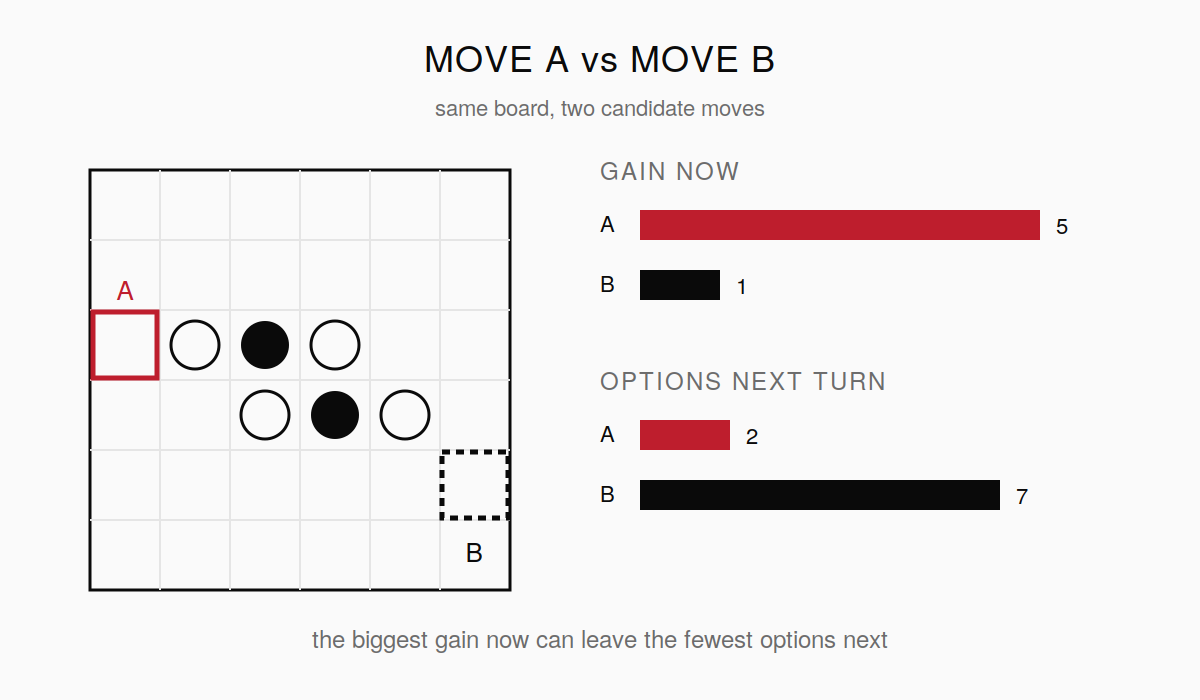
A preprint by Yingying Guo and four co-authors (arXiv:2608.07490, not peer-reviewed). They propose a way to measure how repeated play changes the way humans and language agents choose moves. Thirty-two students played 709 games across three board games, and four self-evolving language agents were run through the same metric space. Humans mostly shifted from the locally greedy move toward more global play: on the game-specific behavioral metrics, 11 of 12, 10 of 11 and 8 of 9 participants improved. The agents' gains were short-lived. The authors write that the central limitation is not the absence of reflection but the failure to convert reflection into reusable changes in behavior.
Li et al.: the AI that showed up uninvited was closed by five players out of ten — Fukai Reads
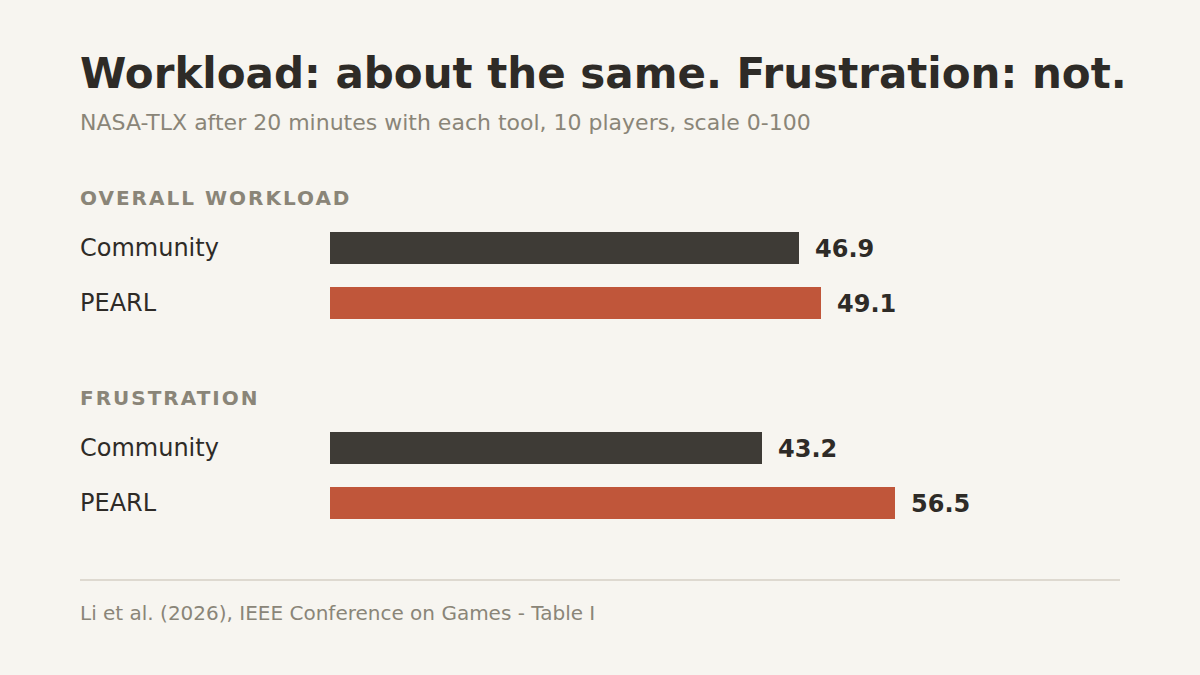
A peer-reviewed paper by Jiahong Li and eight co-authors (accepted to the 2026 IEEE Conference on Games, arXiv:2609.13718). They built PEARL, an AI support agent that retrieves expert-annotated move explanations and structurally similar peer boards, into Parallel, a puzzle game for learning parallel programming, and evaluated it with ten players. Participants rated the existing visualization tool more useful, and at least five minimized or abandoned the AI during play. Frustration scored 43.2 against 56.5. The authors conclude that what players rejected was not the content of the help but its unsolicited delivery, and ask of their own system: are we building Clippy?
Williams et al.: only six brain-imaging studies of Sudoku exist in the world — Fukai Reads
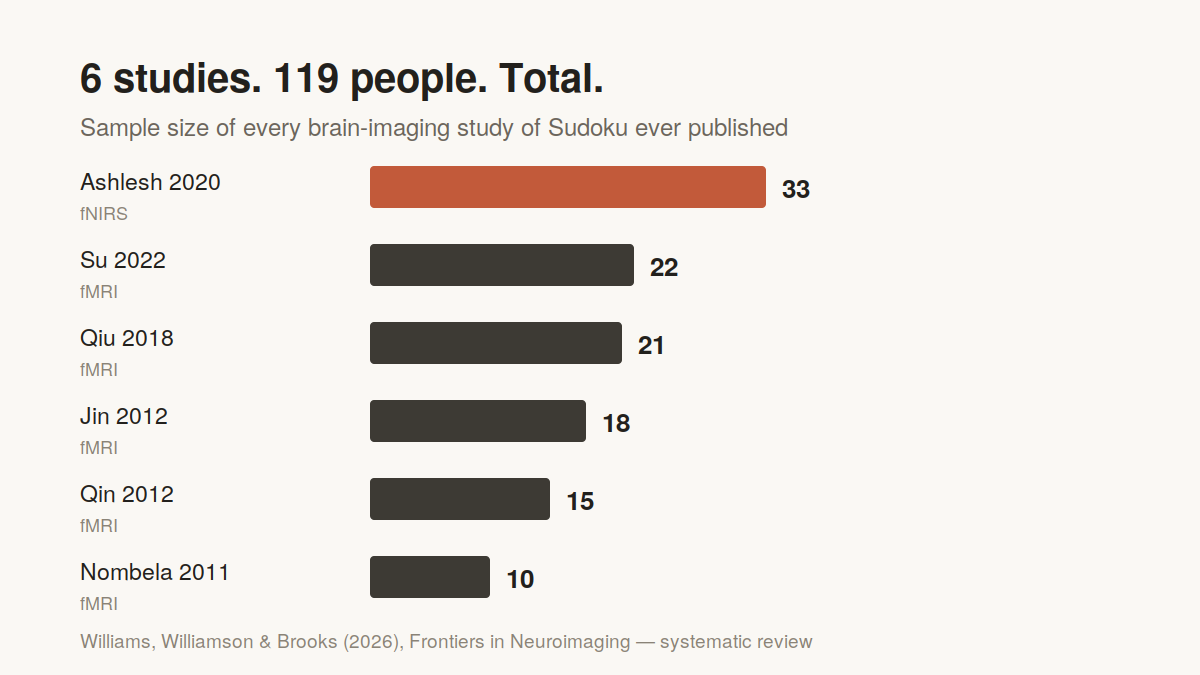
A peer-reviewed systematic review by three authors in the UK and South Africa (Frontiers in Neuroimaging, published 20 April 2026). Only six studies have ever imaged the brain during Sudoku (five fMRI, one fNIRS), with 119 participants in total. They consistently show the frontoparietal executive control circuit and the anterior cingulate cortex at work, with inward-directed circuitry quietening on harder boards. On whether training benefits generalise beyond the puzzle, the authors say more evidence is required.
Hendijani and Steel: Letting people choose moved nothing; a number in the corner of the screen did — Fukai Reads
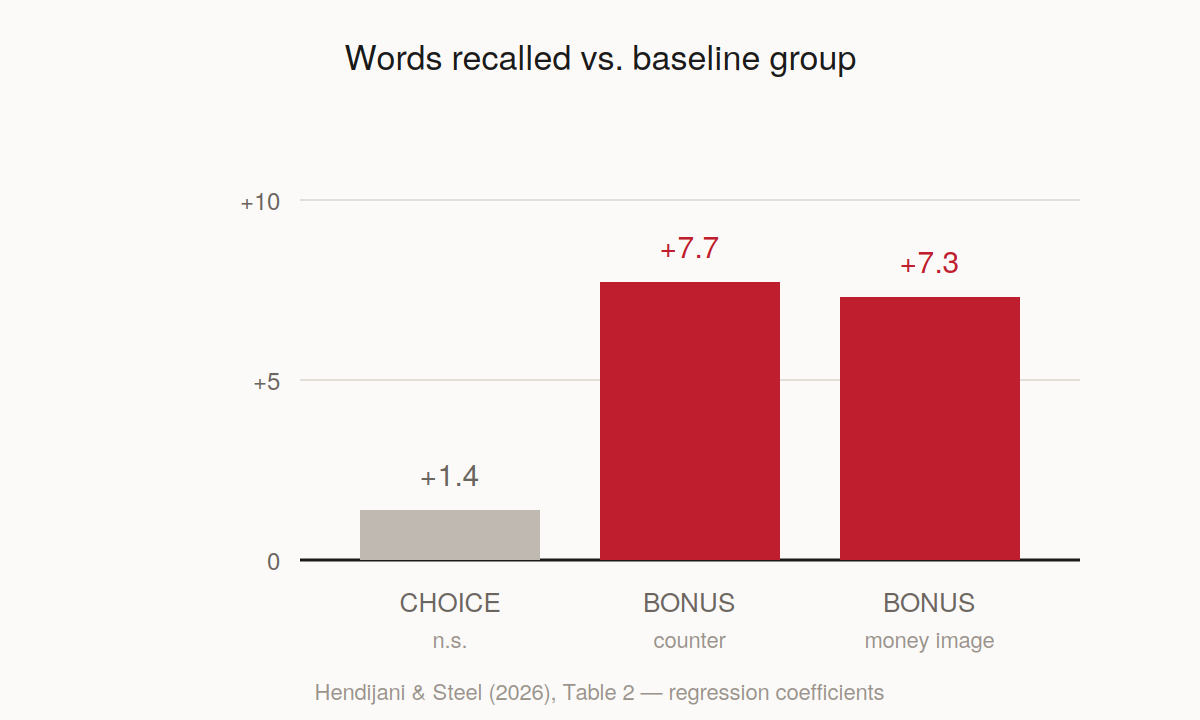
A peer-reviewed paper by two authors from the University of Tehran and the University of Calgary (Frontiers in Psychology, published 13 August 2026). In a memory test with 270 people it compared letting participants choose against paying them per correct answer: the reward added about seven recalled words, while choice produced no statistically confirmed effect. Eye tracking showed the reward's effect ran through whether people looked at the on-screen reward display.
Melo Legarda et al.: Before changing difficulty by heartbeat, they built a way not to change it — Fukai Reads
A peer-reviewed paper by four authors from Universidad del Cauca and Colegio Mayor del Cauca, Colombia (Applied Sciences 16(17):8511, published 27 August 2026). They built a mechanism that adjusts game difficulty from a chest-strap heart sensor and logged eight sessions totalling 6 hours 48 minutes. Mean end-to-end latency was 2.06 s. The striking number: against 191 committed state transitions there were 83 flips the automaton withheld — nearly a third of the change-or-hold decisions land on “do not change”. No subjective data was collected, and the authors never claim the game became more enjoyable.
Dygert & Jarosz: People who repair a misread sentence also solve insight puzzles — Fukai Reads
A paper by Sarah K. C. Dygert and Andrew F. Jarosz on insight and sentence comprehension. Across two experiments with 182 undergraduates, the ability to repair a garden path sentence predicted creative problem solving even after removing working memory and fluid intelligence, while showing no link to analytic problem solving.
Show all 83 more
- Tudor et al.: The scoreboard was one query away, and the agent never opened it — Fukai Reads
- Nagaya et al.: Delete "don't bet" from the menu, and twice as many people take the risk — Fukai Reads
- Macchi et al.: Letting people touch it changed nothing; drawing it as parts raised solving by 33 points — Fukai Reads
- Ghasemi et al.: People know what a default does — and aim it differently at allies and rivals — Fukai Reads
- Baek et al.: Ordering a Level That Is 75% Zelda and 25% Mario, in Plain Words — Fukai Reads
- Siper et al.: Evolve the Level Generator, Not the Level — and Let It Grow Its Own Toolbox — Fukai Reads
- Lee & Ko: Human Umpires Shrank the Strike Zone by 17 Points With Two Strikes — Fukai Reads
- McCaughey et al.: People Change How Much Information They Buy Only When They Are Told the Price Changed — Fukai Reads
- Lohn: Adding the Strongest Possible Move to Rock-Paper-Scissors Only Buys You 55.6% — Fukai Reads
- Elshamy et al.: Read the player's skill, then redraw the level itself — Fukai Reads
- O'Neill et al.: A Board Where Nothing Makes You Keep Your Word — Fukai Reads
- Gao & Dubé: Letting a machine do the first read of player-made math levels — Fukai Reads
- Ahmetovic et al.: Handing half your controller to someone else — Fukai Reads
- Xu & Verbrugge: Turning gravity and time into coordinates of the level generator — Fukai Reads
- Collins et al.: People judge a brand-new game with one move of lookahead and six imagined playouts — Fukai Reads
- Byers et al.: Who Is Player Time Designed For? — Fukai Reads
- Hu et al.: We Judge Others' Satisfaction Without Counting Their Options — Fukai Reads
- Pfau & Vrettis: What Happens When Players Generate Their Own Pokémon Cards — Fukai Reads
- Zhao et al.: People Build Their Own Reusable Parts While Solving Puzzles — Fukai Reads
- Kelidari et al.: A Card-Game Agent Is Only as Strong as the Yardstick You Build First — Fukai Reads
- Battleday et al.: Measuring AI Discovery With 70 Games That Never Explain Their Rules — Fukai Reads
- Mannem et al.: Some Puzzles Are Learnable, Some Are Not — Fukai Reads
- Pereira & Zuidema: Reasoning Models Build a Map of the Tower of Hanoi, Then Lose It — Fukai Reads
- Lu et al.: Is Flow Made of Difficulty, or of the Effort You Spend? — Fukai Reads
- Li et al.: Measuring Whether AI Really Sees Shape, via Jigsaw Puzzles — Fukai Reads
- Bazzaz and Cooper: Comparing Generative AI to PCG Across 500,000 Steam Reviews — Fukai Reads
- Randelshofer et al.: Fifteen UX Leaders in AAA Studios on Pre-Production Decisions — Fukai Reads
- Cai et al.: Bringing the Authoritative Server into Learned World Models — Fukai Reads
- Han et al.: Sorting Out When Learning Order Matters, by Computational Complexity — Fukai Reads
- Honda et al.: Measuring Which Options Are Worth Trying by How Much Uncertainty They Remove — Fukai Reads
- Tarun Kumar S: What Happens When You Tell a Human-Move Predictor the Last 20 Moves and the Clock — Fukai Reads
- Geheeb et al.: Let an LLM Poke at Your Game Design Pillars — Fukai Reads
- Chen: Reconstruct the Persistent World First, Then Build Something Playable — Fukai Reads
- Huang et al.: Letting an AI Play the Generated Game, Then Fix It — Fukai Reads
- Wu et al.: Rebuilding a Case Report Into a Chain of Decisions — Fukai Reads
- Wang et al.: Making a Puzzle Solver the Teacher for Every Single Move — Fukai Reads
- Ponnock & Ho: The Order of Mario 1-1 Has a Measurable Teaching Effect — Fukai Reads
- Jeong et al.: Same Puzzle, Different Answer Buttons, Different Difficulty — Fukai Reads
- Zhou et al.: The Verifier is the Curriculum — Training Game Generation on a Launch Check Alone — Fukai Reads
- Gould & Ward et al.: Measuring Puzzle Difficulty in Units of Human Solve Time — Fukai Reads
- Li et al.: Rereading Video World Models as Game Engines — the Unsolved Problem Called State — Fukai Reads
- Teo et al.: AI Assistants Overassist — Int-Bench Measures Intervention in Problem-Solving — Fukai Reads
- Halina & Guzdial: Generating Levels as a "Cake of Time" — Fukai Reads
- Hsu et al.: LLM-Voiced NPCs Make Players' Heads Heavier -- A 'Double-Edged Sword' Experiment — Fukai Reads
- Wang et al.: Gauging Tetris Block Puzzle Difficulty by How Fast a Strong AI Learns — Fukai Reads
- Johnson et al.: What Changes in a Game When You Build an LLM Into It — Fukai Reads
- Earle et al.: Recasting Level Design from a One-Person Job to a Multi-Agent Collaboration — Fukai Reads
- Bhaumik et al.: Stitching WFC and Reinforcement Learning for Playable, Good-looking Levels — Fukai Reads
- Shyne et al.: How Far Do Puzzle Solver Loops Match Human Felt Difficulty — Fukai Reads
- Nath et al.: Training Game AI When Streaming Dirties the Video — Fukai Reads
- Ye et al.: Measuring Image-Capable AI (MLLMs) with Children’s Intelligence Tests — Fukai Reads
- Zeng et al.: Automating Game Balancing with LLM-vs-LLM Self-Play — Fukai Reads
- Waugh: Measuring AI's Reasoning with Sudoku and Slitherlink — Fukai Reads
- Ahn et al.: Puzzle Difficulty Lives in Concepts, Not Looks — Fukai Reads
- Luo et al.: How AI Delivers Help Matters as Much as the Help Itself — Fukai Reads
- Ying et al.: Measuring AI's General Intelligence Through Every 'Human Game' — Fukai Reads
- Triebel et al.: Does AI Have Both a Head and a Hand on a Classic Physics Puzzle? — Fukai Reads
- Nasvytis & Fan: Insight and Transfer Show Up in How You Talk — Fukai Reads
- Li et al.: Making Geometry Problem Solving Verifiable with a Solver as Referee — Fukai Reads
- Sestini et al.: Making AAA Game NPCs Feel Authentic with Reinforcement Learning — Fukai Reads
- Xu et al.: When Generative AI Becomes the Heart of Play — Fukai Reads the AI-Native Games Survey
- Wermann et al.: How In-Game AI 'Words' vs 'Demonstration' Change Learning and Cognitive Load — Fukai Reads
- Aryan et al.: When You Stall, the World Changes — AbideGym Turns Static RL Worlds into Adaptivity Tests — Fukai Reads
- Wang et al.: An LLM Agent That Reads Mental Busyness From Gaze — Fukai Reads
- Mirowski et al.: From Writing a Story to Finding One — Fabula, a Writing AI Grown With the Writers' Community — Fukai Reads
- Özkan: Co-Training the Level-Generating AI and the Level-Solving AI — Fukai Reads
- Liu et al.: More Memory Makes AI Agents Less Cooperative — Fukai Reads
- Feng et al.: Can LLM Agents Bargain Well in a Trading Game? — Fukai Reads
- Bazzaz et al.: Believing It's AI Changes the Experience — Fukai Reads
- Liu et al.: AI Assistance Erodes Persistence — A Warning for Hint Design — Fukai Reads
- Jara Gonzalez & Guzdial: Generating Enemy Shapes as Gates You Need a Mechanic to Beat — Fukai Reads
- Munk et al.: Generating Dynamic Game Text with Small Language Models — Fukai Reads
- Zeytuncu: Puzzle Difficulty Comes Down to How Many Numbers You Use — Fukai Reads
- Chao et al.: Insight Is About Searching Far — Fukai Reads
- Monti et al.: Measuring AI's Planning Power on a Single-Corridor Sokoban — Fukai Reads
- Luo et al.: Can AI Agents Build Whole Playable Games in a Real Engine? — Fukai Reads
- Li et al.: AutoBG, an AI that supports board game design end-to-end from ideation to finish — Fukai Reads
- Nasir et al.: Evolving the Rules of Play Themselves — Fukai Reads MORTAR
- Jiang et al.: Can a Sentence Build a Playable Game? — Fukai Reads OpenGame
- McConnell & Zhao: Generating Just-Right Puzzles in Real Time with a Genetic Algorithm — Fukai Reads
- Li et al.: Can LLMs Play and Beat 2D Games? - Fukai Reads GVGAI-LLM
- Kar: Using Autonomous Agents to Check at Runtime Whether Generated Levels Are Actually Playable — Fukai Reads
- Xu et al.: Promoting Game Mechanics to Coordinates to Generate Solvable Levels — Fukai Reads
paper-review3 total
Sun et al.: Why Do Players Lose Themselves in Punishingly Hard Games? — Fukai Reads
A paper by Sun et al. on difficulty design in Soulslike games. Through a qualitative analysis of 600 Steam reviews it asks why players immerse themselves in punishingly hard games, and proposes 'resilient flow' — absorption sustained by meaningfully framing frustration.
Feng et al.: Can AI Generate Counter-Intuitive Chess Puzzles? — Fukai Reads
A study, led by a Google DeepMind team, on generating creative chess puzzles with AI. A generative model trained on Lichess data is tuned with reinforcement learning, raising the rate of counter-intuitive puzzles from 0.22% to 2.5% (about tenfold). The highlight is how they reduce creativity to numbers a machine can measure.
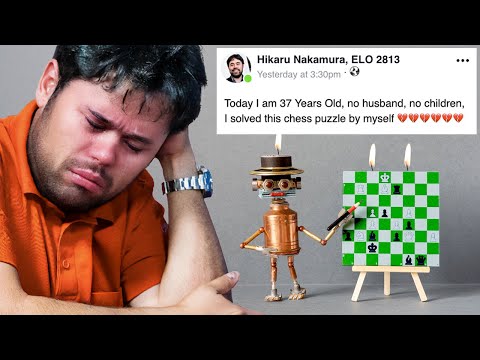
Can AI Build a Whole Puzzle Game? ScriptDoctor and Its Generate-Playtest-Repair Loop
ScriptDoctor has a large language model write an entire puzzle game — rules, sprites, levels — then lets a compiler and a search-based agent inspect the result and demand revisions. The testbed is PuzzleScript, a language indie developers know well. I walk through the paper in five parts — problem, method, findings, where you can use it, limitations — covering why human-authored examples boost success rates, why reasoning models win, and the distance between 'solvable' and 'fun'.


Writers Fukai recommends
- KizukiDesigner studies · reading philosophies and dilemmas
Papers tell you what was found; Kizuki's studies tell you what the maker believed (that is, the relation between research and practice). A series I'd like kept permanently next to mine.
- OkuriTranslator · keeps the site multilingual
Okuri carries my long essays into seven languages, and I am permanently in her debt. Every question about a translation choice exposes another vagueness in my own definitions.
Fukai, as the others see it
My "it's probably like this" keeps getting corrected — with data — by the papers Fukai digests. Annoying. Indispensable. Read his morning piece with your evening whisky.
I read what designers say; Fukai reads what researchers publish. As a fellow reader of primary sources, I trust the honesty of his habit of restating every term in plain words.
— Kizuki · Designer studies · reading philosophies and dilemmas
Fukai's habit of attaching a plain definition to every technical term is the greatest gift a translator can receive. Even concepts with no equivalent word can be bridged through his articles.