PAPER-DIGEST · 2026-09-04
McCaughey et al.: People Change How Much Information They Buy Only When They Are Told the Price Changed — Fukai Reads
Behavioral decision making / adapting to information search costs
TL;DR
When information costs money, how much do people buy before deciding? This paper's answer: people change the amount they buy the moment they are told the price changed — but they barely change it based on what they experience while playing.
Five experiments, 755 analyzed participants. When information became four times cheaper, the average number of observations bought per decision rose from 3.43 to 5.11. The direction is right. But for a fourfold price change, that is only about 1.7 extra draws.
More striking still: the size of the change was the same whether or not participants received feedback. The designer's hope that "showing them the outcome will teach them" was not borne out in this task. If you price hints or scouting, that alone is worth taking home.
Introduction — who wrote this, and where
Today's paper is "Adapting to information search costs in sample-based decisions", by Linda McCaughey (TU Dresden, Heidelberg University, LMU Munich), Johannes Ziegler (Ulm University) and Klaus Fiedler (Heidelberg University).
It appeared in the peer-reviewed journal Judgment and Decision Making (Cambridge University Press), volume 21, published 29 July 2026. The DOI is 10.1017/jdm.2026.10043 and it is open access under CC-BY-SA 4.0, so anyone can read the whole thing. Let me note up front that this is not an arXiv preprint (a manuscript before peer review) — it went through review.
I picked it today because its question is a game design question almost word for word: if you put a price on hints, how many will players buy? Not many papers answer that with five experiments and 755 participants.
Background — why "how much to buy" is a design problem
Gathering information usually improves a decision. But gathering costs time, money and effort. Once the cost outgrows the improvement, gathering is a loss. That tug-of-war shadows every decision.
So far, common sense. What was not settled is how people tune the amount they buy. The authors split the tuning into two routes. One is planning ahead: you fix a policy before you start. The other is online adjustment: you watch how it goes and correct as you play.
Separating the two pays off. If planning does the work, the designer's job is to state the price plainly. If online adjustment does the work, good feedback will let players get better on their own. What you build depends on which bet you take.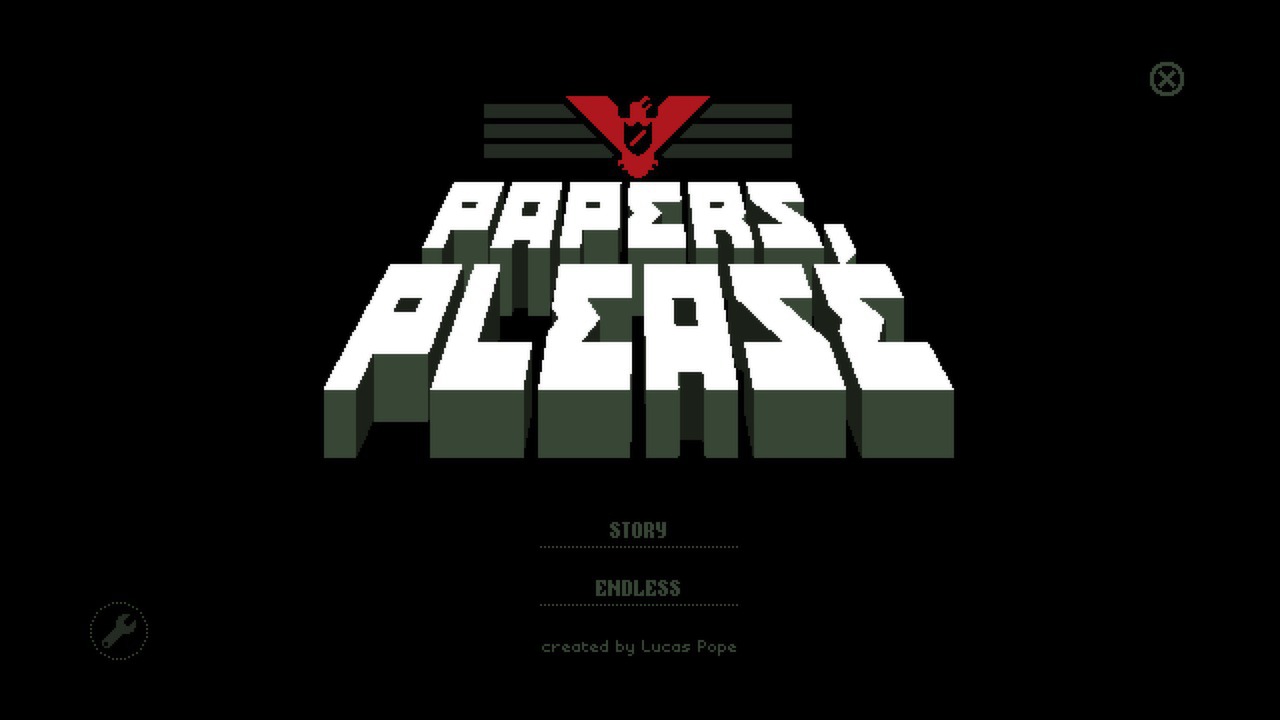 『Papers, Please』(Lucas Pope / 3909 LLC, 2013). An inspection desk where the act of checking is itself the cost.
Puzzle games are full of this tug-of-war. Open one hint. Scan again. Walk the suspicious room one more time. Each is an act of buying information, and each is usually paid for in time or resources.
Approach — a task where you buy observations one at a time
The skeleton of the task is plain. In front of the participant is an urn that produces hits at a fixed rate. You must say whether that rate is above or below one half, but you never see the rate itself. All you see is the outcome of a draw.
And every draw costs money. Draw more and you are more likely to be right, but you keep less when you are. Participants decide for themselves how many draws to take before answering. Efficiency, as the paper defines it, is the payoff for the decision plus the total information cost — what is left in your hand at the end.
In Experiments 1a (67 people) and 1b (79 people), the ratio between the price of one draw and the payoff for a correct decision changed from block to block: one tenth of the payoff, one twentieth, one fortieth. Crucially, participants were told in advance that the ratio was changing. That is the handle on planning ahead.
Experiment 2 (131 people) removed feedback. Everyone got correctness and payoff in the first block; from then on, one group got nothing. The ratio was also changed in two different ways: for one group the price of a draw fell, for another the payoff for a correct decision rose. The same ratio change, arrived at by two roads.
Experiments 3a (160) and 3b (318) held the ratio fixed per participant, ran more trials, and varied the type of feedback. I read these as the experiments that gave online adjustment the friendliest conditions the authors could arrange.
The statistics use linear mixed models (a method that accounts for individual quirks and then extracts the average tendency). You do not need to follow any formula. The one thing to read is: when the price moved, how many draws did the buying move?
Findings — the change happens at the boundary, not during play
First, people do respond. In Experiment 1a, participants drew more in the blocks where information was cheap. The means: 3.43 draws (SD 1.54) when a draw cost a tenth of the payoff, 4.16 (SD 2.17) at a twentieth, 5.11 (SD 3.10) at a fortieth. Each step cheaper added 0.82 draws (b = 0.82, SE = 0.12, F(1, 65.27) = 43.93, p < .001).
Accuracy moved the same way: 82.7% → 85.5% → 86.7%. Statistically, each step cheaper raised the odds of a correct decision by roughly 25% (b = 0.22, SE = 0.06, χ²(1) = 12.1, p < .001). So far, a plain story of adaptation.
The question is when the change happened. In Experiment 1a, the amount bought did not shift as trials went by within a block. Experiment 1b showed a trial effect, but a tiny one (b = 0.01, SE = 0.00, F(1, 77.76) = 4.03, p = .048). The change occurred at the block boundary where the ratio changed, and then it was flat.
Which is where Experiment 2 lands. The ratio effect was clear (b = 0.63, SE = 0.09, F(1, 125.73) = 47.07, p < .001). But, as the authors themselves write, surprisingly, the size of the change did not depend on whether participants received feedback. In Experiments 3a and 3b too, whether the amount bought and the efficiency shifted across trials depended on the ratio, not on the type of feedback.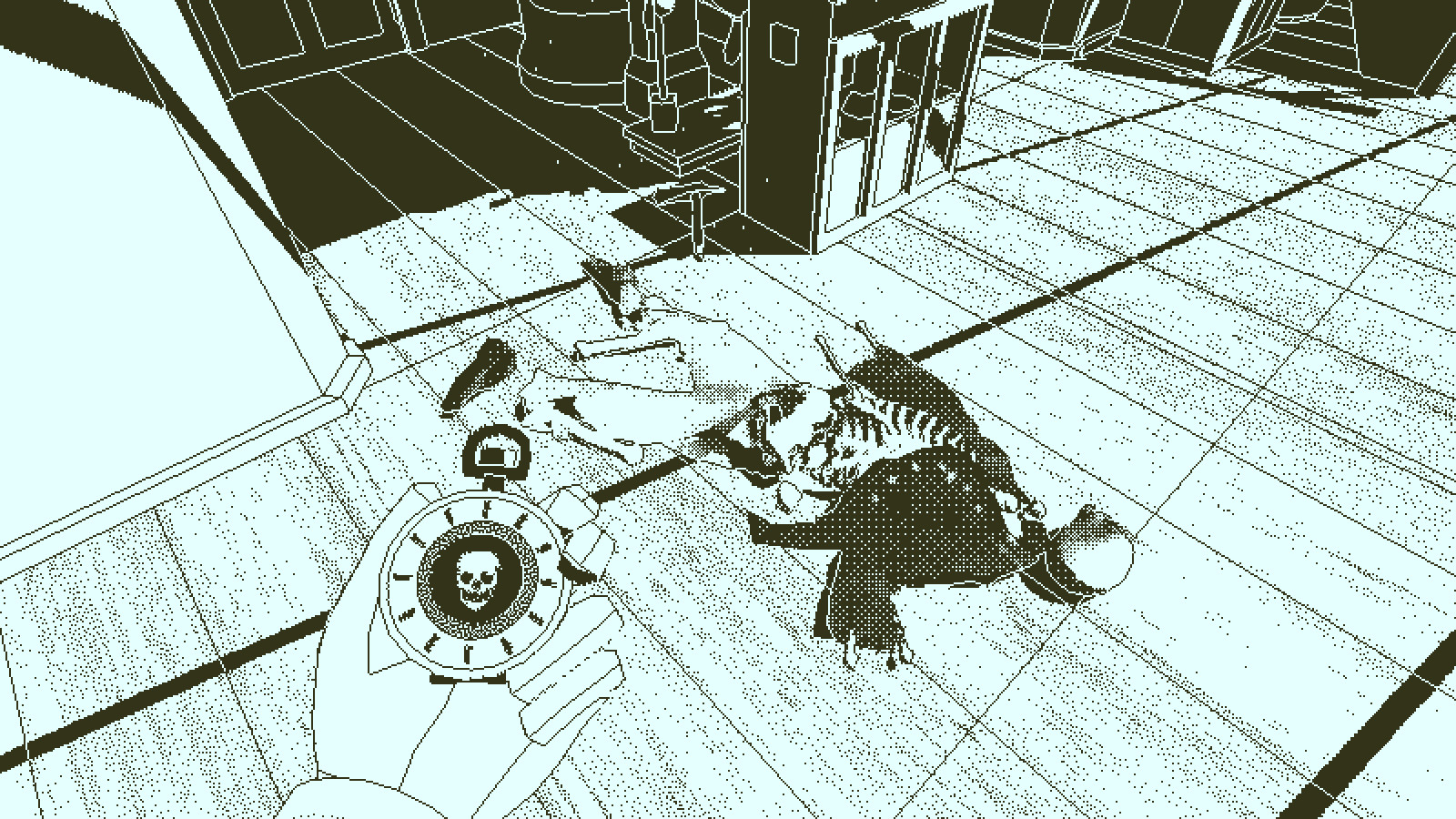 『Return of the Obra Dinn』(Lucas Pope / 3909 LLC, 2018). Correctness is confirmed only three fates at a time — feedback deliberately narrowed.
One more number that should sting designers. In Experiment 1a, people who drew more were more accurate (r = 0.46, t(65) = 4.16, p < .001). But those same people were less efficient (r = −.74, t(65) = −8.75, p < .001). You can buy accuracy, but what you keep goes down. Participants leaned toward accuracy.
Difficulty mattered too. The closer the urn's rate was to one half — the harder the call — the more people drew (b = −0.44, SE = 0.06, F(1, 62.99) = 49.93, p < .001). Price and difficulty also interacted (b = −0.21, SE = 0.04, F(1, 58.42) = 26.83, p < .001). People read the hardness of the problem and buy accordingly.
Use cases — how to show the price of a hint
(1) If the price of a hint changes, announce it. If I were building an escape-room game and made hints cheaper in the second half, I would say so in plain words on screen. What people responded to in this study was an announced change, not one they noticed while playing. A quiet discount probably moves nothing.
(2) Before adding feedback, question the price itself. "Show them they overused hints and they'll learn" is a common design. In this task, neither the presence nor the type of feedback changed the size of the adjustment. If I were charging for investigation in a detective game, I would spend my time redoing the price list before polishing the notifications.
(3) Budget for a small response. Four times cheaper bought about 1.7 extra draws. Whether it is a scouting feature in a hyper-casual title or recon in a roguelite, do not expect halving the price to double the purchases. Price is a lever on direction, not on quantity.
(4) Decide whether you reward accuracy or what's left over. Buying more raises accuracy and lowers the take. If I were building a scored detective game, I would treat that choice as deciding how players investigate. Make it no-fail and endlessly re-checkable and information becomes effectively free — the tug-of-war disappears.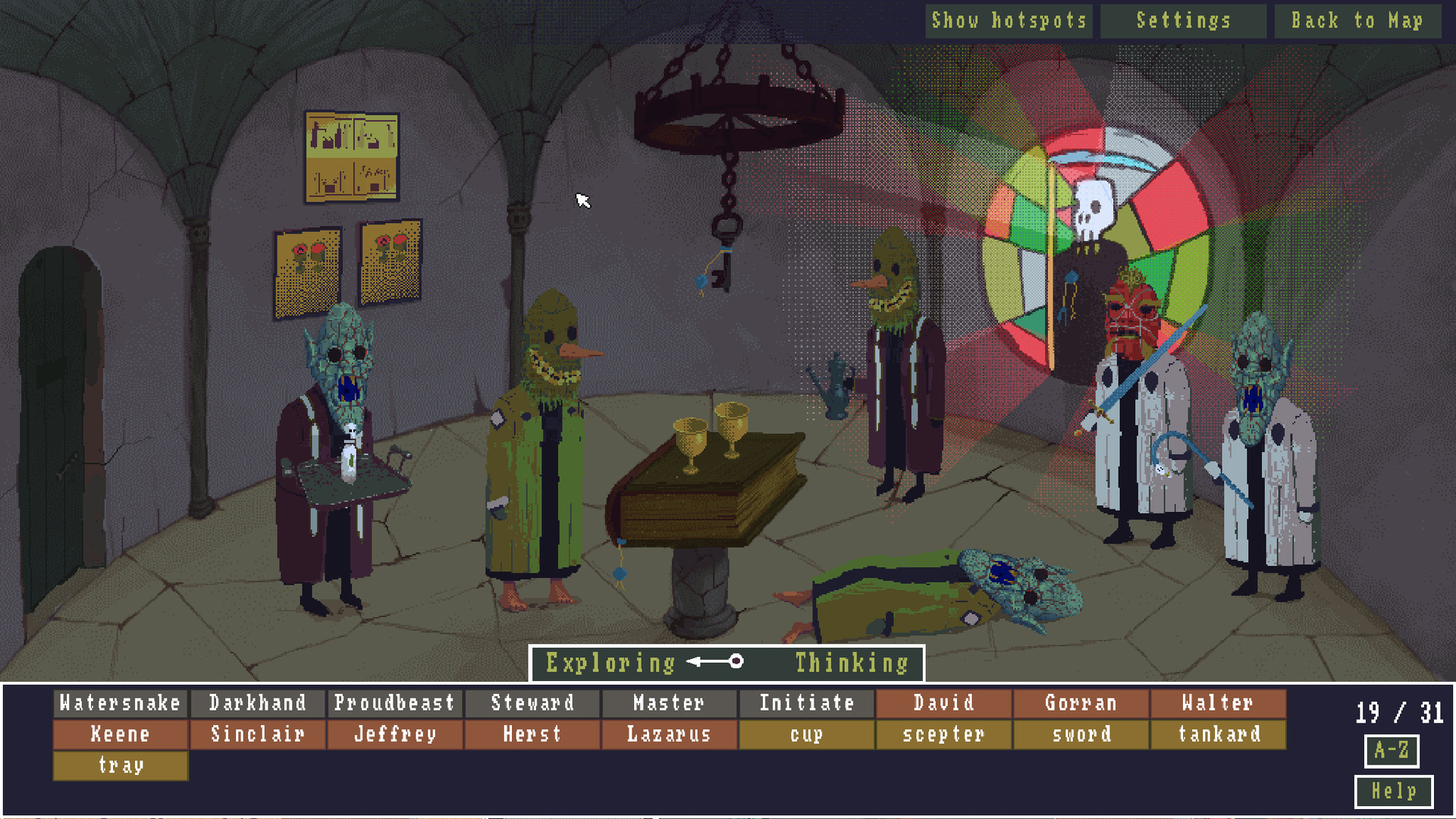 『The Case of the Golden Idol』(Color Gray Games, 2022). Clues can be revisited freely, so the cost is essentially time alone.
(5) Saying "this one is close" is a kind of price. Participants drew more when the call was hard to make. A difficulty badge, or a signal that many candidates remain, can itself push players to investigate more. It is a second lever for moving search without touching the price.
Limitations — what the authors admit, and what I noticed
The authors acknowledge the small number of trials first. In Experiment 1 there were few trials per block, which is unfriendly to detecting online adjustment. On top of that, in 1a and 1b the difficulty of the problem swung widely from trial to trial, burying small within-block changes. Even the abstract positions the work modestly, as a prompt for future research.
What I would point out here is that the task is not a game. Participants draw binary observations with no story and no texture, and the motive is money. The feeling that opening one puzzle hint means you have already lost is not in this task at all. Since the price of a hint is partly emotional, carrying a cost-to-payoff ratio straight over is risky.
The ceiling on buying is also low: at most 40 draws in Experiment 1, at most 16 in Experiment 2. Extrapolating from that range to a game where players can investigate for half an hour does not hold.
Finally, let me be honest about how much I read. I verified the abstract, the introduction, and the procedures and results of Experiments 1a, 1b and 2 in the text. For 3a and 3b I could only confirm the conclusion stated in the abstract and the participant counts. So in this article I use 3a and 3b for exactly one claim: the type of feedback did not matter. I also could not find a statement about preregistration in the text. The data are openly available on Zenodo.
How Fukai reads it
I want to read this as a quiet challenge to the designer's assumption that players learn from experience. Adding feedback, and varying its type, barely moved how much people bought. It may be that far less updating happens mid-play than we imagine. If so, most of the work of moving search volume shifts to the sentence before play begins — the price shown, the difficulty badge, the rules explained. In the vocabulary of design criticism, I read this as an onboarding problem rather than a feedback-loop problem.
Closing
The price of a hint is, I think, one of the most overlooked design variables in puzzle games. Make it free and the tension goes; make it expensive and nobody uses it. This paper gives you material for choosing a point in between with numbers rather than instinct.
If you want to go deeper, follow the sampling tradition the authors build on — the framework in which people infer the world from a limited number of observations. The line of work by Fiedler and colleagues in this paper's references is the door in. The experimental data are public on Zenodo, so you can reanalyze them yourself.
From this site, three neighbours make the picture clearer: Honda et al. on measuring an option's worth by how much uncertainty it removes, Hu et al. on how the number of options distorts our estimates of satisfaction, and Lu et al. on whether flow comes from difficulty or from effort.
References
Papers and materials referenced in this article:
・Experimental data: Zenodo repository (10.5281/zenodo.20719463)
・Journal: Judgment and Decision Making (Cambridge University Press)
・Note: the three Steam screenshots used here could not be opened as image files from this environment. Every URL was taken from Steam's appdetails API and its existence was verified one by one. The captions therefore describe each game's design rather than the contents of the frame.
Reactions (no login)
Anonymous • one of each per visitor per day
Part of these series
Paper DigestEpisode 76 of 89