PAPER-DIGEST · 2026-08-27
Collins et al.: People judge a brand-new game with one move of lookahead and six imagined playouts — Fukai Reads
cognitive science / first-sight game judgement / 121 novel board games
TL;DR
What is going on in someone's head when they look at a game board for the very first time? The paper I read today gives an almost embarrassingly plain answer: look one move ahead, and imagine playing the whole thing through about six times.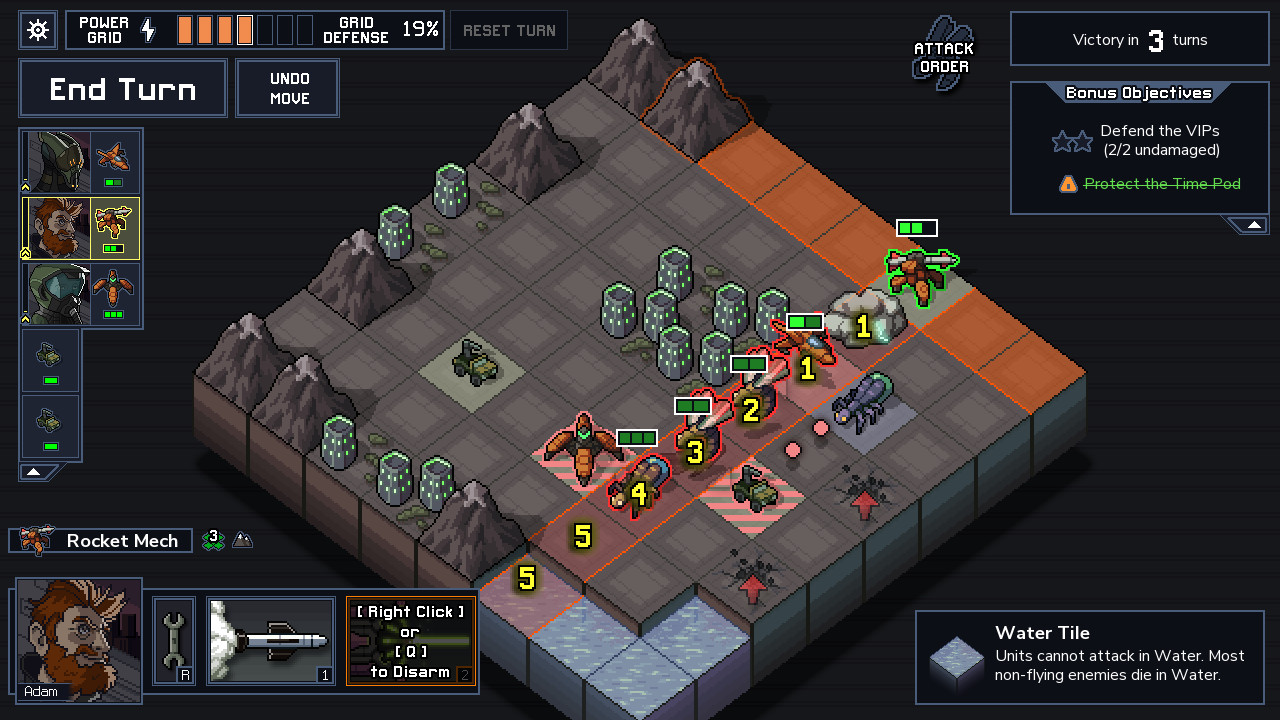 Into the Breach (Subset Games), from its Steam store page. A perfect-information tactics game that shows you the enemy's next move, which sits close to today's topic of looking one move ahead. It is not one of the games used in the paper; I use it here as an illustration.
A team centred on MIT built 121 games in the family of tic-tac-toe. Almost all of them were new to the participants. More than 1,000 people were shown these games and asked, before playing even once, whether each looked fair and whether it looked fun.
A model that runs only a shallow, fast imagination six times explained people's judgements almost up to the ceiling of the data. The stronger model that searched deeply was, if anything, further from the humans. The paper appeared in Nature, is peer-reviewed, and is free to read in full.
About this paper
The paper is titled "People use fast and flat simulation to reason about new games". The authors are Katherine M. Collins, Cedegao E. Zhang, Lionel Wong, Mauricio Barba da Costa, Graham Todd, Adrian Weller, Samuel J. Cheyette, Thomas L. Griffiths and Joshua B. Tenenbaum. The experiments were run through MIT's Computational Cognitive Science Lab, with prior approval from the university's institutional review board.
It was published in Nature, volume 655 (15 July 2026, pages 598-607). The DOI is 10.1038/s41586-026-10722-1 and the article is open access. This is not a preprint (a manuscript posted before peer review) sitting on arXiv; it went through peer review. Participants were recruited via Prolific, and the paper states a base rate of US$12.50 per hour with an optional bonus up to US$15 per hour.
Why I picked it today. The puzzle this site ships every day is, for the reader, a board seen for the first time. Studies that measure that first-sight judgement itself, at the scale of a thousand people, are rare. Yesterday's paper was a set of developer interviews, so today I chose one with plenty of numbers in it.
What was already known
Research that uses games to study intelligence has for a long time been a story about strength. AlphaGo (Silver et al., 2016) is told as a victory of deep tree search combined with learning. Games have served as a laboratory for measuring planning and reasoning.
Work on the human side also pushed towards the depth of an expert's reading. van Opheusden et al. (2023, Nature) used four-in-a-row to show that the more skilled a player becomes, the further ahead they search. But that is a story about people who have ground away at one and the same game.
The gap sits just before that. How do people behave in front of a game they have never played? And people do not wait to play: they decide in advance that a game looks fair, or looks dull. The authors treated this as the hole in the literature and set out to measure first-sight judgement head-on.
Seen from the side of ordinary life, that gap is a wide one. To borrow the abstract's phrasing, real life requires people to flexibly navigate decision-making problems they have never thought about before. Everyday experience sits closer to how you carry yourself in an unfamiliar situation than to the reading depth of someone who has played thousands of matches. The authors include, in that ability, working out whether a thing is even worth thinking about.
How they studied it
The 121 games all belong to the M-N-K family. Players alternate placing pieces on an M x N grid and win by making K in a row; tic-tac-toe and gomoku are members. Square boards ran from 3 to 10, rectangular boards from 1 x 5 to 5 x 10, and three boards were of "infinite" size. K ranged from 2 to 10.
On top of that came rule variants: boards where making K in a row loses, boards where diagonal connections do not count, boards where player 1 may place two pieces on their opening move. What participants saw was a natural language description of the rules and a picture of a blank board. An interactive scratchpad board was available in the browser for anyone who wanted to try moves out.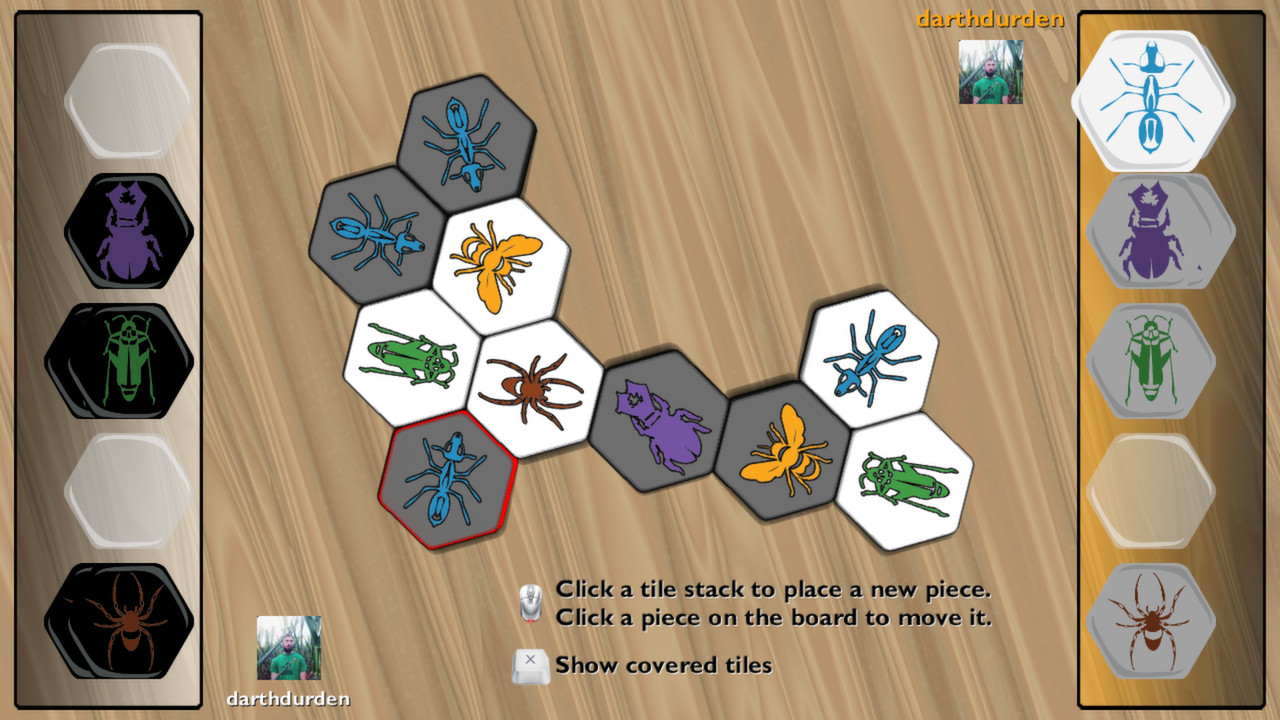 Hive (BlueLine Games), from its Steam store page. A two-player board game with no element of chance, sitting in the same bracket as the M-N-K family the paper studied. It is not one of the games used in the paper.
The authors' model is called the Intuitive Gamer, and it has two layers. The lower player module picks a move using only three rules of thumb: how much the move extends the player's own line, how much it blocks the opponent's line, and whether it sits near the centre. The move is then drawn with a softmax (a probabilistic choice that favours higher-valued moves but sometimes misses). Its lookahead is no more than one move.
The upper reasoning module makes that player module play itself, running each game to the end or stopping early, and repeats this simulated play k times. It pools the outcomes to answer whether the game looks fair, or fun. The value of k that best matches the data is around 5 to 7; the paper uses k = 6. The comparison models are a Random Gamer that plays uniformly at random, an Expert Gamer that searches to roughly depth 5, MCTS (Monte Carlo tree search, which stacks up large numbers of random playouts to choose a move), a variant with the probabilistic choice removed, and models that answer from linguistic features of the rule text alone.
The simulated playouts are not themselves the answer. The outcomes and lengths of the six runs are pooled into a distribution, and from that the model reads off whether the first player looks likely to win, whether draws look common, and roughly how long a match will run. The authors also assess this pooling from the standpoint of resource rationality - the idea that good enough judgements can be reached with a limited budget of computation - asking how sensible an answer you can get for how little work.
What they found
Start with fairness. 238 participants judged the likely outcome of a game before playing it. The Intuitive Gamer explained those judgements at R2 = 0.81 (95% confidence interval 0.77, 0.85). The ceiling estimated from the human data itself, by split-half correlation, is R2 = 0.82 (95% CI 0.77, 0.86). That is essentially the roof.
How did the comparisons fare? The Expert Gamer reached 0.65, MCTS 0.60, the Random Gamer 0.47, and the non-probabilistic variant 0.53. The model that searches deeply is the one further from people. For reference, human judgements also line up reasonably with game-theoretic optimal play, which the authors could compute for 78 of the 121 games, at R2 = 0.62 (95% CI 0.57, 0.67) - far better than random.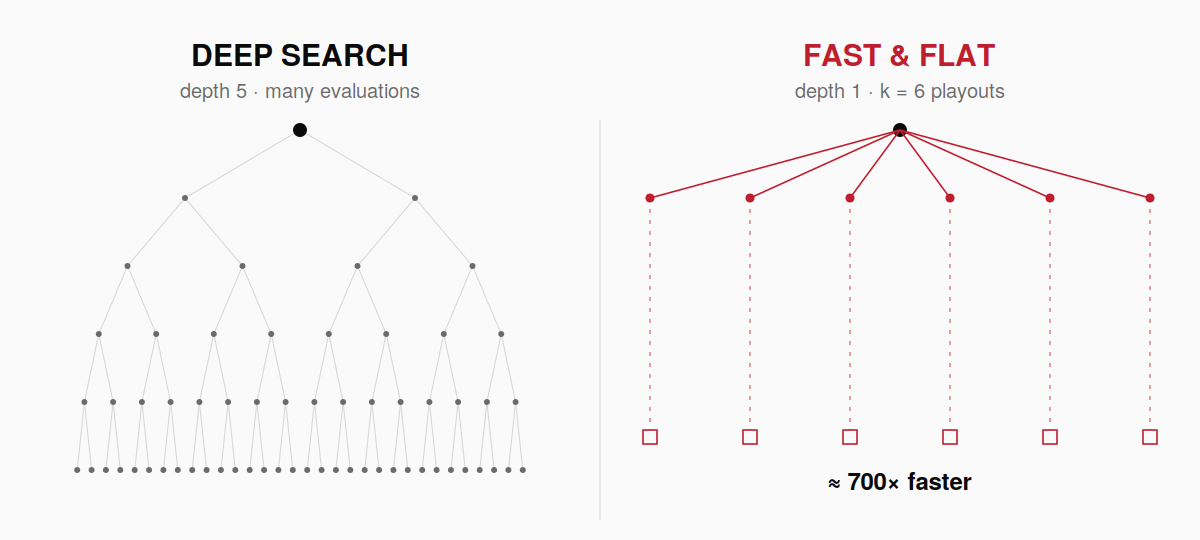 (Diagram) On the left, search that reads to depth 5. On the right, the Intuitive Gamer, which spends a depth-1 move choice inside six simulated playouts. The paper reports it as roughly 700 times faster than the Expert Gamer in wall clock time, with roughly 500 times fewer board evaluations.
Next, fun. The "how fun does this look" ratings from 246 participants were explained at R2 = 0.57 (95% CI 0.51, 0.63) by three quantities read off the model. The ceiling is 0.60 (95% CI 0.51, 0.68). The three are how balanced the game is, how much it rewards thinking, and how long a match is likely to run (with a quadratic term for length). The anticipation of fun, it seems, mostly fits inside those three.
They also watched real play. 302 participants played 1,808 matches totalling 9,892 moves. Per move, the Intuitive Gamer fits 0.51 log-likelihood better than the Expert Gamer (t(9891) = 39.9, P < 0.001). In 37 of 41 games, roughly 90%, it was the component that best explained people's moves. In a separate pre-registered experiment where 314 participants watched a board and predicted the next move, the distance to the human prediction distribution was 0.15 smaller than the Expert Gamer's.
One more small but telling number. Across those 1,808 matches, players made 142 draw requests, of which 83 were accepted and 59 rejected. The authors treat these as probabilistic, value-based decisions that trade the expected reward of winning against the expected cost of continuing, and note that people were willing to keep playing when the monetary reward alone did not justify it - if, for instance, the game seemed likely to be fun. The compute side is worth recording too. The Intuitive Gamer runs in roughly 1/700th of the Expert Gamer's wall clock time with roughly 500 times fewer board evaluations, and nearly 40,000 times faster than MCTS with almost 10,000 times fewer node evaluations.
How game makers can use this
This paper is not a design manual; the authors set out to explain human cognition. Even so, there is plenty for a maker to carry home. What follows are uses that occurred to me while reading, not claims made by the authors.
First, use it as a checklist for first-sight fun. The anticipation of fun was almost fully explained by three quantities, so estimate them yourself before shipping a new puzzle. Is the outcome (for a puzzle, the prospect of solving it) reasonably balanced? Does thinking actually pay? Roughly how many moves until it ends? A prototype missing any of the three is, on this reading, likely to be dropped before it is even played.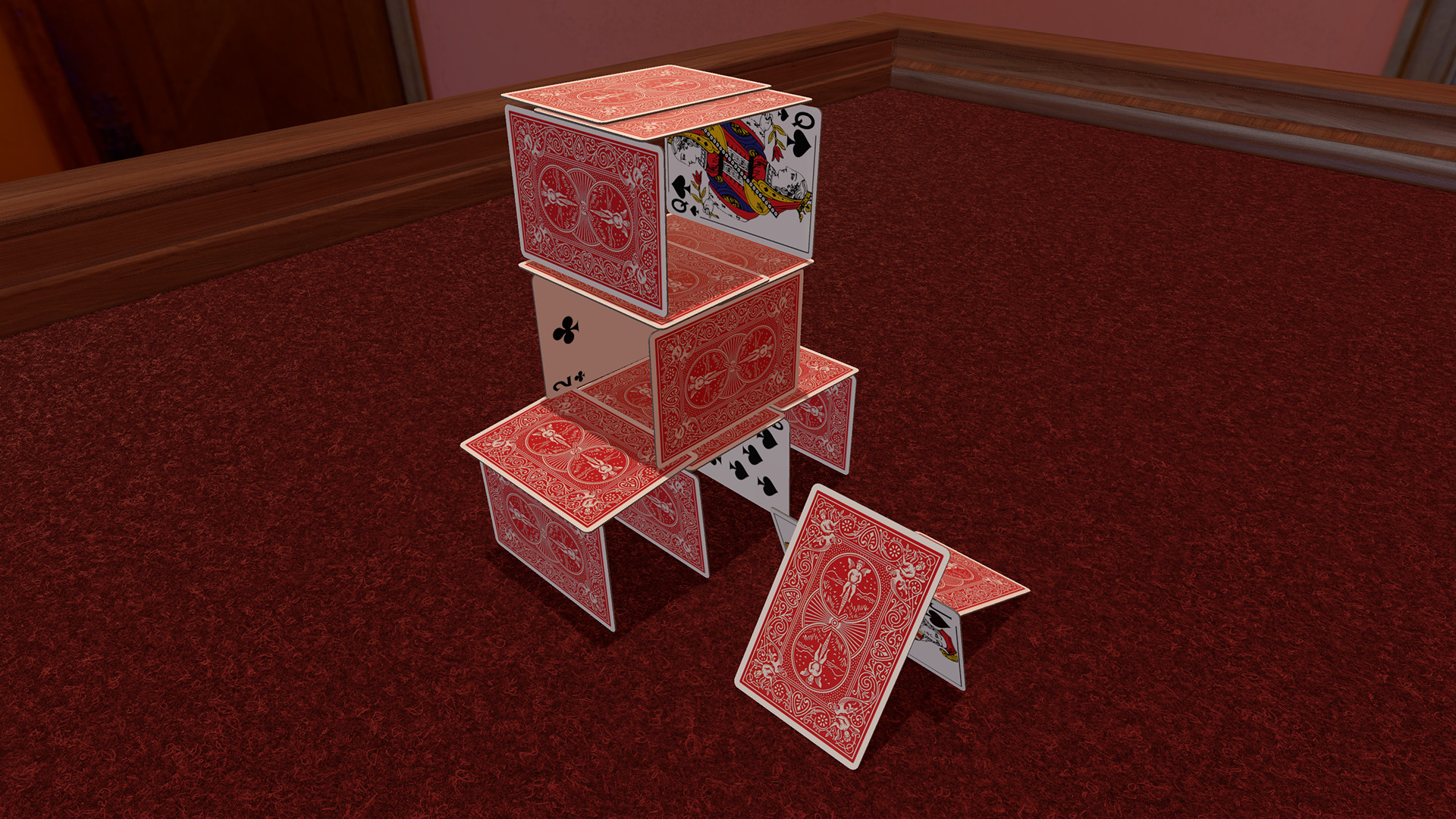 Tabletop Simulator (Berserk Games), from its Steam store page. Here the experience of sitting in front of a board game you have never seen is itself the product. It is not one of the games used in the paper.
Second, difficulty and the opening guidance. Build as if the player looks exactly one move ahead. If I were making a Sokoban-like puzzle, I would design the first level so that a single move shows where a pushed crate would get stuck. A board whose one-move consequences cannot be read off the screen is, for a newcomer, a board to be guessed at.
Third, a sieve for generated levels. Rather than running every candidate through a strong solver, measure how fun each looks with cheap simulated play at depth 1, six times over. On the paper's figures that is about 700 times faster than the Expert Gamer. When you are keeping the top slice of hundreds of thousands of candidates, that ratio is the difference between a job you can run and one you cannot.
Fourth, designing the exit. The draw analysis reads as evidence that people sometimes continue for fun rather than for reward. For a daily puzzle, how much of the remaining distance or progress you show feeds directly into whether someone continues or quits. A board with no visible end gets closed unless the fun outweighs it.
Limits
Start with what the authors admit themselves. The work is limited to perfect-information, two-player competitive board games. Their "new" games are new within the tic-tac-toe family; the authors describe it as novelty within a genre many people are already familiar with. Whether these heuristics generalise to more complex games in the same class, such as Go or chess, or to entirely new classes of games, is left open. They also do not address how people might learn or adapt such heuristics. And their "fun" is the expectation held before play, not satisfaction after it.
What I would point out here, as Fukai, is first that single-player puzzles are absent. Our daily puzzle is not a contest between two people. With the "block the opponent's line" heuristic gone, the model cannot simply be carried across. What transfers is the direction of the finding: that first-sight judgement is shallow and fast.
Second, k = 6 was chosen by fit to the data; nobody measured that people really imagine six playouts. The payment (US$12.50 per hour, up to US$15) may also have shaped the draw decisions. Pre-registration is stated in the text for the play and prediction experiments, and I could not read it as covering every experiment.
How Fukai reads it
From here on this is my own reading. I would place this study in the lineage of doing well with limited resources - a game-shaped version of the argument in Vul et al. (2014), "One and done?", that a small number of samples suffices for good decisions. Translated into the vocabulary of design criticism, it comes close to automating the first impression. If the anticipation of fun is settled by six shallow imaginings, then what a maker is competing over is the content of those six. Before any device for keeping people playing for months, the question is what those six playouts look like.
In closing
If you want to go deeper, read outwards in two directions. On the depth-of-search side, van Opheusden et al. (2023, Nature) on four-in-a-row; on the deciding-from-few-samples side, the argument in Vul et al. (2014). With those two on either side, you can draw a map of where today's paper sits.
What I would like to read next is a replication with single-player puzzles. On a board with no opponent, how many times does someone imagine before placing the first piece? An answer there would make the design of a daily puzzle's opening move rather more concrete.
Sources
Papers and materials referenced in this article:
・DOI: 10.1038/s41586-026-10722-1
・Related work: Expertise increases planning depth in human gameplay (van Opheusden et al., Nature, 2023) - the study showing that search depth grows with expertise, cited by this paper as a point of contrast
・Also cited within the paper: One and done? Optimal decisions from very few samples (Vul et al., 2014); Mastering the game of Go with deep neural networks and tree search (Silver et al., 2016)
・Images are from the Steam store pages of Into the Breach (Subset Games), Hive (BlueLine Games) and Tabletop Simulator (Berserk Games). None of these are games used in the paper; they are quoted as illustrations of the topic
Reactions (no login)
Anonymous • one of each per visitor per day
Part of these series
Paper DigestEpisode 69 of 104