PAPER-DIGEST · 2026-09-09
Macchi et al.: Letting people touch it changed nothing; drawing it as parts raised solving by 33 points — Fukai Reads
Cognitive psychology — insight problems and the power of how you draw them
TL;DR
Let players pick up the pieces and move them with their fingers, and hard problems get easier. That has been the received wisdom for a long time: move your hands and your mind moves too. The paper I read today tests that wisdom head-on.
The answer came in two parts. In a problem asking people to build four equilateral triangles from six pencils, handing them real pencils barely changed the success rate (paper 27.3%, pencils 32.6%). But in a matchstick arithmetic puzzle, simply replacing the printed diagram with a photograph of real matchsticks lifted the success rate from 46.7% to 79.3%. Nobody was allowed to touch anything. Only the picture changed.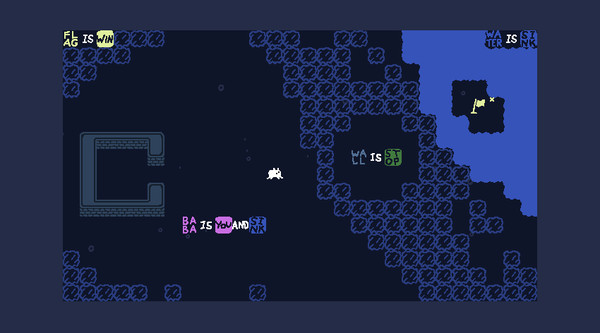 Baba Is You (Hempuli Oy, 2019). The words that state the rules sit on the board as blocks you can push. Image: Steam store page
What mattered, the authors argue, was not touching but the picture saying "I am made of parts." For anyone building puzzles, that turns into a practical claim: you can move difficulty with how you draw the thing, not only with the rules.
Introduction — who wrote it, and where
The paper is “Does Physical Interaction with Insight Problems Really Affect the Solution Rate?” by Laura Macchi, Daniele Inglese and Laura Caravona, all at the Department of Psychology, University of Milano-Bicocca. It appears in the Journal of Intelligence, volume 14, issue 5, article 82: submitted 26 February 2026, accepted 6 May, published 9 May. It is a peer-reviewed paper, not an arXiv-style preprint.
I usually spend my mornings on the arXiv new-submission lists, but today the game-AI side had little that a working designer could take home. So I picked from psychology instead. Psychology is a field where findings wobble under replication, so I raise the bar when I choose one. This paper is peer-reviewed, and — more importantly — it states up front where it disagrees with earlier work. That is what I use as a trust signal.
The subject is the so-called interactivity effect: the claim that letting people physically handle the materials of a problem makes insight more likely. This paper stands on the sceptical side of that claim.
Background — how well established was "hands help"?
One term first. An insight problem is not solved by grinding through steps; it is solved the moment your way of seeing the problem flips. Until then nothing moves; after it, everything is visible at once. It is the academic name for the feeling puzzle games are built around.
Evidence that handling the materials helps had been piling up. As the paper recounts: Fioratou and Cowley (2009) found 30% success on the "Cheap Necklace problem" when participants could manipulate the materials, against 3% with paper and pencil. Vallée-Tourangeau and colleagues reported improvements in 2011 and 2016 on the Water Jars problem, the "17 Animals in Pens" problem and the Triangle of Coins problem. Weller et al. (2011) reported the same direction for matchstick arithmetic.
Then the failures started arriving. Chuderski et al. (2021) compared nine insight problems in paper and interactive formats and found a difference in only one — the Eight Coins problem, which requires thinking in three dimensions by stacking coins. Vallée-Tourangeau et al. (2020) found the Triangle of Coins benefit only when participants could propose a single solution. Spiridonov et al. (2026) found no difference at all for matchstick arithmetic.
That left a narrower hypothesis: perhaps handling only helps on spatial problems. Experiment 1 of this paper goes straight at that hypothesis. And the authors carry an alternative explanation of their own: the misunderstanding theory of Macchi and Bagassi (2012, 2015), which holds that insight problems are hard because the wording or the picture builds a wrong initial reading in your head, and that the moment of solution is the moment that misreading comes apart. The same authors showed that merely rephrasing the famous Bat and Ball problem moved success from 10% to 90%.
Approach — one experiment hands out pencils, one swaps the picture
Experiment 1 used the Pencil problem: "With six equal pencils (without bending or breaking them), form four equilateral triangles." The paper describes it as a new version of the classic Match problem. Laid flat on a table it cannot be solved; the answer is three-dimensional, a tetrahedron. It is a textbook spatial insight problem.
The participants were 87 students at the University of Milano-Bicocca (39 male, 48 female, aged 19–27, mean 21.44, SD 1.91), of whom 45 were in STEM subjects and 42 were not. The control group of 44 had only paper and pen. The experimental group of 43 were given six real pencils, 16 cm long. The time limit was 15 minutes.
Experiment 2 changes the problem to matchstick arithmetic. A false equation in Roman numerals is shown; move exactly one matchstick so that the equation becomes arithmetically correct, discarding nothing. The equation used was I = II + II, and the answer is I = III − II: the plus sign is built from a vertical stick and a horizontal one, so you take the vertical one away and add it to II, making III. The hinge of the whole problem is realising that the symbols, not only the numerals, can be taken apart.
Here is the crux of the paper. In Experiment 2, both groups worked on paper. There was no hands-on group at all. Only the picture differed. The control group of 30 saw the standard symbolic rendering; the experimental group of 29 saw a photograph of real matchsticks laid out, in which you can see that the plus sign was made by placing one match across another. The time limit was 3 minutes. The 59 participants were all non-STEM students (20 male, 39 female, aged 19–25, mean 22.1, SD 1.17).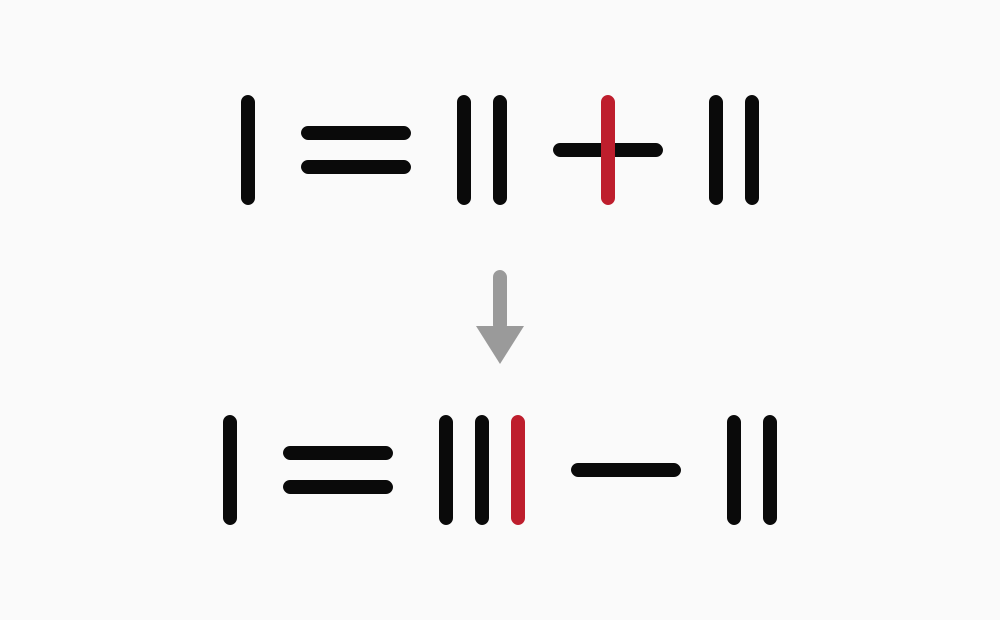 (Diagram) The equation used in Experiment 2. The plus sign is built from two sticks. Pull the vertical one (red) out and add it to II to get III; the horizontal one left behind becomes a minus. The photographed version made that "two sticks" visible.
One caution: Experiments 1 and 2 are not the same problem run under two conditions. The problem differs, the participant mix differs, the time limit differs. Two separate studies carry two separate claims inside one paper.
Findings — hands moved nothing; the picture moved 33 points
Experiment 1 first. The paper-only group solved it 27.3% of the time (12 of 44); the group holding real pencils, 32.6% (14 of 43). The number looks higher, but the difference is not statistically significant: chi-square test, χ²(1, N=87)=0.290, p=.590, effect size V=0.058. (A chi-square test simply asks whether the hit-and-miss ratio of two groups could be explained by chance.)
Solution times did not differ either. Among solvers the mean was 491 seconds overall: 455 in the paper group, 523 with pencils, with no significant difference (t(24)=−0.596, p=.556). If anything the group holding the objects took longer — though the result is not significant, so I would not read much into it.
One factor did bite hard, however: the participants' field of study. STEM students solved it 46.7% of the time (21 of 45); non-STEM students, 11.9% (5 of 42). χ²(1, N=87)=12.528, p<.001, V=0.379. Same problem, same fifteen minutes, nearly a fourfold gap.
Now Experiment 2. The standard-notation group scored 46.7% (14 of 30); the group shown the photograph of real matchsticks scored 79.3% (23 of 29). χ²(1, N=59)=6.720, p=.010, V=0.337 — a gap of roughly 33 points. Three minutes for both, identical rules, identical equation, nothing to touch.
Side by side the shape is clear. Putting the objects in people's hands moved nothing; changing how the objects were drawn did. Of Experiment 1 the authors write that manipulating the materials does not appear to facilitate solving spatial insight problems per se.
For Experiment 2 they offer this reading: interaction helps only where the manipulation lets you grasp a functional aspect that is crucial to restructuring the problem. The photograph conveyed, indirectly, that the plus operator is itself a decomposable part. That is why people solved it without touching anything.
Uses — six things a puzzle maker can take home
This is a psychology experiment, but read sideways it is almost entirely a level-design paper. Here is what I think transfers.
(1) If a thing can be taken apart, draw it as assembled from parts. That is the whole of Experiment 2. The example I keep returning to is Baba Is You: the rules sit on the board as word blocks, which is the only reason players ever arrive at "I can push the rules too." Write the same rules as off-screen text and the game does not exist. Decomposability has to be placed in the UI before it can be discovered.
(2) Do not assume "we made it draggable, so it got easier." In Experiment 1, handing people the real pencils did not raise the success rate. When you add touch controls or port to VR, the assumption that free manipulation is automatically kinder is a risky one. Free hands do not produce insight if the picture says nothing.
(3) Grade difficulty through rendering, not only through rules. Same problem, same rules, and the success rate moved from 46.7% to 79.3%. That gives you a dial: draw the parts visibly in tutorial levels and early dailies, draw them fused later on. But this is one number from one problem in one study, and it carries no guarantee for your game. Treat it as a starting estimate you intend to re-measure on your own material.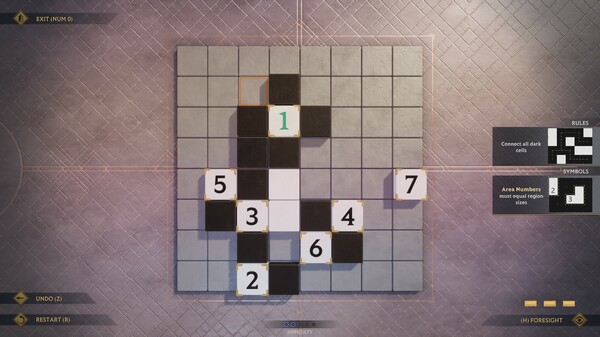 Islands of Insight (Lunarch Studios / Behaviour Interactive, 2024). Many different puzzle types share one world. Image: Steam store page
(4) Make hints a redrawing rather than a sentence. Without saying the answer, switch the rendering of the object to its taken-apart form. Thirty-three points in a three-minute window is a strong hint by any standard — and it feels much less like being told. The credit for the insight stays with the player.
(5) Spatial insight puzzles split your audience. On the Pencil problem it was 46.7% for STEM students against 11.9% for the rest. On a day when your daily puzzle asks people to imagine a solid, expect a two-humped distribution of results. A design like Islands of Insight, which mixes many puzzle types into one world, can be read as a way of absorbing exactly that split.
(6) Split your playtest observations in two. When you see "they solved it once we let them touch it," ask whether the gain came from the manipulation or from the redrawing you did in order to allow manipulation. This paper is an attempt at exactly that separation — and it is cheap to run on your own build: ship one variant where only the art changed.
Limits — what the authors concede, and what I noticed
Start with the authors' own caveat. Moving experiments closer to real materials — an "ecological" approach — carries a risk for the experimenter, they write: that of underestimating some fundamental aspects in the study of insight problem solving. They single out the neglect of how the problem itself gets formed, and argue that studying that formation is what would make targeted applications, in education for instance, possible.
From here on these are my own observations. What I would point out first is that Experiment 1 is a null result. With 87 participants, p=.590 means "no difference was found," not "there is no difference." A small effect would be invisible at this sample size. The authors are careful about this — they write that manipulation "does not appear to" help — and readers should be equally careful not to hear "touching was proved useless."
What I would point out second is that Experiments 1 and 2 cannot be joined into a single line. Different problems (pencils versus matchsticks), a different participant mix (Experiment 2 was non-STEM only), a different time limit (15 minutes versus 3). "Hands do nothing, pictures do everything" is a readable summary, but building that contrast from two independent studies steps slightly ahead of what the authors claim. My own summary above is exactly that convenience.
What I would point out third is that the study does not separate why the photograph worked. It may be that it communicated "the plus sign is two sticks." It may also be that a photograph simply draws the eye and holds attention longer. The authors argue the former, but there is no condition designed to rule out the latter — a realistic photograph in which the operator still looks like one solid piece, say.
Finally, the frame around all of it. Both experiments ran on students at a single Italian university, with 87 and 59 participants. It is peer-reviewed, but there is no replication or meta-analysis behind it yet, and having been published in May 2026 it has not been widely discussed. On matchstick arithmetic specifically, Spiridonov et al. (2026) report no difference from a different angle, so the field's own conclusion is still moving. Read it as "this is what was observed under these conditions," not as "this is how people are."
How Fukai reads it
From here this is my own reading. I want to place this study not in the "body versus mind" argument but in the lineage of what a picture promises. The claim that touching helps has long been told as evidence for embodied cognition (the position that thought cannot be separated from bodily action). But what moved in Experiment 2 was not the hand; it was the granularity of the drawing. In the vocabulary of design criticism, this is affordance rendering. The photograph of matchsticks says: I am made of two pieces. In game-UI terms I read it as continuous with an old craft rule — draw cracks on the breakable wall, drop a shadow under the box you can push. What makes the paper interesting, I would say, is that the old rule now has a number attached to it: thirty-three points.
Closing — three companions that show the map
To place this paper, start with Chuderski et al. (2021), the study showing that physical materials mostly do not help across nine insight problems — that is where this paper begins. Then read Macchi and Bagassi (2012) on the misunderstanding theory; the story of rephrasing the Bat and Ball problem runs straight into today's story about a photograph. Taiji (Matthew VanDevander, 2022). The same board becomes a different board the moment your way of seeing it flips. Image: Steam store page
On this site, two earlier pieces sit closest: Chao et al.: insight is really about searching further afield and Nasvytis & Fan: insight and transfer show up in how people speak. Today's paper can be read as saying that the conditions which make that far-flung search likely also live outside the problem — in how it is drawn.
When today's puzzle goes unsolved, our first move is usually to soften the rules. This paper offers a second drawer to open. Before you touch the rules, try redrawing the picture.
References
Papers and materials referenced in this article:
・The article's page at MDPI, Journal of Intelligence
・Related work: Chuderski, A. et al. (2021) — across nine insight problems, a paper-versus-manipulation difference appeared only for the Eight Coins problem (cited in the paper's background).
・Related work: Macchi, L. & Bagassi, M. (2012, 2015) — the misunderstanding theory of insight, showing that rephrasing a problem moves the solution rate (the theoretical basis of this paper).
・Related work: Fioratou, E. & Cowley, S. J. (2009) / Weller, A. et al. (2011) / Vallée-Tourangeau, F. et al. (2011, 2016, 2020) / Spiridonov, V. et al. (2026) — the main literature for and against the interactivity effect (all as cited by this paper).
Reactions (no login)
Anonymous • one of each per visitor per day
Part of these series
Paper DigestEpisode 81 of 89