DESIGNER-STUDY · 2026-09-14
Inside Gunpei Yokoi's Philosophy — Let the Viewer Fill In the Rest
Game Boy / Virtual Boy / the 1980 mechanical puzzle Ten Billion
What is Gunpei Yokoi's design philosophy, in one line?
"Whether a game is interesting or not doesn't depend on whether it's color or b&w." Gunpei Yokoi's design philosophy nearly fits in that single sentence. He said it in a 1996 interview, reaching for othello and shogi as his examples (Game Hihyou, August 1996 ↗). Whatever the picture leaves out, the player fills in. Almost every decision he made starts there.
Yokoi was the engineer behind Nintendo's Game & Watch and the Game Boy. He was also a puzzle maker: in 1980 he put out a mechanical puzzle called Ten Billion. This piece reads three of his own interviews and lines up his philosophy, his obsessions, the failure he admitted in public, his dilemmas, and his yardsticks.
This is a study of the person, not a tour of his products. One note: the slogan he is best known for, "lateral thinking with withered technology," spread through his 1997 book Yokoi Gunpei Game Kan and does not appear in any of the three interviews quoted here. So I follow the statements rather than the slogan.
What did Gunpei Yokoi actually do?
Gunpei Yokoi, born 1941, was an engineer and toy designer. At Nintendo he made the Ultra Hand (1966), the Game & Watch (1980), the Game Boy (1989) and the Virtual Boy (1995), and produced Metroid and Kid Icarus. He died in a road accident on October 4, 1997 (Wikipedia ↗).
For puzzle readers, one more line belongs on that résumé. In 1980 Nintendo released a mechanical puzzle called Ten Billion. Colored balls sit inside a clear cylinder; you turn two middle drums and slide a black frame up and down until each column holds a single color. Yokoi is credited as its inventor, and it was registered as U.S. patent 4,376,537 (Wikipedia, "Nintendo Tumbler Puzzle" ↗).
Mechanically it sits near the Rubik's Cube, but the sliding frame moves fifteen or more balls at once, which gives it a different feel from a cube that only rotates. He was never only a man of the screen. He also built a puzzle that turns in your hands.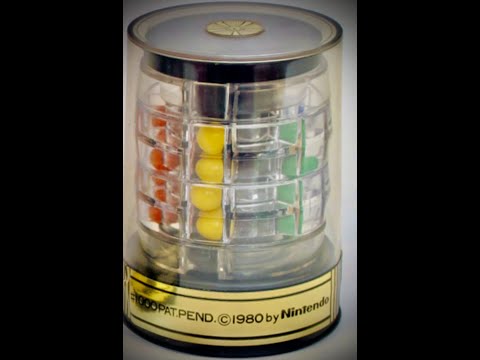 A video about the 1980 mechanical puzzle Ten Billion (Retro Collection Studio / YouTube)
In August 1996 he left Nintendo after thirty-one years, founded his own company, Koto, and led development of Bandai's WonderSwan. It shipped in 1999, after his death.
Where did he say the fun actually lives?
What he repeats is that fun does not come from picture quality. Asked in 1996 about the Virtual Boy's single-color display, he answered: "For example, consider a monochrome game like othello or shogi: the truth is, whether a game is interesting or not doesn't depend on whether it's color or b&w" (Game Hihyou, 1996).
In a 1997 interview he put the same idea more bluntly: "If you draw two circles on a blackboard, and say 'that's a snowman', everyone will sense the white color" (1997 interview ↗). Whatever is missing, the viewer supplies.
So the Game Boy shipped monochrome even though color was available. "The technology was there to do color. But I wanted us to do black and white anyway... Once you start playing the game, the colors aren't important" (1997).
His second pillar is a definition: a game is a contest. "The word 'game' means something competitive, where you can win or you can lose" (1997). In the same conversation he said quality was declining, and blamed the rise of "games that want to give you the experience of a short story or a movie."
These are not two separate claims. Because there is winning and losing, a player leans in even when the picture is coarse. He did not think graphics were worthless; he counted the player's imagination as a material, from the start.
Which habits show up across all his work?
First: decide the movement before the art. "I first take the character and replace them with a dot as a placeholder, then I think about what kind of movement would be fun... putting myself in the player's shoes" (1997). The verb comes first; the look waits.
Second: the "situation." On the Game & Watch he said, "The big thing that I emphasized myself was the 'situation'... I wanted people to be able to tell right away whether they were funny, or weird, or whatever," and offered Manhole as the example: "It's an extremely silly situation, but it's also a scenario that sounds funny just by hearing it" (Game Hihyou, 1996).
Third: make the art carry a job. "If an enemy looks too pretty, they won't seem like an enemy to the player" (1997). Graphics are not decoration; they are instructions.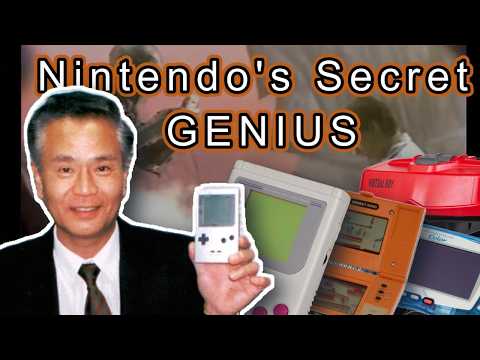 A video essay on the Game Boy and Yokoi's work (Pieces of 8-Bit / YouTube)
Fourth: cheapness. On the Famicom's directional pad: "The truth is, we used the directional pad for the Famicom because of budget considerations. It was the cheapest option for us then" (Game Hihyou, 1996). Of the Game Boy: "we wanted to see how thin, light, and small we could make" it.
Laid side by side, it is consistent. What he settles first is never the amount of visual information, but the movement, the situation and the price.
What failure did he admit to in public?
The Virtual Boy. But note how he admits it. "When the Virtual Boy was released, it received a lot of complaints from hardcore gamers... I feel like I fell short of my lofty ambitions" (Game Hihyou, 1996).
What was missing? Software, first. "I'm not sure if there was a launch title capable of rivaling normal console video games" (same).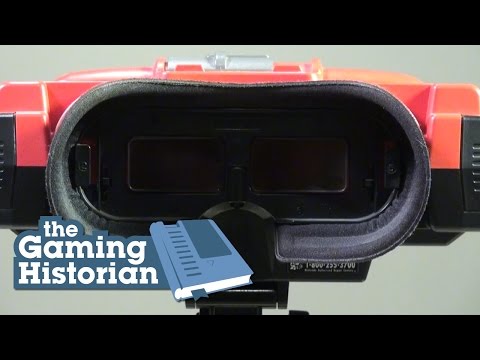 A retrospective on the 1995 Virtual Boy (Gaming Historian / YouTube)
Then he goes further. "Part of me feels like it would have done better if it hadn't been sold by Nintendo. The association people have between Nintendo and TV console video games is just too strong" (same). He locates the failure not in the hardware but in the name on the box.
He also admitted the difficulty of invention itself: "When it came down to it, in reality I found it to be extremely difficult to think of new things" (1997). Coming from a man whose banner was novelty, that is a heavy sentence.
As for why he left, he pre-emptively denied the story that would later spread: "In reality, I did not resign to 'take responsibility for the Virtual Boy's failure.' Since before that, I was thinking that when I turned 55, I wanted to become independent" (Bungeishunju, November 1996, English reprint ↗).
Where did he say he was caught between two things?
First: whether he could convince his own company. Pushing the monochrome Game Boy through, "it was difficult to get Nintendo to understand. Partly, I used my status in the company to push them into it" (1997). He frames it as a question of authority, not technology — a candid way to put it.
Second: the gap between the label and the contents. On the Virtual Boy: "If Nintendo came out and advertised that the Virtual Boy was not for gamers, I think that could rekindle people's interest" (Game Hihyou, 1996). In other words, he had built something his employer could not honestly sell.
Third: fight, or leave. "There's so many kinds of entertainment, so there's no need to fight over scraps, when you can simply go out and make something new. It's much quicker and more direct to create a new world rather than fighting" (same). Yet the Virtual Boy never quite found that unfought ground.
Fourth: his own place. "If Nintendo can have people like Miyamoto making big, grand games, then I think there's room for someone like me who makes games you can enjoy in your spare time" (same). He put himself on the supporting side more than once.
What did he say he measured his work against?
He almost never names a person as an influence. What recurs instead, as a yardstick, is board games and physical toys.
The board games we have already seen: othello and shogi serve as his proof that black and white is enough. His reference point is not the newest game but the ones people have kept playing for decades.
On real toys: "Imagine if I show you a toy on the table here, you'd see it and think 'oh, that looks fun to play with.' But if I take the same toy and put it on a television screen, suddenly people think 'wow, this looks dumb.'" And: "One never tires of the basic movements of a real toy doll or human figure" (1997).
So he pointed his next work away from the screen. "I've been thinking about moving away from television with my future work... Now I'd like to create something real like that, even if it's simple and cheap." And then, naming a puzzle: "The 'My Puzzle' amusement machine is one of those ideas from 20 years ago" (1997).
Kizuki's reading — not a man who built cheaply, but one who handed over the work
What follows is my reading, Kizuki's. It includes things he did not say.
I read him not as a man who built cheaply but as a man who handed work to the player. Monochrome is fine, a dot is fine — every one of those calls looks like thrift. But line up the statements and the order reverses. The premise that the viewer fills in the gap comes first; cheapness follows from it. The snowman on the blackboard says nothing about cost.
Read that way, even his account of the Virtual Boy holds together. It was a machine built on the assumption that you would use your imagination, and the Nintendo name promised a kind of play where you don't have to. Putting the blame on the seller rather than the hardware looks less like an excuse than an analysis faithful to his own premise.
One habit of mine, indulged: the man who in 1996 asked people to compensate with their imagination said in 1997 that "no matter how much CG approaches reality, it will never be able to overtake real visuals," and turned back toward physical toys. It looks like a contradiction; I think it is one claim seen from both sides. If you are going to lean on imagination, the thing it leans against need not be a screen. That the inventor of Ten Billion, in 1980, ended by bringing up "My Puzzle" looks to me like a road back to where he started.
Where should you start with him?
Start with the puzzle you can hold. Ten Billion (1980) still turns up secondhand, and solutions are published. Turning it teaches you, physically, what "think about the movement first" means. Try it alongside its close relative, the Rubik's Cube (1974).
If you would rather start from the screen, the Game Boy puzzles are the short road. Kwirk is a maze puzzle Atlus released in 1989, built on rotating blocks and pushable stones. Mole Mania is Nintendo's 1996 push-and-pull puzzle across two stacked layers, above ground and below. Neither is his own design, but both show what the small monochrome screen he insisted on could pull out of a designer.
If you follow people instead, the nearest neighbors are Alexey Pajitnov, who refused to let a tidying game end; Toru Iwatani, who kept a maze from looking like one; and Keita Takahashi, who made adding no mechanics into a mechanic. Subtractive makers, all of them.
Sources
Primary sources used in this piece (all quotations are translated back from published English translations):
・Gunpei Yokoi × Kenji Eno conversation (Game Hihyou, August 1996, English translation)
・Gunpei Yokoi, 1997 interview (interviewer: Yukihito Morikawa, English translation)
・Destructoid (English reprint of the Bungeishunju, November 1996 interview)
・Wikipedia, "Nintendo Tumbler Puzzle" (inventor credit and patent number)
・Wikipedia, "Gunpei Yokoi" (career and dates)
Videos referenced:
・"The Man Who Made the Game Boy | The Genius of Gunpei Yokoi" (Pieces of 8-Bit)
・"Episode 11 - Nintendo Ten Billion Barrel or Tumbler Puzzle - 1980" (Retro Collection Studio)
Reactions (no login)
Anonymous • one of each per visitor per day
Part of these series
The Designer's PhilosophyEpisode 60 of 63