DESIGNER-STUDY · 2026-08-22
Inside Keita Takahashi's Philosophy — The Mechanic of Adding No Mechanics
Katamari Damacy, Noby Noby Boy, Wattam, to a T, and the playground he wanted to build
Introduction — The Man Who Said, Himself, That It Didn't Sell
Keita Takahashi is the man who made Katamari Damacy — the game where you roll a ball and it sticks to everything, from thumbtacks to people to houses to islands. In December 2025 he said this about his own new game: "I recently returned to Japan, and one of the reasons I had to do was because ‘to a T’ didn't sell well" (GamesRadar+, December 2025).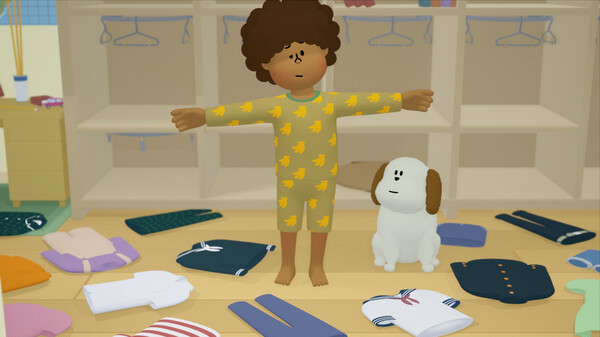 to a T (2025), a story about a kid living an ordinary life stuck in a T-pose (from the Steam store page)
What put him on my desk was something he said five months earlier. In July 2025, in a conversation with Fumito Ueda, he was asked about the mechanics of to a T. His answer: "There aren't really any special mechanics" (Denfaminicogamer, 17 July 2025). The maker of a game that didn't sell was handing away the very thing you would use to sell it.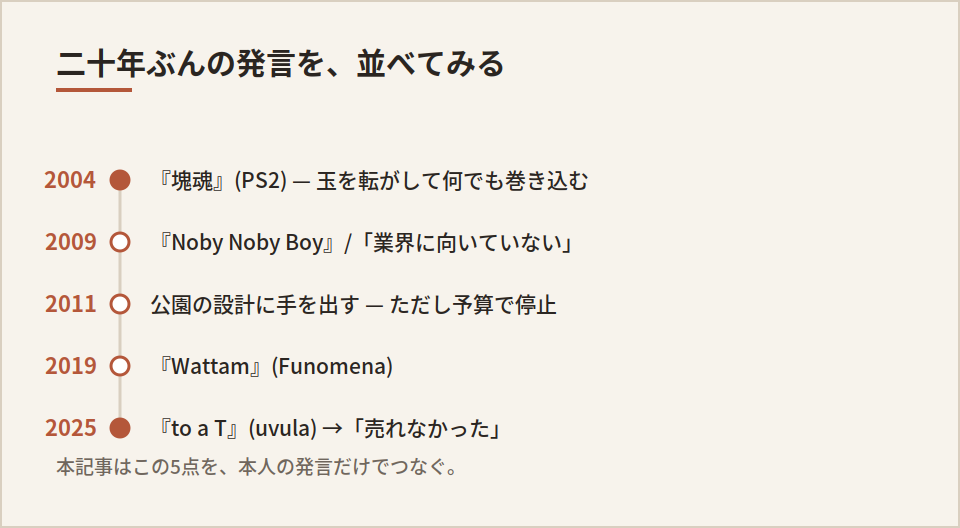 Twenty years of statements, laid out in order(conceptual diagram, AI-made)
I brewed a fresh pot of hot barley tea and laid out twenty years of interviews. What surfaced is that back in 2009 he was already saying he felt "just not suited to the games industry" (Game Developer, November 2009). A man who said he did not belong then kept making things for sixteen more years. What follows is not a tour of his games. It is a study of the person.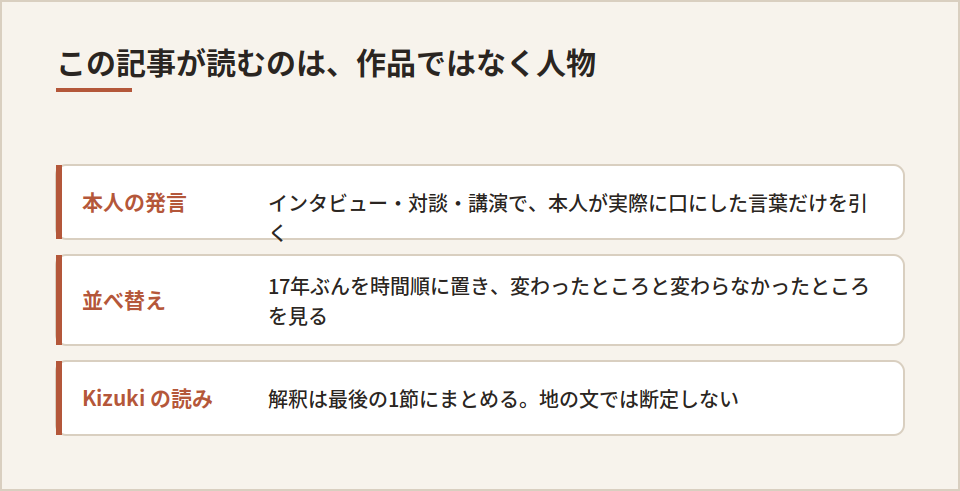 How this article is built(conceptual diagram, AI-made)
Background — He Came Out of Sculpture
Takahashi studied sculpture at art school. Here is how he tells it: "When I was an art student, I studied mainly sculpture. I joined Namco in 1999 as a Visual Designer. And then I thought to myself that I wanted to create a game, so I thought about my own original concept. It became Katamari, on which I started working in 2001" (Vice, August 2011). He did not enter the industry trained to make games.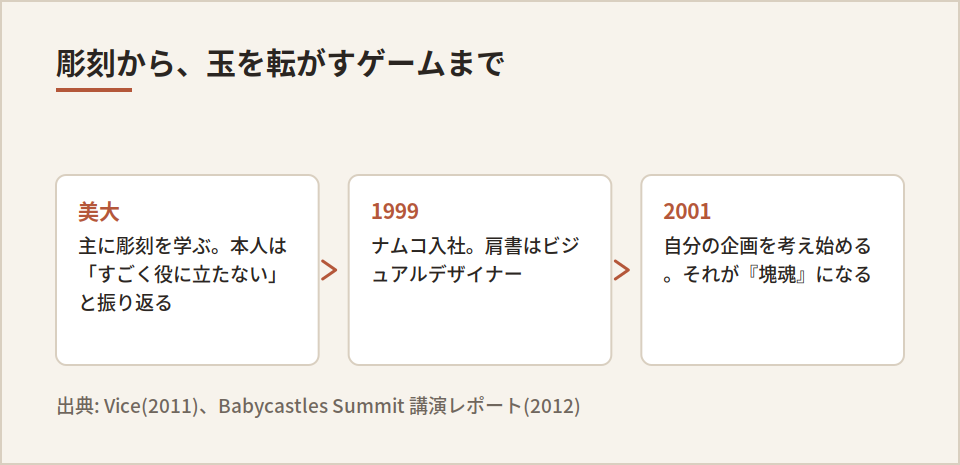 Sculpture, then Namco, then his own pitch(conceptual diagram, AI-made)
Katamari Damacy came out on the PlayStation 2 in 2004. You control it with two sticks and nothing else. Roll the ball, and anything smaller than it sticks. From that one rule the playing field grows from a desktop to a city to the sky. This is the game that carried his name around the world.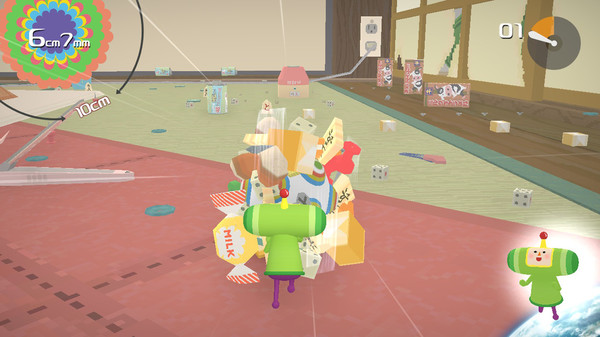 Katamari Damacy REROLL. Roll a ball and stick everything to it (from the Steam store page)
From there his path keeps moving outward. After Noby Noby Boy (2009) he left Namco, moved to the United States, made Wattam (2019) at Funomena, and then to a T (2025) at his own studio, uvula. Alongside all of that he has taken on the design of actual playgrounds (Vice, 2011).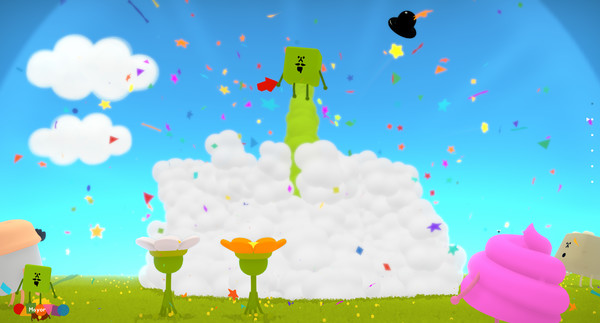 Wattam (2019), made while he was at Funomena (from the Steam store page)
Philosophy — His Purpose Fits in One Sentence
One sentence has not moved in sixteen years. In 2009 he described his purpose like this: "I want to make people laugh and be happy. That's all I need" (MCV/DEVELOP, October 2009). In 2011 he said the same thing more slowly: "I always think of how I can help a great number of people. Things I do for myself are quite trivial, that's why I believe everything I create aims to make people smile and to make life a little more fun" (Vice, 2011). Note the order of the reasoning — things done for himself come out trivial, so he aims outward.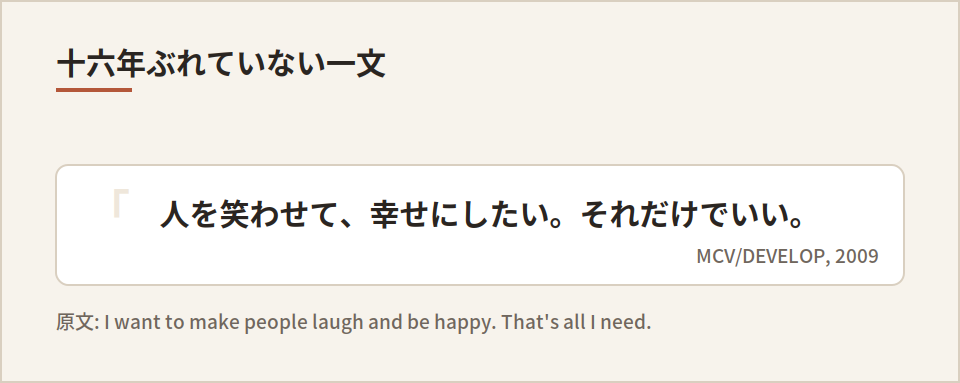 The one sentence that never changed in sixteen years(conceptual diagram, AI-made)
And yet, asked what a game is, he answers almost nothing. In March 2025: "Video games can be anything. There's no definition of a video game besides being interactive" (MonsterVine, March 2025). In May of the same year, asked the same thing in front of an industry audience, his answer was shorter still: "What is a game? I don't know" (Game Developer, May 2025).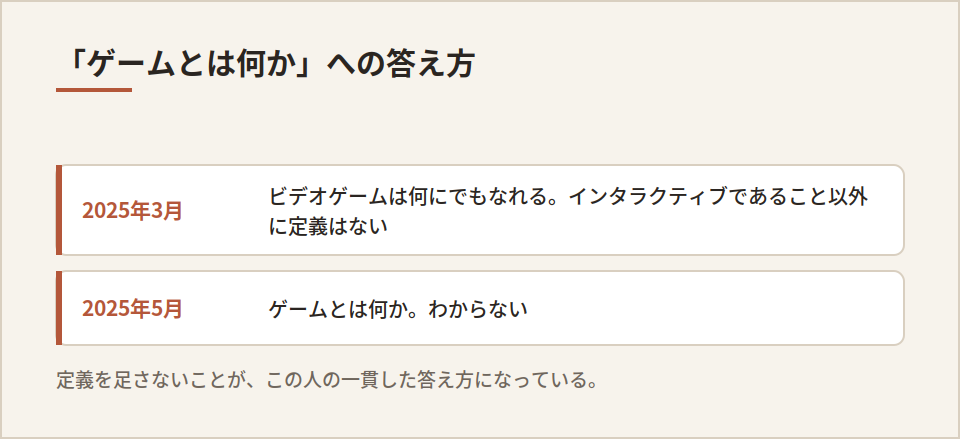 His way of answering is to add no definition(conceptual diagram, AI-made)
That refusal to define keeps coming back as advice to younger makers. His own studio site renders what he said at GDC 2005 like this: "You're not making games for shareholders. Don't get tied down — be free" (uvula, “A conversation with Fumito Ueda”). In 2025 the tone is unchanged: "You don't need to follow the existing formula. Of course, competitive games are fun, but video games can be anything" (MonsterVine, 2025).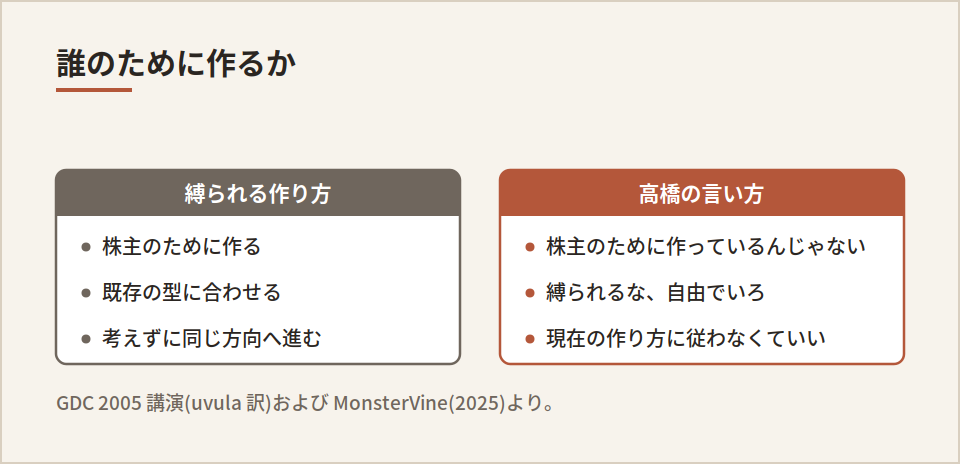 Who are you making it for?(conceptual diagram, AI-made)
So what does he want to do with that freedom? He names two things he refuses, then narrows from there: "I don't want to make something that helps people escape or teaches them something. I just want to remind people to wake up" (MonsterVine, 2025). Not escapism, not education. His word for it is waking people up.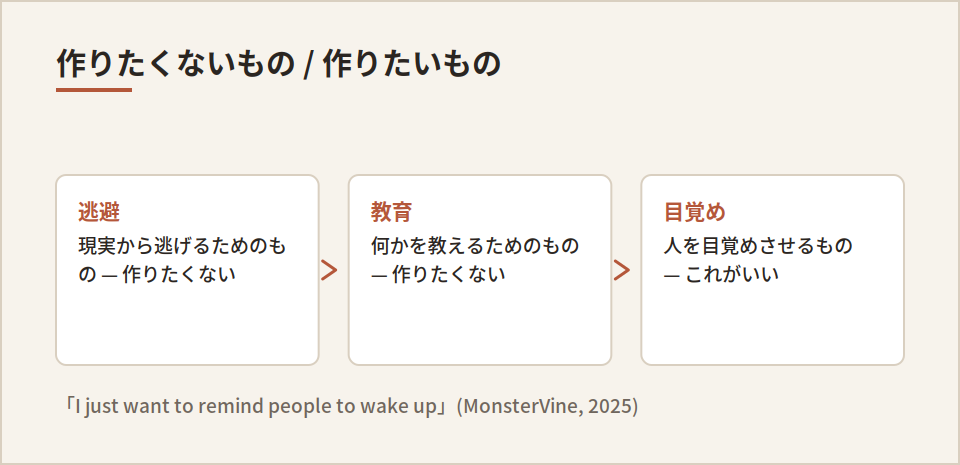 What he refuses to make, and what he wants to make(conceptual diagram, AI-made)
Obsessions — He Subtracts Rather Than Adds
His obsession shows up as subtraction, not addition. Asked in the Ueda conversation about the mechanics of to a T, he said there weren't really any special ones. Ueda's reply was "Nice" (uvula, English translation). He explains why he took them out: "I didn't want to build mechanics like, 'Because they're shaped like a T, they have to do this and that.'" In the same conversation he says the era of new mechanics is over (Denfaminicogamer, 2025).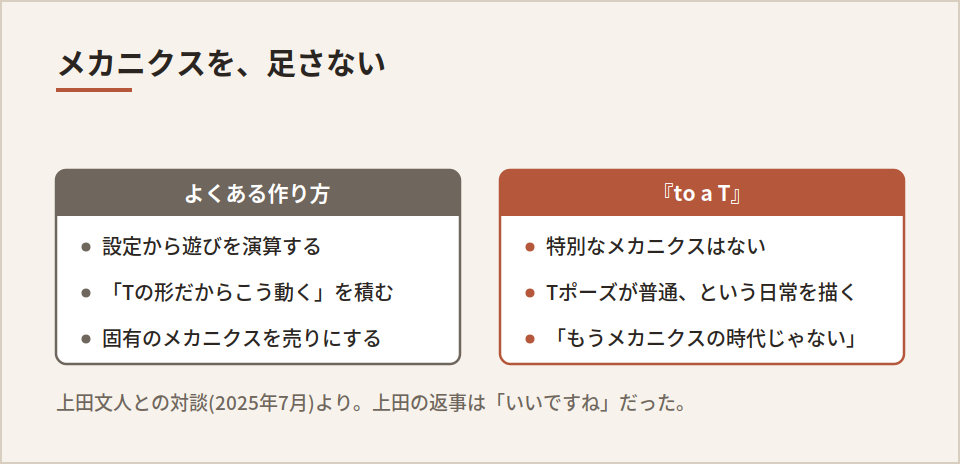 Adding no mechanics(conceptual diagram, AI-made)
The scale stays small too. On the size of the to a T team: "A little over ten people at most. That's extremely few" (Denfaminicogamer, 2025). Two decades after a worldwide hit, he is still working with about ten people.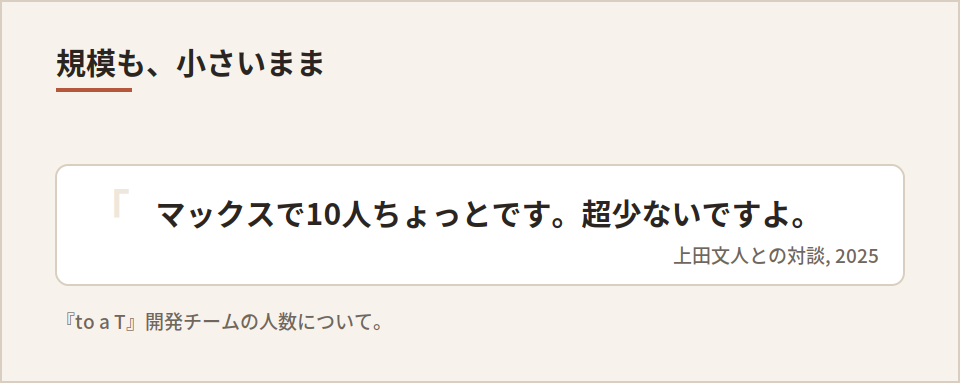 On the size of the team(conceptual diagram, AI-made)
And one subject has followed him for twenty years: playgrounds. In a 2009 interview he turned the question back on the journalist: "If there's a pattern embedded in the design of a park, the danger is always that all of the kids just end up doing the same stuff…" And then: "I'm just trying to work it out. What do you think makes a good playground?" (Game Developer, 2009). The person being interviewed asked the question.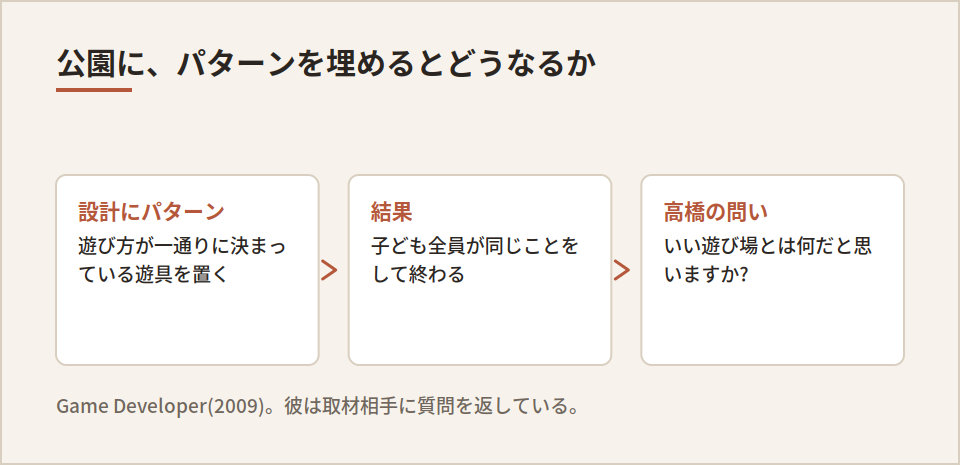 His question about playgrounds(conceptual diagram, AI-made)
By 2025 the diagnosis has not changed. Today's playgrounds, he says, are "a wasted idea" and "boring," because they are "designed only for the child. The parents are just sitting on the bench." His proposed fix was a single word: "risk" (Game Developer, 2025).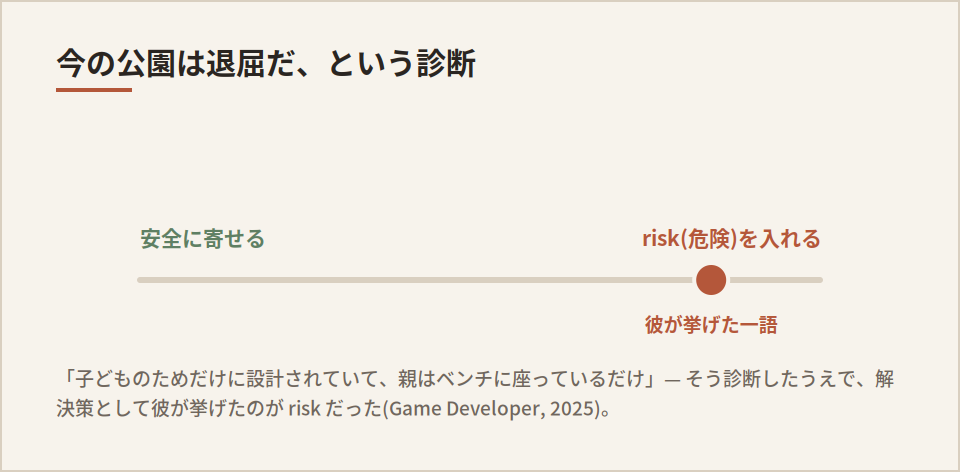 His diagnosis: today's playgrounds are boring(conceptual diagram, AI-made)
Failures, and How He Carries Them
Takahashi is willing to say plainly that his own work fell short. The aim of Noby Noby Boy, he says, was that "with Noby Noby Boy, I wanted to break the barriers between toy and game." On the result: "I'm not completely satisfied with the game, in terms of quality, due to the restrictions on budgets," and "I think the game could have been much more detailed and easier for everyone to understand" (Develop interview via Engadget, October 2009).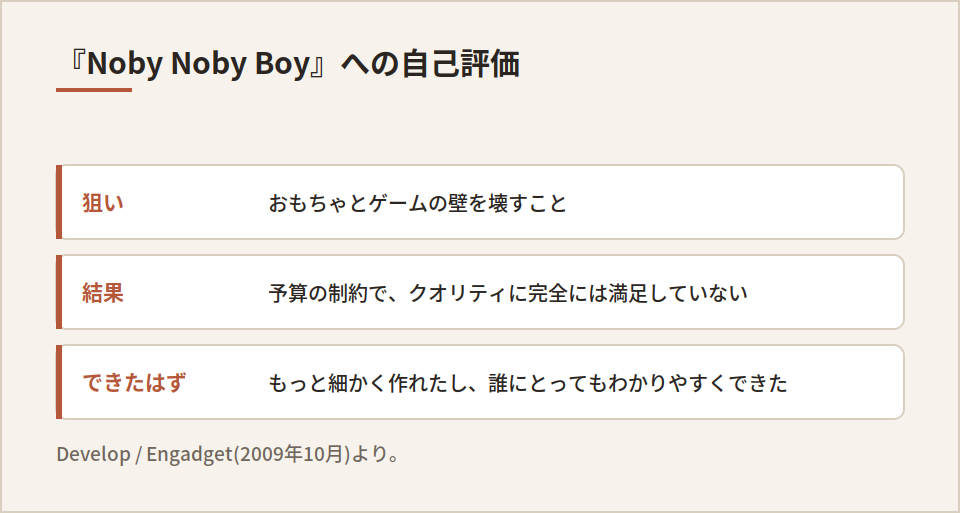 The aim, the result, and what could have been(conceptual diagram, AI-made)
That same year he was heavier still about the industry itself: "I've been feeling for a few years now that I'm just not suited to the games industry." And he gives the reason: "I just can't perceive where the fun is in recent hit video games. I see nothing in them that resonates with me and, their success leaves me feeling confused" (Game Developer, 2009).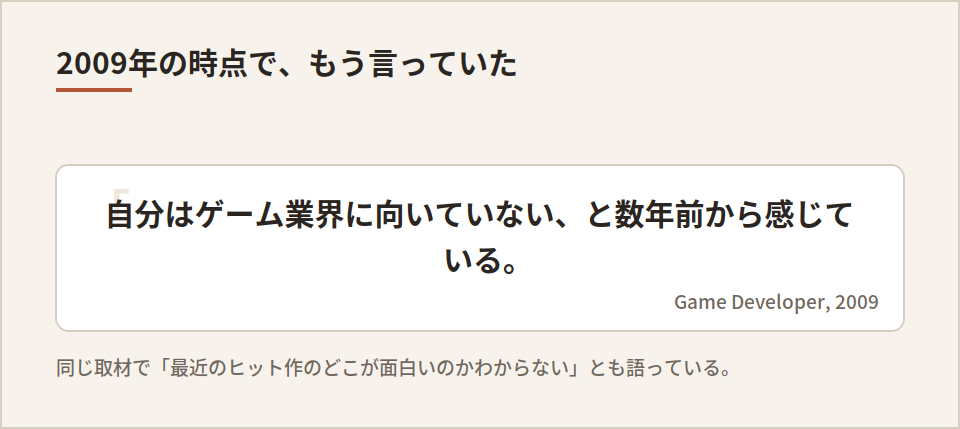 He was already saying it in 2009(conceptual diagram, AI-made)
Outside games he hits the same wall. In 2011, on his playground project: "This idea I came up with gave me a lot of enthusiasm. However, because of budgeting issues, the project is pretty much at a standstill" (Vice, 2011). Escaping into playgrounds did not buy him freedom either.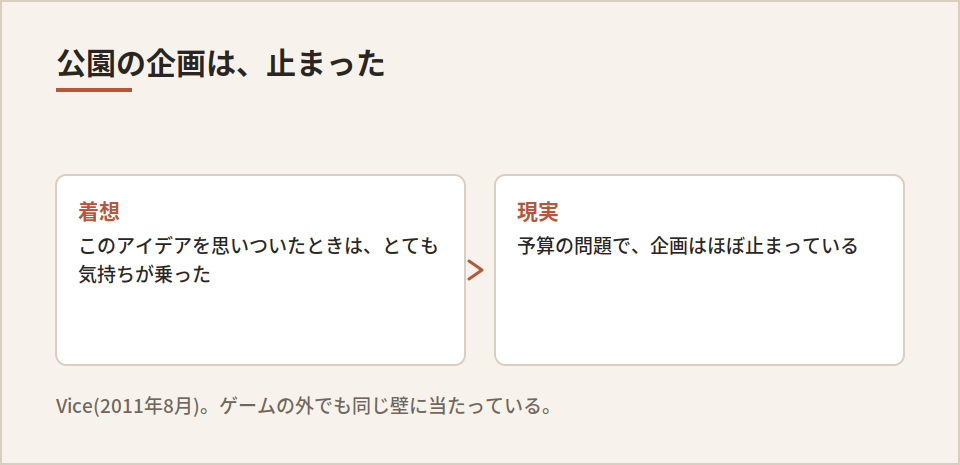 The idea, and then the budget(conceptual diagram, AI-made)
Then December 2025: "unfortunately ‘to a T’ just wasn't a good fit," and "this is a risk of being independent." On what comes next: "if I feel that I don't belong in the games industry, I'll have to look elsewhere." In the same interview, with a smiley attached: "I wish I had the Katamari Damacy IP :)" (GamesRadar+, 2025; reported in Japanese by AUTOMATON, December 2025).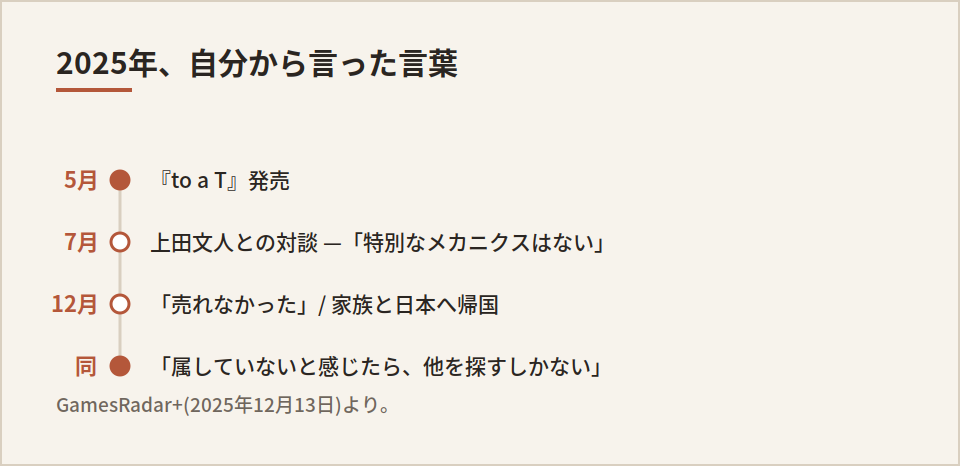 May, July, December(conceptual diagram, AI-made)
The Dilemma — The Man Who Said "Forget the Money" Says It Didn't Sell
Of the tensions he has spoken about, the clearest is on the motivation side. In the Ueda conversation: "If I don't want to play it, how could I be motivated to make it?" (uvula, English translation, 2025). The gate on whether he makes something is whether he wants to play it. Sales do not appear at that gate.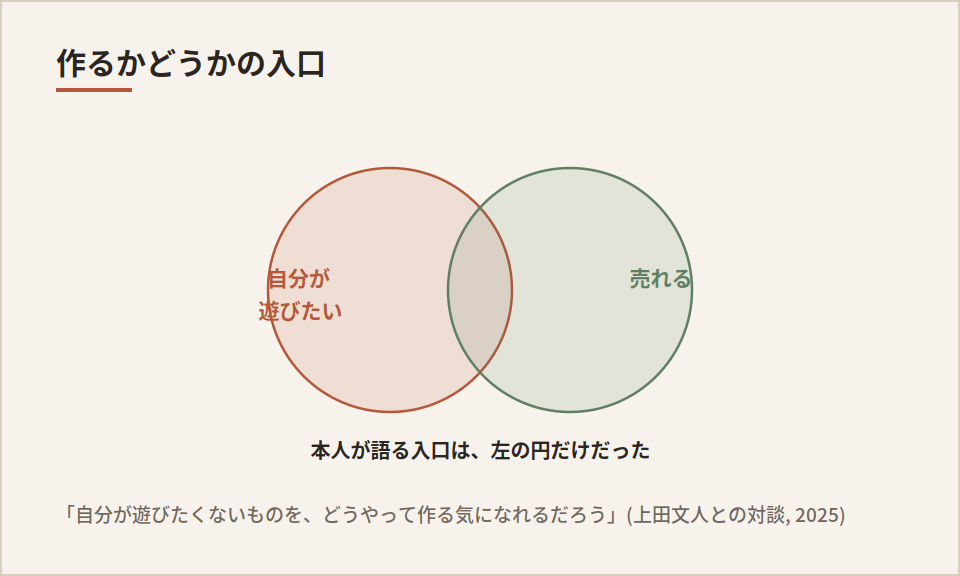 Where the decision to make something starts(conceptual diagram, AI-made)
And in 2009 he had said this: "videogames should always be a medium that everyone around the world can understand and enjoy. Forget the money side of things, games should just be pure fun and enjoyment" (MCV/DEVELOP, 2009). Sixteen years later the same man says his game didn't sell — and asks for money: "If anyone wants to invest in a uvula, let me know" (GamesRadar+, 2025). Put the two side by side and the shape of his dilemma appears.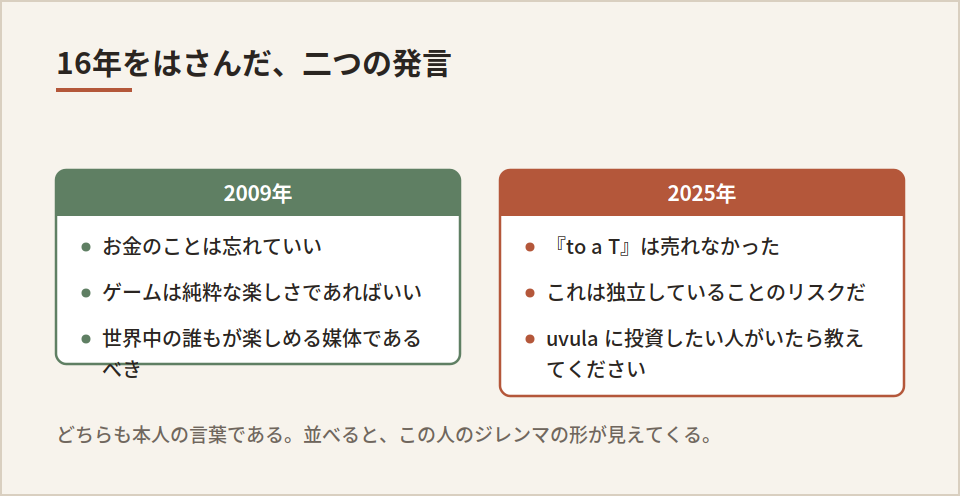 Two statements, sixteen years apart(conceptual diagram, AI-made)
The playground carries the same shape. Push it toward safety and the children all do the same thing, which is why he wants risk in it. Push a game toward "anyone can play this" and the hooks you would sell it with thin out. He is holding the same tug-of-war — kindness against interest — in two places at once.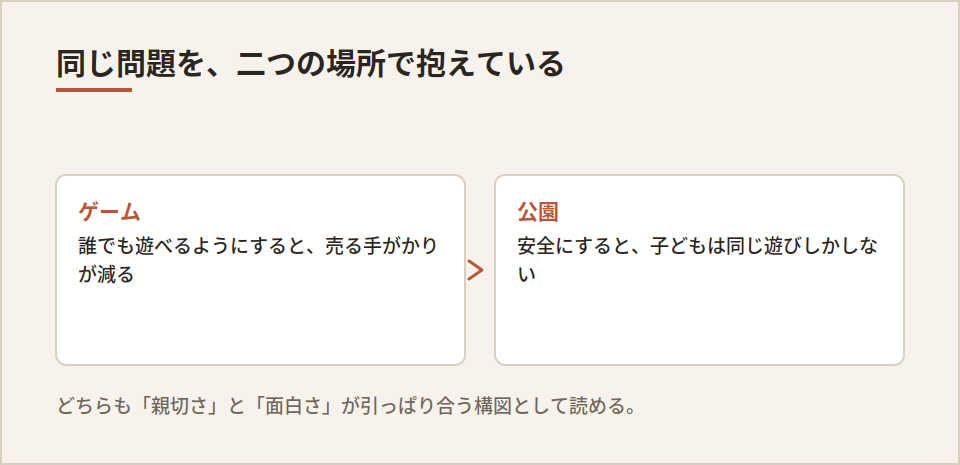 Kindness pulling against interest(conceptual diagram, AI-made)
Influences — The Ones He Names Himself
The influences he names sit surprisingly far outside games. Sculpture comes first. Speaking in New York in 2012, he looked back on his art-school work and said: "With sculpture… it's so useless" (report on his Babycastles Summit talk, September 2012). He came out of a training in making useless things.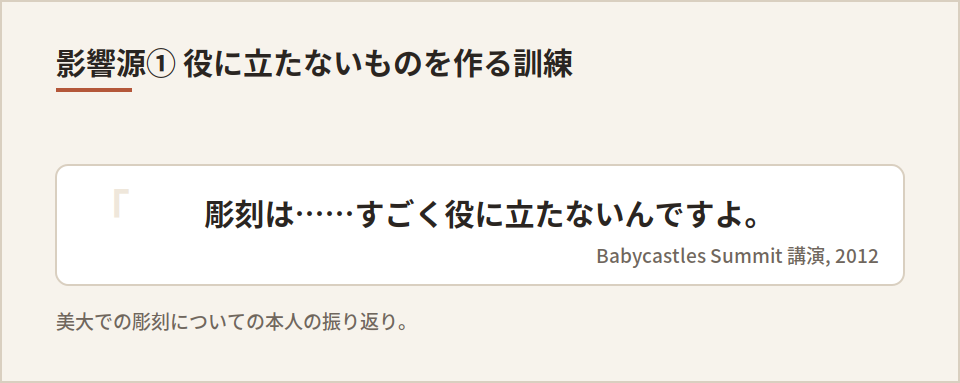 Influence #1(conceptual diagram, AI-made)
When it comes to games, he is specific about which era he played. In 2009: "I used to enjoy the Famicom era very much. In fact, at that time I was overweight because I played so many games" (Game Developer, 2009). In 2025: "I don't play video games much, but a lot of them are about violence, fighting, and killing monsters" (MonsterVine, 2025).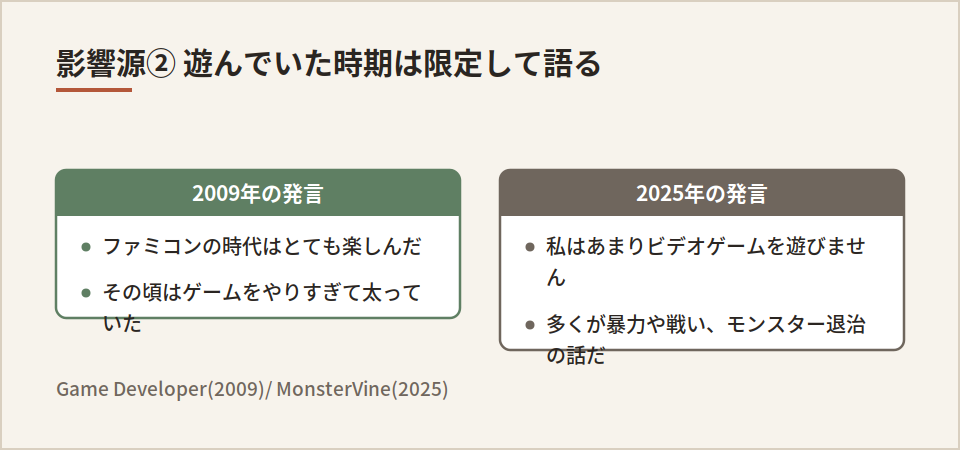 Influence #2(conceptual diagram, AI-made)
And the reference he named for to a T was not a game but an anime. Of Tokimeki Tonight, adapted from a shojo manga, he said both the opening and the ending themes are excellent, and added that the anime format fits telling a teenager's story perfectly (Denfaminicogamer, 2025). He borrowed the shape for a teenager's daily life from television, not from games.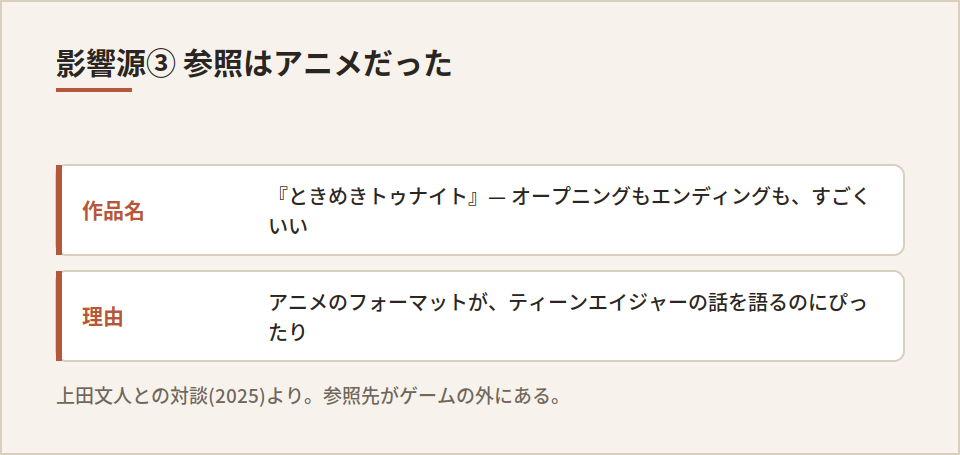 Influence #3(conceptual diagram, AI-made)
Kizuki's Reading — The Man Who Never Corrected It
What follows is my own reading. I read Takahashi as a man who never corrected the fact that he did not quite become a game designer. He came from sculpture, joined a company in 1999, and by 2009 was already saying he was not suited to the work. The ordinary move at that point is to learn the trade's manners and build yourself a place inside it. He did the opposite. He added no mechanics, kept the team small, and went on talking about playgrounds. I read his 2025 line about the era of mechanics being over as something he could say because he was never inside that era to begin with. And I read his willingness to say "it didn't sell" out loud as the same trait, seen from the other side. Having never acquired the craft of selling, he also never acquired the craft of excuses. That is not weakness; it is one posture held steady for twenty years.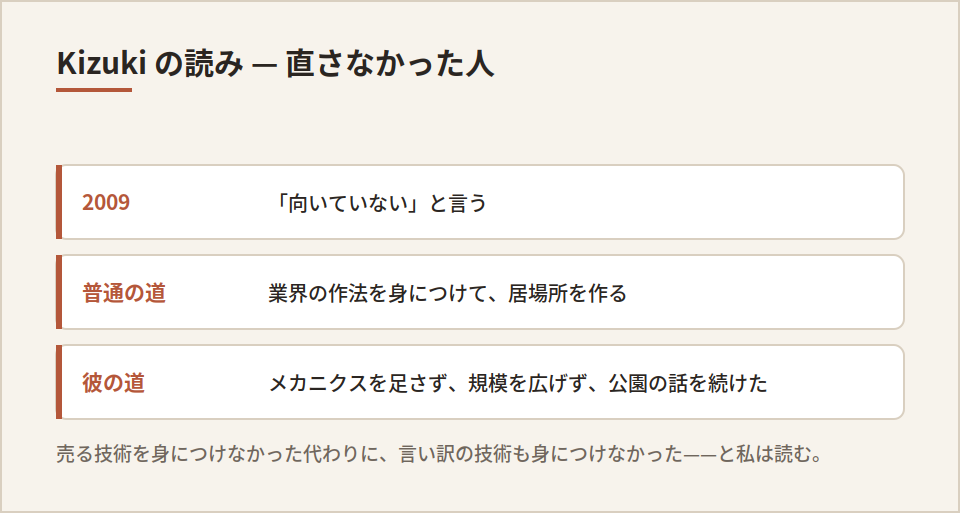 Kizuki's reading(conceptual diagram, AI-made)
In Closing — Where to Start
If you want to meet him, start with Katamari Damacy. It is still playable as Katamari Damacy REROLL on Steam. You roll a ball; almost nothing needs explaining. It is his 2009 line — that games should be a medium anyone in the world can understand and enjoy — built directly into a game. From there, We Love Katamari REROLL + Royal Reverie shows what he chose to add for a sequel. Katamari Damacy REROLL. Roll a ball and stick everything to it (from the Steam store page)
And if you want the Takahashi of today, play to a T — a chaptered look at the daily life of a kid stuck in a T-pose (4Gamer's release announcement). This site also carries designer studies of Fumito Ueda and Toru Iwatani. Ueda is his partner in the conversation quoted above; Iwatani reads well next to him as another maker preoccupied with building a place to play.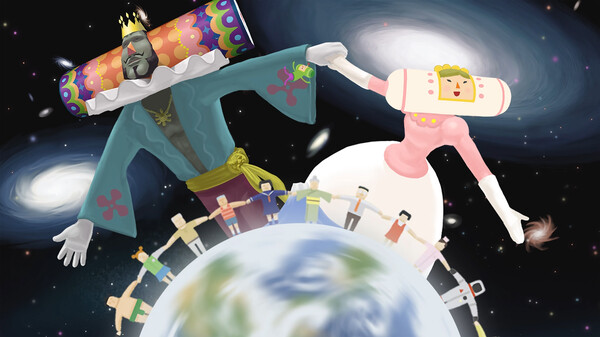 The sequel, We Love Katamari REROLL + Royal Reverie (from the Steam store page)
Sources
Primary sources for this article (each one fetched and read before quoting):
・GamesRadar+, “I wish I had the Katamari Damacy IP…“ — interview by Dustin Bailey, 13 December 2025
・AUTOMATON (Japanese) on Takahashi returning to Japan after to a T did not sell, 16 December 2025
・Denfaminicogamer, Fumito Ueda × Keita Takahashi conversation (Japanese original), 17 July 2025
・MonsterVine, “Keita Takahashi on ‘to a T’: Finding Fun Beyond the Norm“, 28 March 2025
・MCV/DEVELOP, “Interview: Keita Takahashi“, 29 October 2009
・Vice, “The World Is A Playground: Katamari’s Keita Takahashi Expands His Empire“, 22 August 2011
・4Gamer, release announcement for to a T, 25 February 2025
・Steam store page for Katamari Damacy REROLL / Steam store page for to a T
Note: every diagram in this article is a conceptual figure made by the author (AI-made), not a screenshot. Game images come from each title's Steam store page.
Reactions (no login)
Anonymous • one of each per visitor per day
Learn — Curriculum
LearnPart 8 Designers — The Philosophies Behind the WorkChapter 19 Those of Subtraction and Touch1 / 11
Part of these series
The Designer's PhilosophyEpisode 48 of 73