DESIGNER-STUDY · 2026-08-23
Inside Tim Schafer's Philosophy — Make Being Stuck the Fun Part
Grim Fandango, Day of the Tentacle, Broken Age, and "happy confusion"
Introduction
Time spent stuck on a puzzle is usually treated as dead time. Tim Schafer is the designer who tried to make that time the good part. "You have to make that 'stuckedness' entertaining," he says (Vice, January 2015).
Schafer made Day of the Tentacle (1993) and Grim Fandango (1998). He now heads Double Fine, the studio behind Psychonauts 2 (2021). He is one of the best-known authors of the classic point-and-click adventure.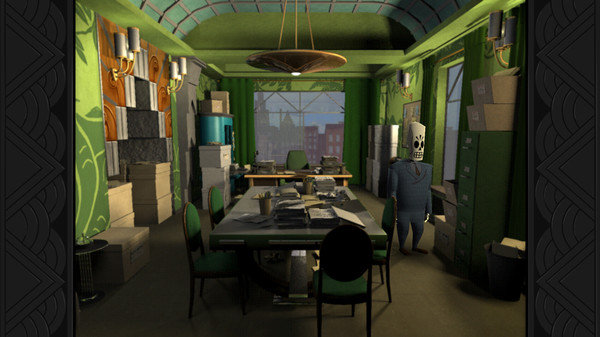 Grim Fandango (1998), an adventure set in a city of skeletons in the land of the dead (from the Steam store page)
I put him on the desk now because Double Fine shipped Keeper in October 2025 — an adventure with no dialogue at all. A studio that made its name on words and jokes took all the words out. Schafer did not direct it, but he describes it as "a weird, but chill experience" (PC Gamer, August 2025).
So I made a fresh pot of tea and laid out twenty years of his statements. The line that snagged me was about his own most famous game. In 2008 he graded his own puzzles in Grim Fandango like this: "holy smokes, some of them puzzles were nuts. Obscure. Mean, even." The man who wanted being stuck to be entertaining called his own puzzles mean. What follows is a study of the person, not a review of the games.
Background — From a Folklore Class to a City of Skeletons
Tim Schafer was born in 1967. He took a computer science degree at UC Berkeley and joined LucasArts in 1989. His first major credit was The Secret of Monkey Island (1990), where he and Dave Grossman wrote roughly two thirds of the dialogue.
From there: Day of the Tentacle (1993, co-designed with Grossman), Full Throttle (1995), Grim Fandango (1998). He founded Double Fine in July 2000, then made Psychonauts (2005), the Kickstarter-funded two-act Broken Age (2014 and 2015), and Psychonauts 2 (2021).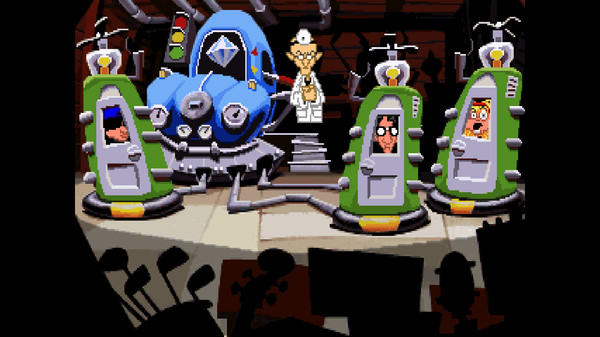 Day of the Tentacle (1993), famous for its three interlocking time periods (from the Steam store page)
Asked about his schooling, he said this in a 2003 conversation: "There was Alan Dundee's folklore class at Berkeley, which really inspired Grim Fandango." In the same conversation he brings up "this psychology of dreams class I took when I was at Santa Cruz" (Game Studies, May 2003). A man with a computer science degree names a folklore class first when asked where his work comes from.
Philosophy — Designing "Happy Confusion"
When Schafer states the point of an adventure game in one phrase, the phrase is "happy confusion." "It's the whole point of adventure games, happy confusion" (USgamer).
He restates it more carefully elsewhere: "The well crafted, entertaining confusion – that is, can we confuse you in a way that is still delightful to you?" The job is not to build answers. "You're kind of crafting this mental path for the player" (both USgamer).
That is why he resists handing over solutions. "If you have given the answer, you've taken that away from the player." "It's not entertaining to just execute a series of solutions" (USgamer). He draws the same line around hints: "You want to give a hint but you don't want to ruin the puzzle, and so you have to write them just enough" (Game Studies, May 2003).
Back in the Monkey Island days the tormenting was deliberate. "We knew we were tormenting them—like, 'Wink wink, you know the solution's here!'" And then the rule that follows from it: "you have to make that 'stuckedness' entertaining" (Vice, January 2015).
Obsessions — Always Answer the Player Who Got It Wrong
The recurring feature of his games is that a wrong action still gets an answer. In his own words: "you have to hammer a nail. Sure, here's a hammer, and here's a nail. Wrong! That's a rubber hammer" (Vice, January 2015).
You are led to feel close to the solution, then missed. The miss comes back as a joke. His stated rule — make being stuck entertaining — reads as being implemented through the sheer volume of those answers.
A second habit is distrusting the obvious answer. "You have to use one of these objects in a combination it's not meant for." "The opposite of the obvious solution often turns out to be the one." "Counterintuitive, lateral thinking they call it" (USgamer).
He also has an odd insistence on making players take notes. On the wiring puzzles in Broken Age: "the wiring puzzles aren't that difficult if you take notes. I really wanted the player to have to take notes on paper, like I did when navigating mazes in Zork" (Game Informer, June 2015).
And he refuses to throw out the stupid idea. "Just put out the dumb stuff! And you can always edit it and take out the bad stuff, but let those ideas that seem really silly come through because often they're more entertaining to people" (NME, August 2021). Of letting the three-headed monkey joke through, he recalls: "I'd be terrified that this raw, silly joke was going in there" (Game Informer, August 2021).
There is a line on the comedy, though. "I first heard this quote a while ago, always punch up, never punch down. Like, it doesn't seem that funny to be mean to someone who has less power than you or is less fortunate" (NME, August 2021).
Failure, and How He Takes It — Grading Himself Ten Years Later
The complaint that Grim Fandango's puzzles were too hard existed from launch. Schafer answered it ten years later.
On 6 November 2008 he posted the game's 1996 design document — 72 pages, solutions to more than eighty puzzles, plus everything that got cut (it is now also on the Internet Archive). What he wrote alongside it: "People said the puzzles in Grim were super hard...But now, reading this again, I've realized that, holy smokes, some of them puzzles were nuts. Obscure. Mean, even" (Double Fine blog / Game Developer, November 2008).
Note the shape of the response. He did not redesign the puzzles and he did not argue with the critics. He published the document and graded himself.
In remasters, meanwhile, he leaves the content alone. His reason, in 2017: "When I play the Special Edition of Monkey Island, for example, I really appreciated that the game existed if I wanted to see it, exactly as I remembered" (Engadget, March 2017). The puzzles he called mean are still in there.
One inconsistency I want to record. Broken Age's second act also drew difficulty complaints, and there he does not call it a failure: "I'm happy with the backer's response to the puzzle difficulty in Act 2. They wanted them more difficult than Act 1 and they got it" (Game Informer, June 2015). Ten years out he can say "mean, even"; weeks out, he says the audience got what it asked for. His self-assessment appears to need time to develop.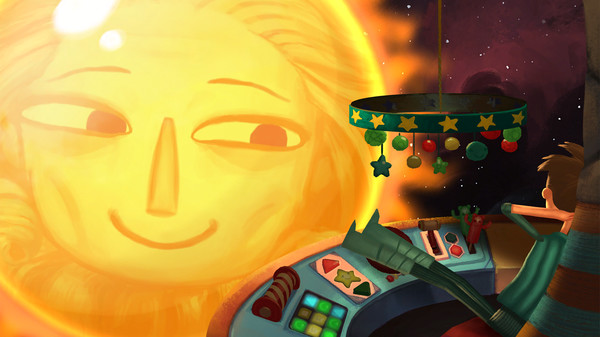 Broken Age (2014 and 2015), the Kickstarter-funded two-act adventure (from the Steam store page)
The Dilemma — The Man Who Wants You Stuck Ships an Invincibility Toggle
Psychonauts 2 (2021) ships with an invincibility option. The studio run by the man who made being stuck the product handed out a device for not being stuck.
His explanation: "To me, it just seems very straightforward and intuitive to let the player choose how they want to engage with your game." And, more forcefully: "Why shouldn't that person be able to enjoy the game you made? And we have so many hours of narrative content in the game, just let them have it!" (WellPlayed, July 2021).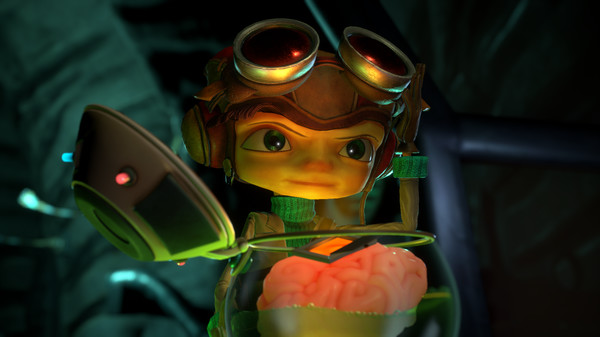 Psychonauts 2 (2021), whose difficulty settings include an invincibility toggle (from the Steam store page)
He says the same about unintended play. "Who am I to say how someone should engage with my game? They're getting fun out of it – in a way I didn't intend – but like, I'm not there to say 'No, no, no, no, you're liking the game wrong'" (WellPlayed, July 2021).
So where did happy confusion go? Lay his statements side by side and both are present at once. "There are winners and losers out there. You should make the game for the losers because there's a lot more of them." Right next to it: "There's a certain nostalgia for not knowing what's going on all of the time." And then: "Getting that right is always a challenge" (all USgamer). This is the spot he himself marks as hard.
Influences — The Ones He Names Himself
Of the influences Schafer names, the strongest claim goes to Warner Bros. animation. "Duck Amuck has influenced every game I've ever made." He adds the reason: "Warner Bros. cartoons and growing up with surrealism, I think affected a whole generation of creators" (Game Informer, August 2021).
Duck Amuck (1953) is the short in which Daffy Duck is tormented by an animator he cannot see. It reads as continuous with his own phrase about tormenting the player.
For people, he names Ron Gilbert. During Monkey Island, Gilbert taught him that a silly line could be shipped as final content rather than placeholder (NME, August 2021). This site has a study of Gilbert himself.
The Simpsons comes up too. It premiered during Monkey Island's development, and the team spent a good share of meeting time talking about it (Vice, January 2015).
For Grim Fandango, two sources. One is the Dundes folklore class above. The other is the film Double Indemnity: he was drawn to a lead who is an insurance salesman rather than a detective, and made his own protagonist a travel agent (Game Studies, May 2003).
Kizuki's Reading — What He Protects Is the Reply, Not the Difficulty
From here on this is my reading. What Schafer protects is not the difficulty of a puzzle but the reply. The rubber hammer, the three-headed monkey joke he was scared to ship — these are what the screen says back to a player who is stuck. Difficulty is only the pretext that lets the reply exist. Which is why the invincibility toggle breaks nothing for him: turning on invincibility does not reduce the number of replies.
Read that way, the 2008 self-assessment changes meaning. "Mean, even" sounds less like regret over difficulty and more like a confession that, ten years later, he found the places where he had failed to write a reply. Getting the player stuck was never the failure. Leaving a stuck player in silence was — that is how I read him.
Closing — Where to Start
For a first game, I would start with Day of the Tentacle Remastered. Three protagonists sit in three time periods, and what you do in one arrives in another. It is where the design of replies works most pleasurably.
Grim Fandango Remastered is far and away the most beautiful of them, in art and in music. But the puzzles he called mean are still in it, so keeping a hint page open is nothing to be ashamed of. The best order, I think, is to play it and then read the 1996 design document he published — the cut content is in there too.
And then Keeper, from October 2025 — not directed by Schafer but by Lee Petty, an adventure with no dialogue at all. In a game that has decided not to answer in words, what does that studio say back?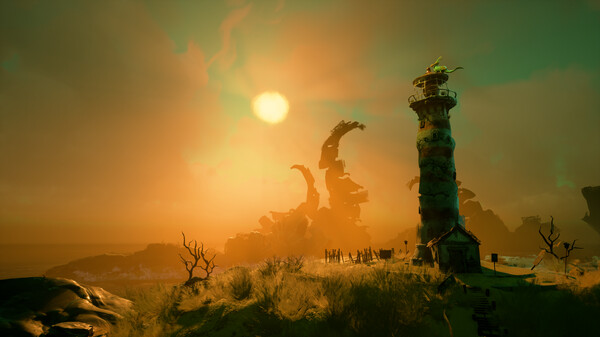 Keeper (2025), a wordless adventure about a walking lighthouse and a bird (from the Steam store page)
For a related designer, there is the study of Ron Gilbert, whom Schafer names as an influence. Read together, what the LucasArts adventures cared about comes into fuller relief.
Sources
Primary sources used in this article:
・The Grim Fandango puzzle/design document (1996, 72 pages, Internet Archive)
・Game Informer, "Afterwords – Broken Age In Retrospect With Tim Schafer," 25 June 2015
・Engadget, "Why Tim Schafer keeps remaking his classic games," 3 March 2017
・Game Informer, "Inside The Mind of Tim Schafer," 22 August 2021
・PC Gamer's report of Schafer's gamescom 2025 remarks, 24 August 2025
Reactions (no login)
Anonymous • one of each per visitor per day
Learn — Curriculum
LearnPart 4 Difficulty — Designing the Learning Curve and FailureChapter 11 Hints, Undo, Dead Ends10 / 10
Part of these series
The Designer's PhilosophyEpisode 49 of 73