DESIGNER-STUDY · 2026-08-29
Inside droqen's Philosophy — The Man Who Said "Kill Gameplay," Then Rewrote His Own Slogan
Starseed Pilgrim and The End of Gameplay
Introduction: A Sign That Says "I Want to Kill It"
A game developer whose own sign reads "I want to kill gameplay." That is how droqen introduces himself on his website: "droqen or, Alexander Martin :the one who wants to kill gameplay" (his site ↗).
droqen is a Canadian game maker. His name became known with Starseed Pilgrim in 2013, a puzzle game about planting seeds that grow into platforms — with almost no instructions. Working out what is happening is left to the player.
In 2025 he released The End of Gameplay. The title is exactly what it says. Sign and game finally matched.
What happens next is the interesting part. In the summer of 2025, the man who raised that slogan rewrote it himself. This article follows that rewrite.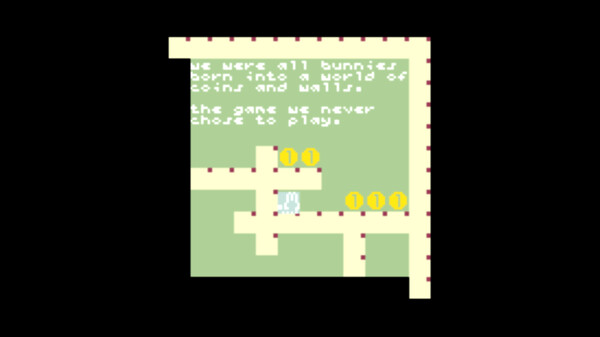 The End of Gameplay (2025). Official screenshot from its Steam store page
Background: It Started With One Line on IRC
Starseed Pilgrim began with a line someone typed in a chat room: "What if you made a game where you had to plant platforms?" droqen said so in a 2013 interview (Game Developer, March 2013 ↗). The earliest prototype went out on October 11, 2010.
It took about two and a half years to finish — but not of steady work. "Starseed Pilgrim had been 90% done for a year and a half before I finally finished it," he says. Ninety percent done, and stuck there for eighteen months.
Other hands closed the last ten percent. Ryan Roth arrived a week or two before release and made nearly every sound in three days. Mert Batirbaygil turned what droqen called "desaturated and kinda ugly art" into a colourful landscape (same interview).
He went on to make a great many small games. Then, around the 2025 release of The End of Gameplay, he set up his own forum at hidden.droqen.com. It is the main source for this article: a place where he writes down his thinking and answers people's reactions himself.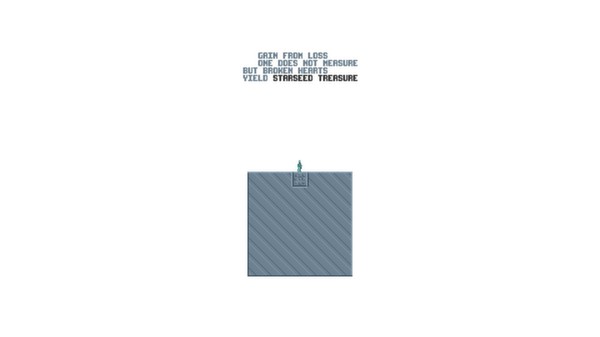 Starseed Pilgrim (2013). Official screenshot from its Steam store page
Philosophy: What He Wanted to Kill Was Not Gameplay
"Kill gameplay" was his sign for years. When he appeared on a podcast in May 2025, the episode was titled "Who Could Want Gameplay?" (Everybody's Talking At Once, May 12, 2025 ↗).
Then, on August 4, 2025, he opened a thread on his forum titled "we can do whatever we want." There he writes, in substance, that adopting "kill gameplay" made him lose sight of something more fundamental (source ↗).
That more fundamental thing is "do whatever you want" — and then work out what is stopping you. On his own account, killing is not the goal. It is what falls out of the idea once you take it seriously.
In the same thread he writes that helping someone means enabling them to do this, and lists the skills involved: noticing what you want, telling real obstacles from imagined ones, and accepting yourself. Nothing on the list is about telling other people what they ought to do.
He has put the anti-preaching stance in his own words: "personally, i want to get even further away from the finger wagging type of art" (July 26, 2025, source ↗).
Obsessions: Twelve Years of Not Explaining
In 2013 he was explicit about why there were no instructions: "I never added clear instructions because I have no love for those, and I learned that the world became more interesting that way."
He adds: "Much of the game's strength comes from what you discover and I wouldn't ruin that for you for anything." That is a maker refusing to spoil his own game.
Twelve years later he is still working the same seam. In a 2025 post he looks back on earlier works — HANDMADEDEATHLABYRINTH, the oubliettes series — as having handled emptiness in a more didactic way, and describes The End of Gameplay as showing how much can be done while not attending to that at all.
Other designers strip instructions away too; Stephen Lavelle is one. What is unusual about droqen is that the stripping extends past how-to-play, all the way to the author's own verdict. That is the next section.
Failure, and How He Takes It: Calling His Own Work "A Sprawling Mess"
Start with the old failure. Starseed Pilgrim sat at ninety percent for a year and a half. That figure is his own. He does not hide how long it stayed unfinished.
The newer failure is more specific. After The End of Gameplay shipped, he read through a great many reviews and private notes, and wrote up his reaction on July 6, 2025 (source ↗).
There he marks his own work harshly. Of the part he calls "open field": "i don't love, that clashes with the vibe." Of the part he calls "crisis": "a sprawling mess."
Could it have been more tonally consistent? More navigable? He asks himself both. So far this reads like any author's regret.
The conclusion is what differs. He writes that the game "gives me a feeling of sadness" and also "a desire to do better," then asks: "what am I going to do with the way that it makes me feel?" Not how do I fix it — what do I do with the feeling.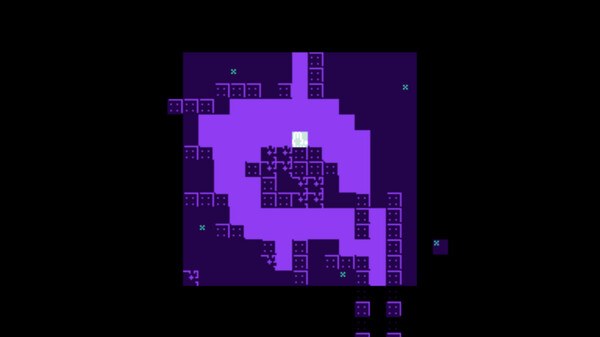 The End of Gameplay (2025). Official screenshot from its Steam store page
Dilemmas: He Could Fix It, and Doesn't
He knows the flaws and could fix them. He doesn't. His stated reason: "to change in response to reviews, wouldn't that make it more of the time, more generic, more temporary?"
Change it to match the reviews and it becomes of its moment, more generic, more temporary. He also writes that revising would disrespect the interpretations readers had already formed.
Wanting the work to be better, and refusing to tune the work to an external score. The two collide head-on. He gave up the first to protect the second.
A second dilemma sits inside the slogan. "If gameplay is killed, should there also be a void where gameplay could be?" He finds the question interesting, and answers that The End of Gameplay may only feel free of such a void because it does in fact contain gameplay (July 26, 2025). He says kill, and he keeps some — and he says so himself.
Influences: The Ones He Names Himself
One book is named outright: Ursula K. Le Guin's The Dispossessed (1974). On July 13, 2025 he wrote: "sorry, it turns out that kill gameplay is actually just a longing for anarchy" (source ↗).
Kill gameplay, he decided, was only ever a longing for anarchy. In the same thread: "i love this book. it also made me very sad and not in the usual way that a book will make me sad."
In animation, .hack//SIGN. In a short note on July 2, 2025 he set himself homework: "rewatch hack sign, consider my long lasting appreciation in it through the kill gameplay lens" (source ↗).
He files these under a forum board called "media that kills." Squid Game is there too — works that break something in you.
There are practical influences as well. Ryan Roth, who made Starseed Pilgrim's sound in three days, and Mert Batirbaygil, who changed its art. droqen names both in the 2013 interview and credits them with transforming the game.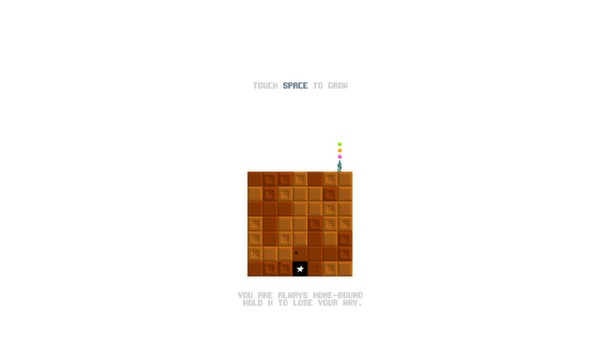 Starseed Pilgrim (2013). Official screenshot from its Steam store page
Kizuki's Reading: What He Wants to Kill Is Someone Else's Score
What follows is my own reading. Line up three of his phrases in order: "kill gameplay"; "sorry, it turns out that kill gameplay is actually just a longing for anarchy" (July 2025); "we can do whatever we want." (August 2025). In one month a slogan built on a negation became one built on a permission.
I read him not as a man who hated play, but as a man who hated someone else's score. Gameplay is, among other things, a machine that decides in advance whether you did well. If you resent that machine, "kill" is the word you reach for. But what he wanted was the place where no score is kept.
Read that way, his refusal to revise after the reviews stops looking contrarian and starts looking consistent. To move the work toward an external score would be to rebuild the very thing he wanted gone. The rewrite from "kill" to "do whatever you want" was not a new sign, I think, but the same claim said in the other direction.
Closing: Where to Start
Start with Starseed Pilgrim. Whether you can sit through its first fifteen unexplained minutes tells you most of what you need to know about your fit with this maker.
Then The End of Gameplay — though he himself writes that it is exhausting despite being short. Play it when you have the energy, not just the time.
As reading, hidden.droqen.com is the real find. There are not many places where an author lists his own work's flaws and answers strangers' reactions in person.
For neighbouring designers: Stephen Lavelle, who also strips explanation away; William Chyr, who makes space itself the subject; and Bennett Foddy, who designs for going wrong.
Sources
Primary sources referenced in this article:
・droqen's own website (self-description and works)
・Game Developer, "Road to the IGF: Starseed Pilgrim," March 8, 2013 (interview)
・hidden.droqen.com, "we can do whatever we want." August 4, 2025 (his own post)
・hidden.droqen.com, "the absence of gameplay," July 26, 2025 (his own post)
・hidden.droqen.com, "reviewing reviews, revisiting The End of Gameplay," July 6, 2025 (his own post)
・hidden.droqen.com, "media that kills: The Dispossessed," July 13, 2025 (his own post)
・hidden.droqen.com, "media that kills: .hack//Sign," July 2, 2025 (his own post)
・Everybody's Talking At Once #184, "Who Could Want Gameplay?" May 12, 2025 (guest appearance)
Reactions (no login)
Anonymous • one of each per visitor per day
Part of these series
The Designer's PhilosophyEpisode 50 of 50