SOUNDTRACK · 2026-08-29
Soundtrack: The Witness — the seven-year decision never to write a score
Andrew Lackey (Wabi Sabi Sound)
Introduction: not a single score plays on this island
The moment I stepped onto the island, I reached for a BPM out of habit. All I could hear was the surf and my own footsteps. The Witness is a first-person observation-puzzle adventure released in 2016 by Jonathan Blow's Thekla, Inc. (see Komugi's review). You walk an uninhabited island, tracing lines on panels wedged into the scenery. Hundreds of puzzles, and not one of them has a score.
The fact that no soundtrack exists is the whole subject of this piece. Andrew Lackey of Wabi Sabi Sound spent six of the game's seven years of development on its audio, and he says it plainly: "95% of what you hear is footsteps and ambiences." Choosing not to write music was, for him, the biggest job of all.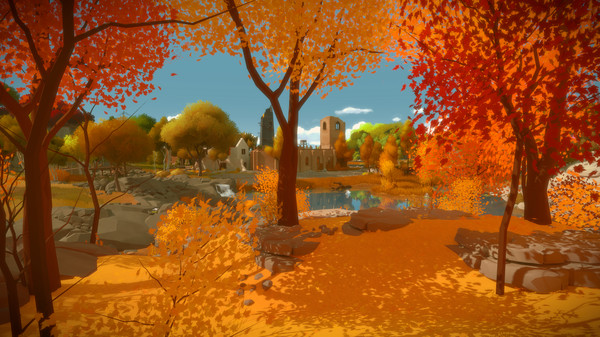 The island of The Witness, scored only by its own ambience
The decision to go silent — why the music was cut entirely
Why cut the music entirely? Because the game's whole subject is observation. Jonathan Blow has said in interviews that The Witness is about "noticing subtleties in the puzzles you find, noticing details in the world around you." Add music, and in his words it becomes "a layer of insulation that you have to hear through" to stay present. Nothing that dulls that noticing belongs, however pretty the melody.
Even so, true silence wasn't an option either. The island, by Blow's own admission, has no birds in its trees — an artificial place short on the ambient cues nature usually supplies for free. So instead of music, the team had to compose the island's own sound from scratch.
The hidden link to the experience — when footsteps become a clue
That job fell to Andrew Lackey of Wabi Sabi Sound. Rather than lean on stock libraries, he re-recorded nearly all of the ambience himself on Angel Island in San Francisco Bay. One pair of shoes, one microphone angle, held constant across the whole island to keep the texture uniform — deciding the constraint first and building sound on top of it, exactly the approach I love.
The ambiences layer a dozen-odd tracks at their densest. Each step subtly reshapes the quiet of a forest with no birds in it. Change the ground material and the footfall changes with it — that difference becomes the entry point for noticing that something here is off. It's not decoration; it's sound working as part of the puzzle itself.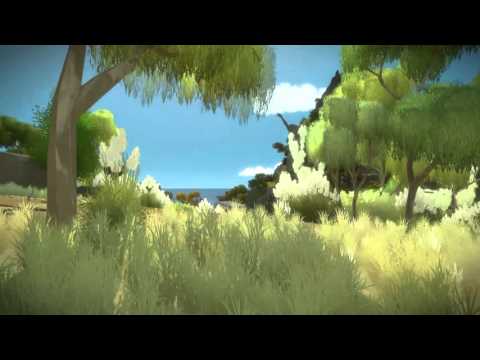 From "The Witness sound design: Open field and eucalyptus forest" (Game Developer, YouTube)
The puzzle analogy — sound with no beat never betrays a long think
What draws me to this silence is how well it fits the tempo of solving. The Witness's panels ask for nothing more than tracing a single line. But the thinking time before the answer appears swings wildly, from seconds to minutes, person to person.
No fixed-tempo score can survive that swing. Write a three-minute track and you force the same beat onto the person who solves in ten seconds and the person still stuck at minute three. Cutting music down to pure ambience is also a choice to carry no beat at all. Near-silence suits a long think the same way it suits a grind-it-out puzzle like Stephen's Sausage Roll.
I want to call it roughly 0 BPM, but that's not quite right — it's not that there's no beat, it's that the sound refuses to let you count one. Only the footsteps keep time, and they keep it at the speed of your own thinking.
What to listen to — the design of the recording, in place of a song
No "track" appears in this piece. Instead, here are two comparison videos released alongside the reporting on Andrew Lackey's work, each pairing the recording from one biome against another. First, the beach and the bamboo grove — you can hear the same microphone character carrying the grain of the surf and the dry rustle of bamboo leaves.
Next, the temple's exterior and interior. The instant you step into the stone chamber, reverb alone tells you that you've gone indoors. No music needed — the change of place still reads through sound.
Closing — what I'd steal for my own work
What I'd steal for my own work is deciding the constraint first. One pair of shoes, one microphone angle — narrowing the choices before adding anything secures the one thing that matters most: a unified feel.
Next time you meet a game with "no music," don't read the quiet as a shortcut — trust it first. I wrote about Myst before, a game that also decided against music and still came back to a single synthesizer in the end. The Witness is the one that never went back.
Sources
・Game Developer: The minimalist sound design of The Witness (interview with Andrew Lackey)
・PCGamesN: The Witness has no musical score, a soundtrack would "work against the game"
・Inverse: Why Doesn't 'The Witness' Have a Soundtrack?
Reactions (no login)
Anonymous • one of each per visitor per day
Part of these series
Puzzle SoundtracksEpisode 82 of 83
Read next
Related reviews
Tetris Effect: Connected
The falling-block game you already know, with its rules left exactly as they were. Across thirty-odd stages the music and light move in step with every piece you drop, and two things sit on top: a Zone that freezes time so you can clear more than four lines at once, and a three-player co-op mode that joins the boards together. Made under Tetsuya Mizuguchi's Enhance.
FRACT OSC
A first-person musical-exploration puzzle set in a vast synthesizer-built ruin, where you actuate glowing nodes and sound rigs to wake dormant machinery and music back to life. There's almost no instruction; working out what is even interactive is itself the puzzle. Phosfiend Systems, 2014, winner of IndieCade's audio design award.

