SOUNDTRACK · 2026-08-28
Soundtrack: Inscryption — The music changes genre the moment you leave the cabin
Jonah Senzel
Inscryption's score is unsettling — so why do I keep coming back to it?
The short answer: the horror is confined to the opening cabin. The instant you step outside it, the score changes genre so completely it's almost funny. Inscryption is a puzzle game released in 2021 by Daniel Mullins Games, blending card-battling with escape-room design. As Komugi's review notes, you're trapped in the cabin of a hunter named Leshy, collecting cards and solving the puzzles laid out on his table.
The music is by Jonah Senzel, who wrote nearly all thirty tracks on the album alone. Out of habit I tried to clock the tempo of the opening track, "Deathcard Cabin," but I don't think this one is meant to be measured. Before any drum enters, the air of the room itself is already the beat.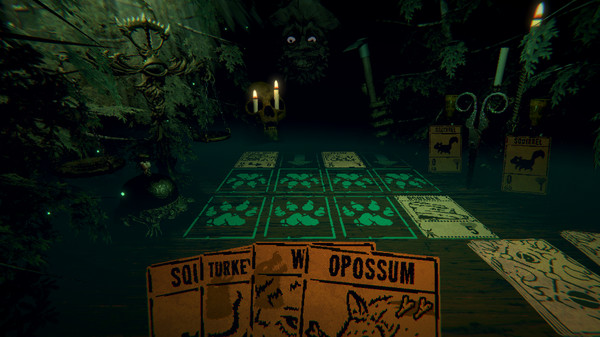 It begins in Leshy's cabin.
Why does each of the four factions — Death, Beasts, Magick, Technology — get its own musical genre?
As the story advances, you end up battling four "Scrybes": Grimora (Death), Leshy — the same hunter from the cabin (Beasts), Magnificus (Magick), and P03 (Technology). The soundtrack's own tracklist spells this out: "Temple of the Dead," "Temple of Beasts," "Temple of Magicks," "Temple of Technology," paired with "The Scrybe of the Dead," "The Scrybe of Beasts," "The Scrybe of Magicks," and "The Scrybe of Technology" — eight tracks in all.
My read is that the track titles themselves are a design document. Death's temple sounds like a hushed funeral, Technology's is hard and synthetic, Magick's hums with ritual sustain — from what I can hear, each faction is distinguished less by genre than by atmosphere. You could close your eyes and still tell which faction you're fighting, purely from what's playing.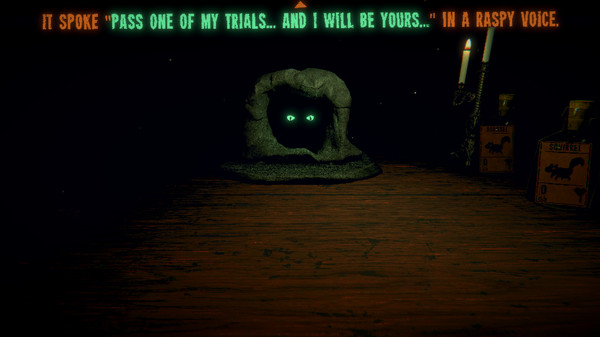 Each Scrybe stakes its claim in sound as much as in cards.
One composer is voice-acting eight distinct characters, purely through music. It's an extravagant amount of craft for a card game score, and it means that even when your hand stalls over the table, the music never hesitates to tell you exactly which room you're in — more eloquent than any loading-screen hint.
How does this wholesale genre-swapping connect to the story itself?
Inscryption's own shape changes with its story: cabin horror in Act 1, a 16-bit-style RPG fighting the four Scrybes in Act 2, then P03's digital domain Botopia in Act 3. On the podcast Level with Emily Reese, Senzel described writing "in a handful of different styles, from music heavy with sound effects to the simplest, slow chip-tune chords."
Once you're inside Botopia in Act 3, track titles shift to "Uberbot Activated" and "G0lly's Theme," along with its variant "G0lly's Theme (Uploading)." That single word — Uploading — is enough to tell you a character is mid-transformation into data, with no dialogue or lyrics required. The craft was recognized industry-wide too: Inscryption won "Excellence in Audio" at the Independent Games Festival Awards and was nominated for Excellence in Audio Design at the 2021 SXSW Gaming Awards.
Blending it all into one vague "horror-RPG" genre would probably have been the easier choice. Senzel didn't take it — he swapped genres completely at every act boundary instead. That refusal to half-blend is exactly what keeps the three-act twist honest on the musical side, too.
Where does the puzzle-solving tempo actually lock in with this score?
Arranging cards in the Act 1 cabin, I can't clock a tempo at all. It reads more as ambience than music, and it never asks my thinking to keep a beat. It feels like it drops to somewhere around 50, though that's an ear-guess and nothing more. While my hands are still, the music looks still too.
Then Act 2 arrives, and the tempo suddenly jumps in my hands as I fight the four Scrybes. Turn-based card combat asks for a small decision on every turn, and the music seems to line up a new development every bar — the speed of "what do I play next" and the speed the music unfolds feel like the same clock.
That swing — from near-silent thinking time to a tempo that snaps forward — is, I think, exactly why Senzel's score never sounds lightweight, whether it's being horror or being an RPG.
Tracks worth hearing
First, the opening track — a piece that stands in for the cabin's air itself.
Next, the theme for The Angler, one of the first traders you meet in Act 1.
And if I can name one more, it's the theme shared by The Trapper and The Trader that I'd want to keep close. The Trapper & The Trader ↗
Closing — what I'd steal if I were writing this myself
Two things I'd steal. First: let the track titles double as your design document — naming them "Scrybe of the Dead" or "Scrybe of Technology" tells the listener which faction they're in before a single note plays. Second: when you change genre, don't half-blend it — swap it out completely at the chapter boundary.
If I revisit this, it's right before Act 2 starts. Pour a black coffee, put on "Deathcard Cabin," and I'm back in the cabin, not yet out the door. On chiptune building atmosphere, I've also written about Baba Is You — there, 8-bit sits beside you through trial and error; here, it's a disguise worn across chapters. Same instrument set, a completely different job.
Sources
・Steam: Inscryption Soundtrack (official DLC)
・Jonah Senzel's Bandcamp: Inscryption Original Soundtrack
・Daniel Mullins Games official channel: OST Preview "Deathcard Cabin"
・Level with Emily Reese: interview with Jonah Senzel (Inscryption episode)
Reactions (no login)
Anonymous • one of each per visitor per day
Part of these series
Puzzle SoundtracksEpisode 81 of 116
Read next
Related reviews
Tetris Effect: Connected
The falling-block game you already know, with its rules left exactly as they were. Across thirty-odd stages the music and light move in step with every piece you drop, and two things sit on top: a Zone that freezes time so you can clear more than four lines at once, and a three-player co-op mode that joins the boards together. Made under Tetsuya Mizuguchi's Enhance.
Inscryption
A deckbuilding card game played across a candlelit table from Leshy, a narrator holed up in a cabin: you draw woodland-creature cards and sacrifice your own pieces to put them into play. Stand up from the table and the cabin itself becomes an escape-room puzzle. By Daniel Mullins, who made Pony Island.
HUMANITY
A puzzle-action game where you play a glowing Shiba Inu placing command tiles — turn, jump, float — beneath an endlessly marching crowd to guide it to the goal. tha ltd. and Enhance's modern redrawing of the Lemmings lineage.


