REVIEW · 2021-10-19
Inscryption
Reading a review pool that tells you not to read reviews
First Impressions
Inscryption arrived on Steam on October 19, 2021, developed by Daniel Mullins Games and published by Devolver Digital. The store copy describes it as a deckbuilding roguelike, escape-room puzzling and psychological horror blended into a blood-laced smoothie, and it names the same author's Pony Island and The Hex in its opening line. The pitch is less what was built than what it continues.
As of my 2026-08-19 snapshot: 96% of 76,347 Steam reviews are positive, labelled Overwhelmingly Positive, and the last thirty days hold at 95% of 864. The Japanese-language pool, though, reads 87% of 1,458 — nine points below the whole. Metacritic carries a critic score of 85 from 49 reviews (46 positive, 3 mixed, 0 negative) and a user score of 8.5 from 1,087 ratings (907 favourable, 132 mixed, 48 negative). Four per cent turn negative on Steam; sixteen per cent decline to be favourable on Metacritic.
The first thing you notice about this pool is how little of it describes the game. Near the top of the helpful sort sit posts whose entire content is: do not read reviews, do not watch the trailer, start knowing nothing. The Japanese top ten carries several of the same. And near the top of the negative side sits a review whose argument is that you should not be fooled by the ones telling you to buy it unread. What I am reading is a body of votes that has agreed not to be read, and a body of votes objecting to that agreement.
 Inscryption — Steam store key art
Putting the Mechanics into Words
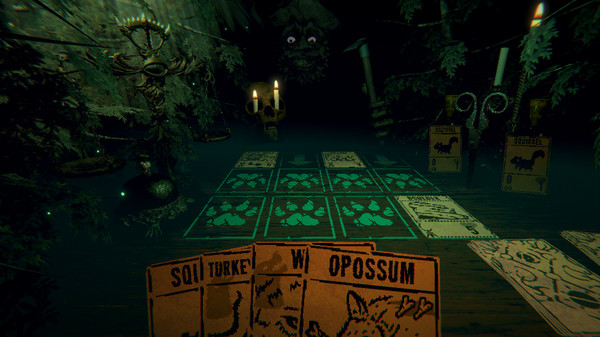
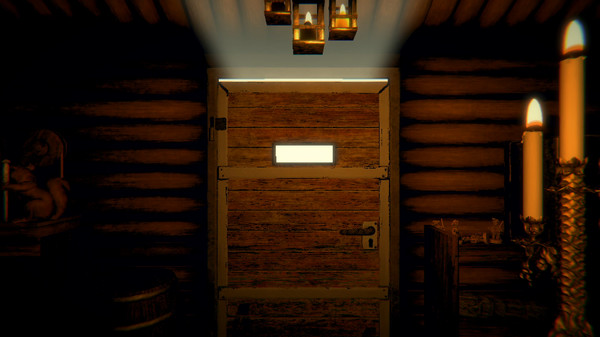
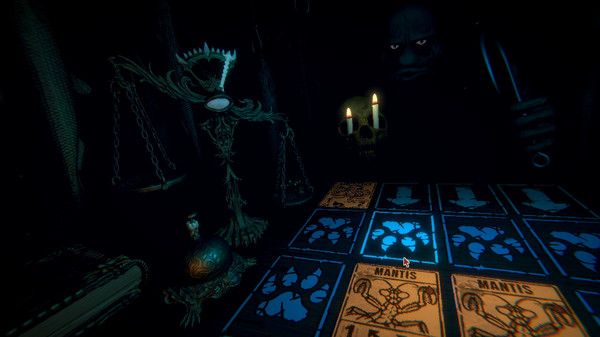
Gather the reviews that actually explain things and the skeleton comes out like this. Leshy, the narrator, sits across a candlelit table; you draw woodland-creature cards and put them into play, and putting them into play costs you pieces you already have — the store copy itself lists acquisition as draft, surgery and self-mutilation. Lose and you start the run again, with the board reshuffled roguelike-fashion. Stand up from the table and you can walk the cabin, opening drawers and examining walls.
In Puzzlebyrinth terms what matters here is not the number of verbs but the number of layers they belong to. On the table there is a closed grammar: draw, sacrifice, place. Off the table there is another: walk, inspect, carry away. Most card games deepen the first one only. Inscryption lets the first settle and then inserts the second. I once summarised Daniel Mullins' philosophy as turning the frame around; what gets turned here is not the picture but the premise that there is a table at all.
On the cost system the reviewers agree. You cannot field the next creature without destroying one you have, so strengthening the board is the same act as thinning it. Subtraction is built into the win condition rather than bolted on beside it. The table is small and the lanes are few, so observational resolution is high from the first hand. You can also see the split by hours: the long-playtime posts talk about the weight of a single play, the short ones talk about atmosphere.
 Inscryption in play — Steam store screenshot
The Feel of the Story
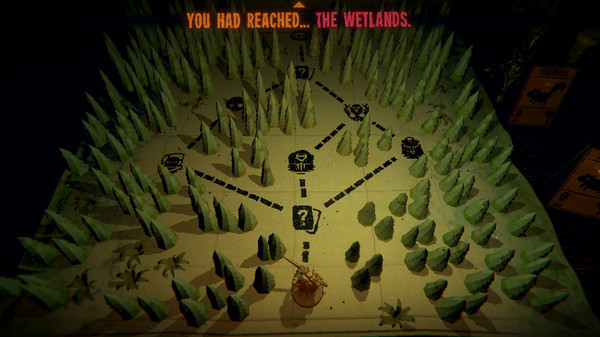
The story the pool describes changes shape as the acts turn over. It opens as a one-on-one in a cabin with Leshy, and from there the game rebuilds itself twice. Among the most helpful Japanese reviews is a long one that reads the four Scribes as designers each chasing an ideal game, and interprets the whole work from that arrangement — the in-game antagonists taken as figures for game authorship. I neither endorse nor dispute the reading; what strikes me is a structure that makes someone write it inside a store review.
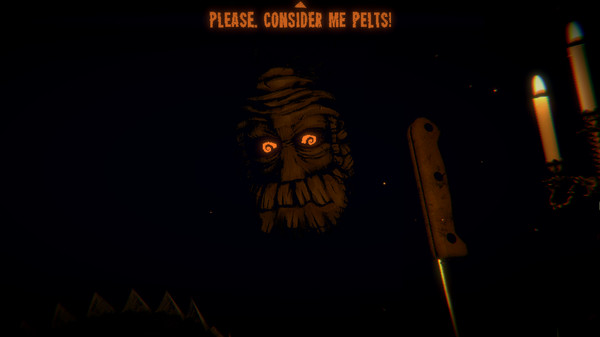
The densest affect in the pool sits in one-line posts. Two of the ten most helpful Japanese reviews consist of nothing but a wish to have shaken hands. I will not say what that refers to. The design point is that keeping the figure across the table consistently a person who talks is what allows the absence of a physical gesture to become a vote. Not many games collect their upvotes on a missing gesture rather than on a mechanic.
There is one further report from late in the game that reads to me as a genuine design risk. A reviewer past a hundred hours describes a stretch where Steam friends appear on the board as cards, and writes about meeting the account of a relative who had died. Bringing live data onto a board generates meaning the author cannot control. This particular account was warm about it; I read the whole arrangement as a bet the author took, consequences in both directions included.
 Inscryption in play — Steam store screenshot
Pacing
The fault line runs through length, and what makes it interesting is that both sides are pointing at the same fact. Several of the most helpful English reviews — including ones past two thousand upvotes — are not praise but requests: sell the first act as its own game, give Leshy an endless mode, expand the roguelike into a full card game. The most-upvoted recommendations in the pool are asking for the return of exactly what the game chose to give up.
The negative side attaches the opposite sign to the same observation. A Japanese negative review with 195 helpful votes objects to the structure itself — the opening is good enough that everything after it disappoints — and to the fact that the switch is not disclosed before purchase. Metacritic's 2/10 describes a high-quality opening that forces a transition into a different, low-quality game; a 5/10 calls the second act overcomplicated. PC Gamer's 69, the lowest of the 49 critic scores, says the game does not know when to hold and when to fold.
To me this is not a learning-curve problem but a replacement problem. The opening teaches one grammar carefully and then discards it once taught. That is neither subtraction nor addition; it is swapping the floor out. If you value play that interrogates its own frame, the swap is the subject of the work. If you value the game on the table, your skill has had its destination taken away mid-climb. Both readings are accurate. They differ in what the design was aimed at.
On length, the hours stated in the reviews I read scatter from 11 to 101, with the middle landing in the low thirties — though that mixes in the repeatable modes and the external puzzling described below. Other tallies put a single pass through the story at around twelve hours and full collection at around twenty. Note also that an official later mode (Kaycee's Mod) exists specifically to replay the opening act. At least one of the requests above has already been answered.
 Inscryption in play — Steam store screenshot
Design Craft
The most finely engineered thing here is probably the release of information — and that engineering reaches into how the reviews themselves are written. Near the top you find one-liners: the less you know the better; the only flaw is that the first time only happens once. In the Japanese pool, stop reading reviews and just buy it has hardened into a formula. The game withholds in order to maximise the single first pass, and the votes withhold for the same reason. The pool has become the work's gatekeeper.
Which is what gives the one dissenting review its force: because the game is strongly not for everyone and yet forbids spoilers, this buyer went in without research and found it entirely wrong for them. There is nothing to inflame here. A design that maximises the unrepeatable first pass also removes the means by which someone unsuited to it could have found that out in advance. Both effects come out of the same single choice, so this is not better-or-worse but a question of what the design was aimed at. Close the gate and the experience inside thickens while judgement from outside gets harder.
The puzzling also extends past the executable. The single most-upvoted post among 76,347 — around 2,500 helpful votes — is not a recommendation but a decode log: strings typed into in-fiction terminals, morse, and an investigation that reportedly runs out to physical floppy disks mailed to players, organised act by act. Play that extends observational resolution beyond the work occupies the very top of the review column. That fact alone tells you most of what this pool has been rewarding.
 Inscryption — Steam store media asset
Sources
This piece was written by reading the user reviews on the Steam store page as of 2026-08-19. No review text is quoted directly; typical claims are reconstructed.
- Steam: Inscryption (Overwhelmingly Positive, 96% of 76,347; 95% of 864 in the last thirty days; 87% of 1,458 in Japanese)
- Read via WebFetch: the ten most helpful reviews across all languages and the ten most helpful in the Japanese locale (two of them negative) — roughly twenty once duplicates are removed. I also used the store description and the thirty-day and Japanese-language summary labels
- Metacritic critic score 85 (49 reviews: 46 positive, 3 mixed, 0 negative), Metacritic user score 8.5 (1,087 ratings: 907 favourable, 132 mixed, 48 negative). Individually I read a 2/10, a 5/10 and two favourable user reviews, plus the gist of three critic reviews including PC Gamer's 69, the lowest of the set
- TheGamer on how long Inscryption takes (about twelve hours for one pass, about twenty with collection, and the existence of Kaycee's Mod). The images below the text are official assets served by the Steam store page itself; the image CDN was unreachable from the environment this piece was written in, so their contents could not be checked by eye and the captions are kept generic
- Act structure, characters and the specific names of the tricks are deliberately withheld in the body to avoid spoilers
Closing
Against Steam's 96%, the critics' 85 and Metacritic's user 8.5, I put 8.8. The high mark is not for the card game on the table but for the structure that contains the table. The reason for the gap to a perfect score is equally clear: the work swaps its grammar twice, and each swap voids the skill you accumulated under the previous one. The price of making you doubt the frame is the continuity of the play inside it. Steam's four per cent and Metacritic's sixteen are the people who received that price as an invoice.
It suits players who can welcome standing up from the table, and who will spend time on play that questions its own premises. It does not suit players who want the opening extended as it stands, or who want to establish in advance whether a game is for them. For that second group the work is doubly unhelpful, because the review pool has closed the gate too. Reading the same author's Pony Island at least previews the kind of thing that happens, if not what happens.
One conclusion as a meta-review. The figure of 96% across 76,347 reviews does not really function as an assessment of how good this game is. What that pool has agreed on is an etiquette for handling the unrepeatable first pass. Hence a decode log sitting at the very top, the most-upvoted recommendation arriving as a request to make the opening endless, and the most-upvoted negative answering that if you insist on silence you must also accept who gets filtered out. I want this one on record as a case where a game's design ended up designing the shape of its own review column.
 Inscryption — Steam store key art
Where are you with this game?
Press one and the game goes on your shelf. You can see it on your account page.
Reactions (no login)
Anonymous • one of each per visitor per day
Read next

Related reviews
Pony Island
A meta-puzzle in which you are trapped in a deliberately shoddy arcade cabinet built by the devil, alternating between a pony side-scroller and puzzles that reorder instruction blocks inside the machine itself. Daniel Mullins's first commercial release turns the window and the UI into the mechanism.
Tiny Room Stories: Town Mystery
An escape-room puzzle game in which a private detective, summoned to the deserted town of Redcliff, inspects diorama-like rooms that can be rotated and viewed from any angle, opening keys and combination locks while searching for his father. Made at a very small scale by Kiary Games and ported from mobile.
Happy Game
A point-and-click adventure that walks a sleeping boy through three chapters of nightmare. You pull, turn and pick at the screen to open the way forward, and what waits there is smiley faces, pink bunnies and rooms the colour of blood. Amanita Design's first turn toward horror, scored by the Czech band DVA.


