REVIEW · 2021-10-28
Happy Game
Inside a 90% positive score, both sides point at the same three facts — easy puzzles, two hours, a red strobe. What differs is whether they call it a game or a film
First Impressions
Amanita Design was for a long time the studio known for cute. With this one, released in October 2021, they put that sign down. The store's line reads: a little boy falls asleep to a horrible nightmare — can you make him happy again? Three nightmares, three stolen comforts to get back.
Across the Steam reviews I read, the positive and the negative side write down the same three facts in the same words. The puzzles are easy. It ends in about two hours. The screen flashes hard and red. Hide the thumbs and there are sentences here you could not sort into the right column.
What splits is what those three facts get called. The positive side writes that it is not really a game but an experience. Japanese reviewers call it a piece of film. The negative side calls the same thing a somewhat interactive slideshow of interesting drawings. All three are describing the same screen.
The aggregate is 3,219 positive of 3,583 across all languages, about 90%, labelled Very Positive (snapshot 2026-09-05; the store page itself displays 1,248 reviews at 88%). The three press reviews I could read spread wider than the users: 7.5/10, 8.5/10, and one unscored negative verdict.
This piece rereads the pool from that gap — same facts, different names. Follow where the difference in naming comes from and you arrive at the one thing this game took away.
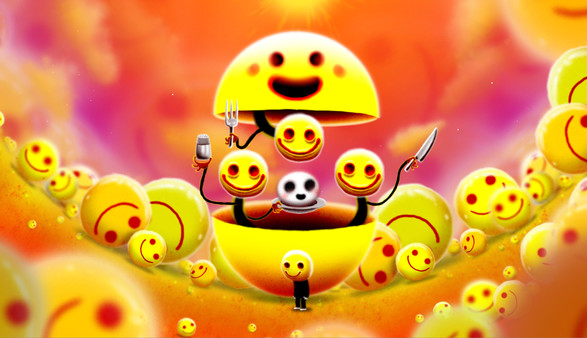 Happy Game in play — the first image listed on the Steam store page — Steam store screenshot
The World
Reading 23 negative reviews, the thing that surprised me most was the running order. Almost all of them praise the art before they start complaining. Great art, visuals and music comes first, then: but it is boring to play. Nine are built in exactly that sequence.
The positive vocabulary is just as consistent — macabre, creepy, grotesque, twisted, psychedelic. In Japanese, gross-cute, and "like a single painting." What both sides credit is the coexistence of dread and charm on one screen.
The sound gets the same treatment. The store credits the score to the Czech freak-folk band DVA. Reviewers write "excellent sound design"; one Japanese reviewer calls it a sound like an electronic drug. The only dissent I read was a critic who found the mix hard to make out.
In Komugi's terms, what rises here is observational resolution. The art and the audio force up the resolution at which you look at the screen. Machinarium turned the same dial so that you would search. Here it is turned so that you cannot look away.
So the art is not the argument. The argument is what the game asks you to do at that resolution — what the raised resolution is spent on. That is the rest of this piece.
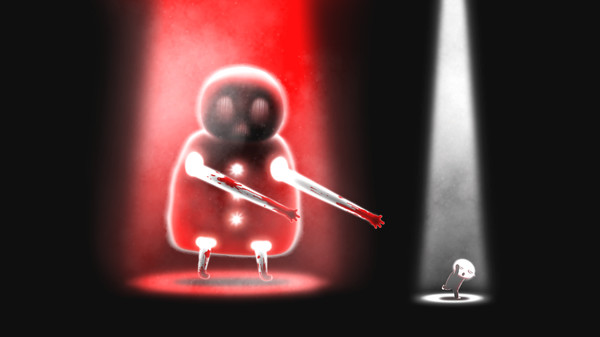 Happy Game in play — the second image listed on the Steam store page — Steam store screenshot
The Feel of the Story
The readings converge to a surprising degree: bullying, family pressure, and being told to keep smiling. Several unrelated reviewers independently describe a smile you are not allowed to take off. One Chinese review says that what you see and feel here is happening right next to us.
At the same time, many of them say they did not understand it. One Japanese review says the ending made no sense, then immediately adds that this is fine. The opacity is not counted as a fault. What repeats instead is that they took it in by mood rather than by explanation.
The negative side names the same opacity differently — weird for weirdness's sake, tryhard edgy, like a mid-2000s Flash short. Their reading is not that the story is hidden, but that there is only shock where a story would be.
I read this as the subtraction going one layer deeper. The same hand that took difficulty out of the puzzles took explanation out of the story. Whether the remaining blank reads as symbol or as shortcut depends on what the player brought in. It is one blank with two names on it.
From the author's side, that is a choice about reach. Explain it and misreadings drop, but the nightmare stops being a nightmare. This game picks its side clearly, and once you pick it, the players it fails to reach are part of the design too.
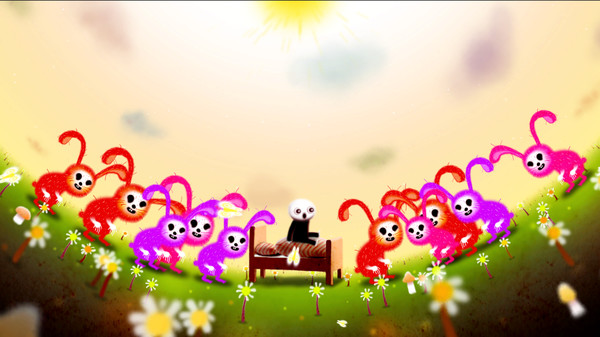 Happy Game in play — the third image listed on the Steam store page — Steam store screenshot
Subtraction
What Amanita's earlier work was credited for was looking closely at a screen and assembling something out of it — the workshop logic of Machinarium, the light and shadow of Creaks. This one deliberately thins that out.
The positive side welcomes it: stress-free, gentler than the studio's other games. The phrase that repeats is that you never stall, so the dream never breaks. Read that way, the subtraction protects continuity. Across the reviews I read, almost nobody reports going to look up a solution.
Eight of the 23 negative reviews describe what is left instead. Pull, turn, pick. The verbs are still there, but the reason a verb is the right one cannot be read off the screen, so you end up whipping the mouse around hunting for the hotspot. "Trial and error" appears verbatim.
So what was subtracted is not the verbs. It is the reason behind them. An action without a reason is not deduction; it is ritual. As a way to walk through a nightmare that is correct, but it costs the learning curve. Across two hours, nothing accumulates in the player.
CHUCHEL ran into the same thinness. There, comedy caught it. Here the catcher is fear, and fear tires faster than a joke. When four of the negative reviews say the strangeness stopped being fresh after half an hour, I think that difference in catcher is what they are naming.
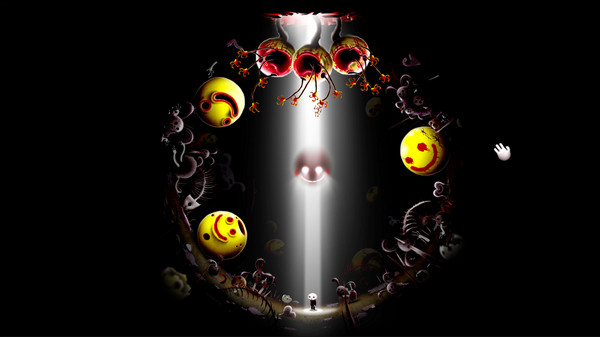 Happy Game in play — the fourth image listed on the Steam store page — Steam store screenshot
Pacing
The length figures line up well. All three press reviews I could read say roughly two hours, three at the outside. Negative Steam reviewers' playtimes sit at a median near 2.3 hours; the English positive ones near 4. That gap looks less like a difference of opinion than the difference between stopping partway and watching it out.
For the positive side, brevity becomes a price question. A Japanese reviewer writes: 1,500 yen, cheap, too good a deal. The negative side also makes it a price question, pointed the other way — buy it on sale. One says it is dear even at 55% off. The same two hours read as a bargain and as a loss.
More telling is what four of the negatives say instead: the strangeness stops being fresh after about half an hour. The three nightmares sit side by side at the same intensity rather than escalating, so where people drop out varies a lot. One reviewer says the second half engaged them less than the first.
There are real defects too, named from both sides. There is no options screen, so the volume has to be turned down in the OS. Much of the animation cannot be skipped. The Japanese line "there are no settings" holds up as a plain statement of fact. One critic adds that on Switch a mouse-shaped game sits badly on a stick.
And the flashing. Every action can set off a hard red strobe. The store carries a warning, and the most-read Japanese review opens by advising people with photosensitive epilepsy, or an aversion to gore, not to play. That is not a matter of taste, so it belongs early.
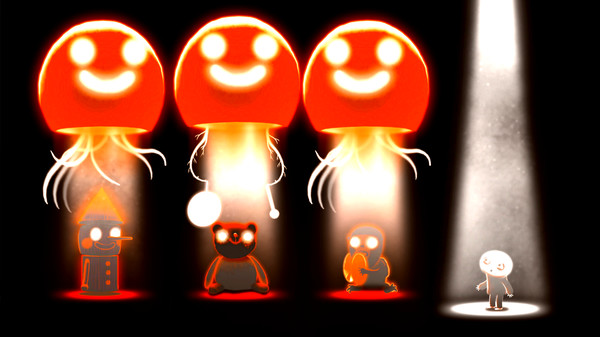 Happy Game in play — the fifth image listed on the Steam store page — Steam store screenshot
The Reviews I Read
This piece was written from the Steam store page's user reviews as of 2026-09-05.
・Steam: Happy Game (3,219 positive of 3,583 across all languages, about 90%, Very Positive; the store page itself displays 1,248 reviews at 88%)
・Read: the top 20 positive by helpfulness, the top 23 negative, the 20 most recent, and 10 Japanese-language reviews — roughly 60 once duplicates are removed.
・Press: Nintendo World Report (7.5/10), WayTooManyGames (8.5/10), and New Game Network (no score, negative verdict).
・Developer, release date, the three-chapter structure and the music credit were checked against the Steam store page as primary source.
・All images are screenshots published on the Steam store page and their URLs were verified to resolve. The image files themselves could not be downloaded from this run's environment, so the captions record only their order on the store page and make no claim about what they depict.
Closing
I give it 7.4. That is below Steam's roughly 90%, but the gap is not a deduction. The two numbers measure different things: theirs is satisfaction as an experience, mine is what the design manages to build. Two numbers, one object, different rulers.
The achievement is clear. A studio that sold on cuteness showed it could reassemble that same cuteness into material for horror. Neither side argues about the level of the art or the sound. That most of the negative reviews praise the art before they start complaining is the evidence.
What I mark down is that nothing was put where the difficulty used to be. Removing the difficulty was fine. But observation, accumulation, choice — something could have gone into the space. Because nothing did, the three nightmares simply sit side by side. The two hours are not short so much as flat.
I rate the difficulty 2, the easy band. You almost never stall. That does not mean there is no friction: the friction moved to "which part am I supposed to pull?" One critic writes that it is meatier than the studio's previous game, while most users write that it is too easy. I read that disagreement as the friction having moved rather than gone.
Who is it for? Anyone who wants to walk through ninety minutes to three hours of a strongly drawn, strongly scored nightmare. Not for anyone who wants puzzle resistance. And given the strobing and the gore, anyone whose body reacts badly to either should skip it. That narrow reach reads less like a flaw than like the shape the studio chose.
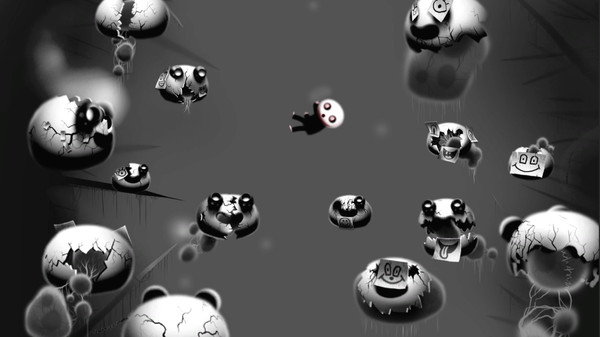 Happy Game in play — the sixth image listed on the Steam store page — Steam store screenshot
Where are you with this game?
Press one and the game goes on your shelf. You can see it on your account page.
Reactions (no login)
Anonymous • one of each per visitor per day
Read next

Related reviews
CHUCHEL
A comedy adventure from Amanita Design in which a hairy little creature chases a single cherry through thirty short stages, helped and hindered by his rival Kekel. There is exactly one verb — click — and behind almost every press waits a hand-drawn gag.
Genesis Noir
A hand-drawn black-and-white point-and-click adventure in which you play No Man, a watch peddler diving through the history of the universe to save his love from the Big Bang — a gunshot fired by a jealous god. Feral Cat Den built it out of tactile puzzles: turn a dial, touch a thing, see what happens.
The Last Campfire
A 3D puzzle adventure in which Ember, a small lost flame, walks an underground world and works through the small contraptions blocking the stranded souls it finds there. A storybook-shaped project from Hello Games, the studio behind No Man's Sky.


