REVIEW · 2020-07-22
Creaks
Reading Amanita's gentle puzzle-platformer, where light turns monsters into furniture
First Impressions
Line up the helpful positive reviews and the first words are about art and sound: beautiful, hand-painted, atmospheric, delightful. Many say the simple act of descending a hand-drawn mansion room by room is worth the price on its own. Then comes the first click: shine light on a lurking monster and it collapses into ordinary furniture.
The qualified positives and the negatives keep returning to: repetitive, too easy, and "just count your steps and switch off the lamp." "Too many dog puzzles early," "not the old point-and-click Amanita," and "the story doesn't stick" are the standing complaints. English reviews sit at Overwhelmingly Positive, 96% of 1,975 (around 5,100 across all languages, roughly 90% positive, as of 2026-07-24). The score is high, but the opinions quietly fork.
What interests me is how often praise and complaint point at the exact same thing. One reviewer's "clean" is another's "thin." My job isn't to stage that as a fight but to translate where the verdicts split into design terms — and to read who this is, and isn't, for.
 Creaks — Steam store screenshot
The World
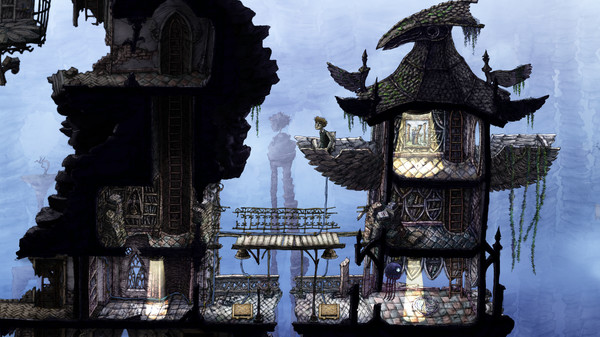
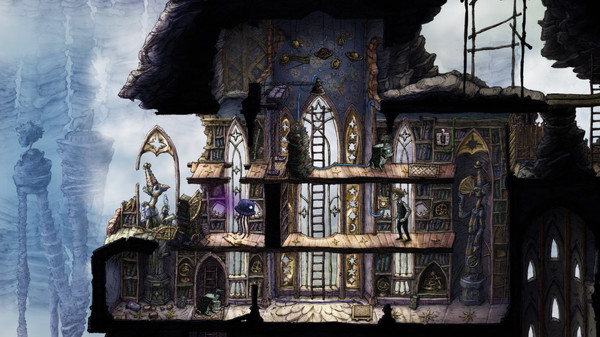
On atmosphere the review vocabulary is remarkably uniform: dark but beautiful, hand-painted, an adaptive score by Hidden Orchestra, and "play it with headphones." The muted mansion connects like one enormous cutaway, and with no text or dialogue the environment itself carries the story — the Amanita signature, as many put it.
In design terms this is a game of observation resolution. As one reviewer notes, in dim light a mere coat rack looks like a monster; light dispels the illusion in an instant. The world isn't backdrop, it's the medium the puzzle is made of. In its wordless telling it stands beside Gorogoa and Machinarium.
Reviewers repeatedly note the mansion is one continuous, organically linked space. The rooms, woven up and down by ladders and cracks, look tangled at first and settle into "a single house" as you go. Reading the space better is the progression itself.
 Creaks — Steam store screenshot
Putting the Mechanics into Words
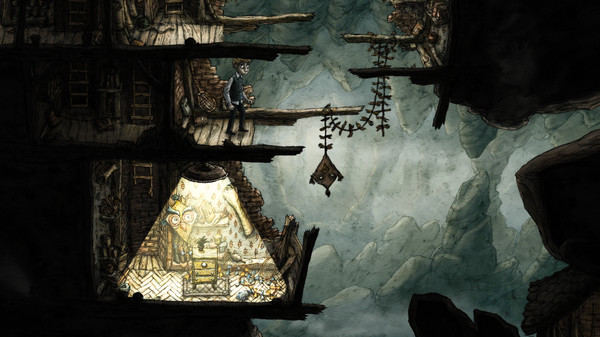
When reviewers explain the mechanics, nearly all land on the same sentence: shine light and the monster becomes furniture. Hit a mechanical dog with light and it freezes into a nightstand; push that nightstand into a step and climb. No combat, no inventory, no dialogue. There is timing, but what's asked of you is thought, not reflex.
This is what Puzzlebyrinth calls subtraction of verbs. Your verbs are close to three: walk, toggle light, push. The recurring praise "simple yet challenging" is the natural product of a board pared down that far, and those few verbs converge on one clear grammar: enemy + light = furniture = platform.
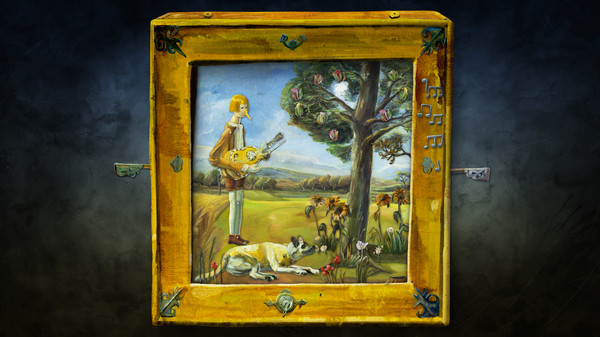
From that grammar the later game grows a combinatorial bloom: not just dogs but drifting jellyfish-like creatures and flocks of birds, the same light rule drawing out different reactions. Hidden interactive paintings add a second layer, some as minigames tied to achievements. The skeleton is thin; the floor is not shallow.
 Creaks — Steam store screenshot
The Texture of Difficulty
On difficulty the reviews split cleanly. One camp writes "average, flat, no Celeste-grade precision"; the other writes "it gets genuinely hard later — I missed my train stop more than once." Neither is lying. Gather the places people stall and the texture of difficulty sorts into three kinds.
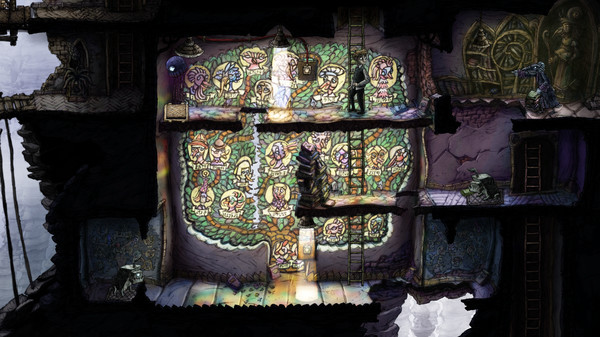
First, the early "dog" rooms — the prime suspect behind "repetitive," essentially managing steps and lamp toggles. Second, the mid-to-late rooms that combine creature types, where most of the "clever" praise collects. Third, the painting minigames, the one exception that demands reflex and vexes achievement hunters. "Too easy" points at the first; "clever" at the second.
So the early repetition is a teaching curve by design. With no text, Creaks lines up similar problems to drill the same rule into your hands. Reading that as a patient tutorial or as padding is exactly where verdicts fork — a matter of design range, not of better or worse.
 Creaks — Steam store screenshot
Place in the Lineage
Reviewers measure Creaks on two axes. One is Amanita's own line — Machinarium, Samorost, Botanicula. The other runs sideways to Limbo, Flashback, Oddworld. Those using the first ruler feel thrown — "I expected point-and-click"; those using the second welcome it as "a gentle Limbo without the death-by-precision."
As design, it's a change of verbs: from the point-and-click grammar of hunting and combining inventory to the environmental grammar of manipulating space. Amanita set down its familiar vocabulary and relearned a new one. Press was broadly warm — Metacritic 82, a Polygon Recommends — yet press and users agree the story is thinner than the studio's best. That agreement is the rare point where both sides meet.
Its place, then, is interesting less as a peer of masterpieces than as the record of a masterful studio testing a new grammar. Pared verbs, a single rule called light, a wordless world. It never sells itself on sharp difficulty, but it never breaks the beauty of its rule either — and that consistency is what holds up the 90-plus percent.
 Creaks — Steam store screenshot
Sources
This piece was written by reading the user reviews on the Steam store page as of 2026-07-24. No review text is quoted directly; typical claims are reconstructed.
- Steam: Creaks (English reviews Overwhelmingly Positive, 96% of 1,975; about 5,100 across all languages, roughly 90% positive)
- Read via WebFetch: the top ~10 helpful positive reviews, representative negative complaints, and several recent reviews
- Press: Metacritic 82, Polygon (Recommends), Wccftech (9.5/10), Adventure Gamers (4.5/5)
Closing
Creaks is a game whose verdicts quietly split, yet split with surprising coherence. For those who love a hand-drawn world and a grammar of light it is near-perfect; for those who want dense difficulty or a heavy story it will feel thin. Both reactions flow from a single design choice — gentle, wordless, verbs pared to the bone — and the review pool traces that choice cleanly.
Steam's English reviews sit very high at 96%, but on design grounds I give it an 8.0. The early repetition and the slight story are real weaknesses, and I've discounted for them. Even so, the consistency of never breaking its one rule called light, and the finish of that hand-painted mansion, fully earn the 90-plus percent. Creaks chose the lasting beauty of a rule over spectacle.
 Creaks — Steam store screenshot
Where are you with this game?
Press one and the game goes on your shelf. You can see it on your account page.
Reactions (no login)
Anonymous • one of each per visitor per day
Read next
Related reviews
Happy Game
A point-and-click adventure that walks a sleeping boy through three chapters of nightmare. You pull, turn and pick at the screen to open the way forward, and what waits there is smiley faces, pink bunnies and rooms the colour of blood. Amanita Design's first turn toward horror, scored by the Czech band DVA.
CHUCHEL
A comedy adventure from Amanita Design in which a hairy little creature chases a single cherry through thirty short stages, helped and hindered by his rival Kekel. There is exactly one verb — click — and behind almost every press waits a hand-drawn gag.
Samorost 3
A point-and-click adventure across nine tiny worlds with no dialogue and no text, where a hooded figure carries a found brass flute and opens the way by playing notes at rocks, creatures and machines. From Amanita Design, the studio behind Machinarium.


