REVIEW · 2016-03-24
Samorost 3
Reading the gap between adoration and 'guess-and-test' in a wordless cosmos
Introduction
Blow the brass flute you find, and the rock or creature in front of you answers with a note. A small figure in a white hood travels nine tiny worlds that contain no dialogue and no text at all. Released in March 2016, Samorost 3 is a wordless point-and-click adventure by Amanita Design, the Czech studio behind Machinarium.
I write this from the Steam review pool. The label is 'Very Positive': 4,334 reviews counted across all languages, with the filter breakdown reading 5,183 positive against 369 negative — roughly 93%. Narrow it to English and it is 94% of 1,592; the last 30 days sit at 87% of 40 (snapshot 2026-08-03). On the numbers alone there seems to be nothing to argue about.
Read the bodies of those reviews, though, and the picture changes. Almost all of the praise points at the art and the sound, and the reviews that talk about puzzles get vague — even the positive ones. That 93% is not 93% for the puzzles. What is being endorsed, and what is being quietly let go, is what I want to put into design terms here.
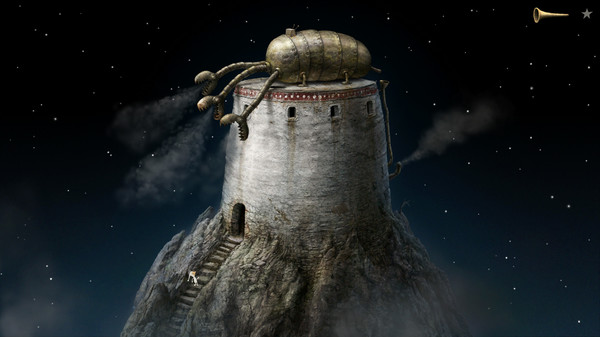 A white tower on a rocky peak, with a small figure climbing the stairs below — Steam store screenshot
First Impressions
Line up the most helpful positive reviews and the vocabulary rhymes: beautiful, gorgeous, magical, peaceful, 'I want to live here.' One older reviewer describes playing it with his grandchildren like a bedtime story, noting that because nobody speaks, the kids start narrating the scenes themselves. That sentence captures how the game is received better than any score.
The negative side keeps returning to guess-and-test, trial and error, and 'I clicked around until something happened.' One reviewer compares himself to a chimpanzee pressing buttons for a banana; another writes that he loves everything about the game except playing it. The complaints never touch the art or the sound — they land on one thing, how the puzzles solve.
What interests me is that both camps are pointing at the same decision. The refusal to put any text or tutorial on screen is 'room for imagination' to one side and 'no cues at all' to the other. My job isn't to pick a winner but to translate why the split happens exactly there.
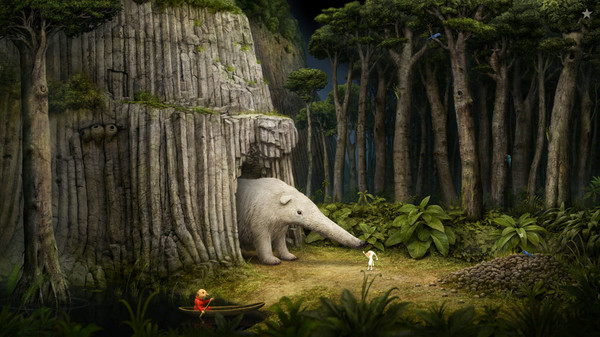 A giant white anteater in the forest, its snout reaching toward a tiny figure — Steam store screenshot
The World
The centre of gravity in the positive reviews is, almost without exception, the art and the sound. Photographic rock and moss share a frame with creatures that could not exist; one reviewer called it 'photorealistically unrealistic.' A green hill under a star field, a cave riddled with lava, a nest adrift in space — each of the nine worlds is drawn as its own picture.
The other pillar is sound. Characters speak in meaningless voices and the game holds no text whatsoever. Point the flute at a marked object and a melody comes back, often summoning a sketchy spirit that mimes a hint. Floex, credited with the Machinarium soundtrack, is credited here too, which is why so many reviewers describe the music as a language rather than an atmosphere.
In Puzzlebyrinth terms, the game raises the observational resolution of the world to a maximum and drops the resolution of its interface to zero. No meters, no dialogue box, no map. The same studio stripped text out of Creaks as well, but that game still stated a rule — light and gravity. Here there is no stated rule, only the world. That difference is what shows up later as difficulty.
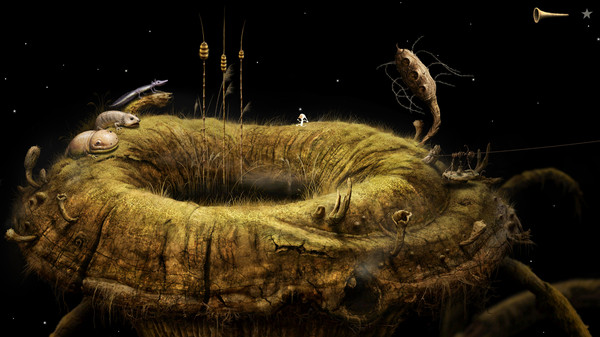 A ring-shaped nest adrift in a star field, with a small figure and animals on top — Steam store screenshot
Putting the Mechanics into Words
So how many verbs are there? From the review pool, effectively two: click (and drag), and play the flute. The flute is the only thing you carry between scenes; anything you pick up is spent where you found it. As subtraction of verbs goes, it is about as far as the idea can be taken.
The question is what was put in the space that subtraction opened. With one verb, the candidate solutions stop being 'how do I act' and become 'where do I press.' The combinatorial explosion happens over screen coordinates rather than over logical branches. When the negative reviews say they brute-forced it, that is the structure they are describing: a finite set of hotspots and no penalty for failure make clicking everything the shortest path.
The press lands in the same place. GameSpot scored it 7/10 under the headline 'One-note,' observing that since you never accumulate tools, the last chapter asks for the same kind of act as the first. As design that reads to me as a choice rather than laziness: the learning curve never climbs, so every world can be entered in the same mood as day one. The 'relaxing' that positive reviewers keep repeating is the other face of that choice.
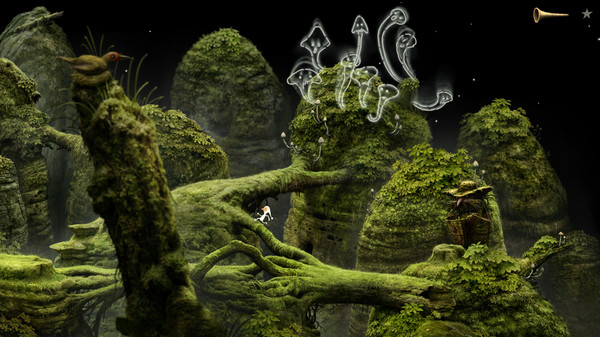 A mossy forest with white line drawings floating across the top of the screen — Steam store screenshot
The Texture of Difficulty
Difficulty here is a question of kind, not amount. Sort the pool and the ways people get stuck fall into three: you can't see what is clickable — one review names it precisely, that the hand cursor doesn't distinguish 'touchable' from 'movable'; you have to repeat an action several times with no cue that repetition is wanted; and you have to walk back to an earlier scene with nothing telling you to.
The first is the heaviest. A photo-collage image does not make its hotspots stand out. As a design that turns observation itself into play that is ideal, but for anyone whose observational resolution falls short, the screen becomes a flat wall. The same picture is information to one player and wallpaper to another. That, I think, is where the split really happens.
The hint book is the relief valve, and reviewers disagree about it too. Some are grateful that being stuck never lasts; others note that it shows the whole solution, so opening it deletes any chance of solving the thing yourself. Several call it all-or-nothing. Graduated hints would have produced a different outcome, as I argued in the piece on hint systems. There are three kinds of stuck here, and only one kind of rescue.
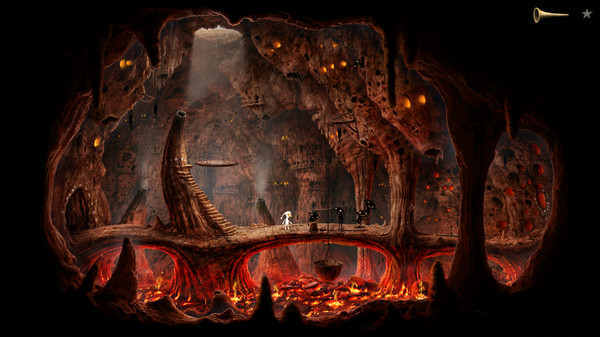 A cross-section of a cave with lava below, pocked with openings, and a small figure on a bridge — Steam store screenshot
Sources
This piece was written by reading the user reviews on the Steam store page as of 2026-08-03. No review text is quoted directly; typical claims are reconstructed.
- Steam: Samorost 3 (Very Positive; 4,334 reviews across all languages, 5,183 positive against 369 negative, 94% of 1,592 English reviews)
- Read: the top 10 helpful positive reviews, the top 10 helpful negative reviews, and the 5 most recent English reviews
- Press: GameSpot review (7/10); Metacritic 80
Closing
Steam reads about 93% positive, Metacritic 80, GameSpot 7/10 under the headline 'One-note.' My design-critique score is 7.5 — a little below the users' warmth, a little above the press.
The marks come off for subtracting the verbs down to one and then not building a grammar on top of it. They go back on because what was placed in that empty space is the world itself. Reviewers report finishing in roughly four to eight hours, with a median near five, and giving each of nine worlds its own picture and its own music at that length is plainly impressive.
What is left after reading the pool is that the 93% is not an endorsement of good puzzles but of wanting to stay in the place. Anyone after logic with real resistance is outside the game's reach — not a flaw, but a line the authors drew from the start. Ten years on, recent reviews still open with childhood memories, which suggests the line was drawn about right.
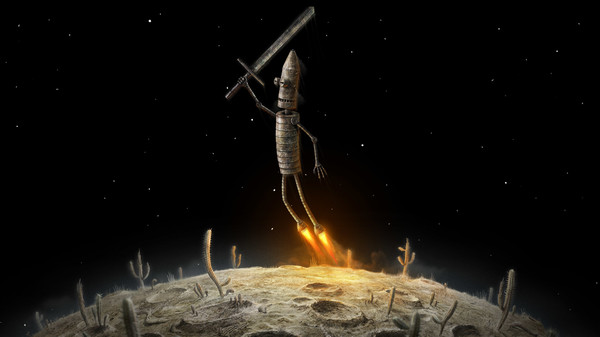 A handmade rocket lifting off a small white body, trailing flame — Steam store screenshot
Where are you with this game?
Press one and the game goes on your shelf. You can see it on your account page.
Reactions (no login)
Anonymous • one of each per visitor per day
Read next

Related reviews
CHUCHEL
A comedy adventure from Amanita Design in which a hairy little creature chases a single cherry through thirty short stages, helped and hindered by his rival Kekel. There is exactly one verb — click — and behind almost every press waits a hand-drawn gag.
Happy Game
A point-and-click adventure that walks a sleeping boy through three chapters of nightmare. You pull, turn and pick at the screen to open the way forward, and what waits there is smiley faces, pink bunnies and rooms the colour of blood. Amanita Design's first turn toward horror, scored by the Czech band DVA.
Machinarium
In a town built of scrap, a small robot rescues his lover. A hand-drawn, dialogue-free adventure.


