REVIEW · 2021-10-07
The Last Campfire
A dying ember relights other dying embers
First Impressions
Across all languages the Steam page holds 20,547 reviews, 20,032 of them positive — 97%, labelled Overwhelmingly Positive (2026-09-16 snapshot). Restricted to English it is 6,506 of 6,717, which rounds to the same 97%.
Sort the negative side by helpfulness, though, and the top ten reviews say one thing: the puzzles are too easy. "Three or four interesting puzzles out of thirty." "Bland fillers." "Not a real puzzle game."
The positive side is pointing at the same property. Their words are "chill", "relaxing", "a sit back and relax puzzle game". One trait, read once as thinness and once as comfort. That is what I want to follow here.
The World
The setting is underground. You move Ember, a small flame, down a single path through forests, marshes and caves. The art is storybook-shaped: round outlines, few colours, soft shadows, a narrator over all of it.
The vocabulary on the positive side is remarkably uniform — beautiful, peaceful, a touch of melancholy. Unlike the hand-drawn density of Gorogoa, this is legibility built by subtraction. What is interactive and what is scenery separates at a glance.
Read as design, the game lowers its own observation resolution on purpose. Most contraption games generate difficulty by hiding where the information is. This one tells you up front. The scenery is there to be looked at, not searched.
The Feel of the Story
Along the path sit Forlorn — souls who have given up and stopped moving. Each gets a short vignette and one contraption. Solve it and they stand up. The game repeats this shape to the end.
Positive reviews get personal about it: "the hug I needed", "sobbing like a child", "my own flame was getting a bit dim". Structurally, the short repeated vignette is doing the work — no single episode is long enough to lose you.
The negative side keeps returning to the narrator: "emotionless", "talks at me like I'm five", "incessant yapping". Japanese reviewers add that the localisation reads too literally to carry the story.
This is the same stumble I described in In Other Waters. The narrator arrives at the meaning before you reach for it. Take away the delay and what is left is confirmation, not discovery.
The Texture of Difficulty
The review pool uses the word "difficulty" for three different things, and they are worth separating.
First, the resistance of the contraptions themselves. Everyone agrees it is low — "extremely easy" on one side, "easy to medium", "about right" on the other. The reading splits; the observation does not.
Second, the cost of travel. Japanese reviewers put it best: there are no warp points, the dash is slow, and backtracking means walking a very long way. What stalls you is your feet, not your head.
Third, the pace of the narration — "drags", "put me to sleep". That is tempo, not load. Collapsing all three into one score is what makes the reception look split down the middle. Measuring this against a game like A Monster's Expedition, which builds difficulty out of search space, gets you nowhere.
Design Craft
The game lets you skip a contraption you are stuck on and move ahead unsolved. One Japanese reviewer lists this as a virtue. The centre of gravity is visible right there.
Drawn out, it looks like this. The story is one solid line; the contraptions are nodes on it; each node has a dashed bypass. The puzzles are not the road — they are stops beside it.
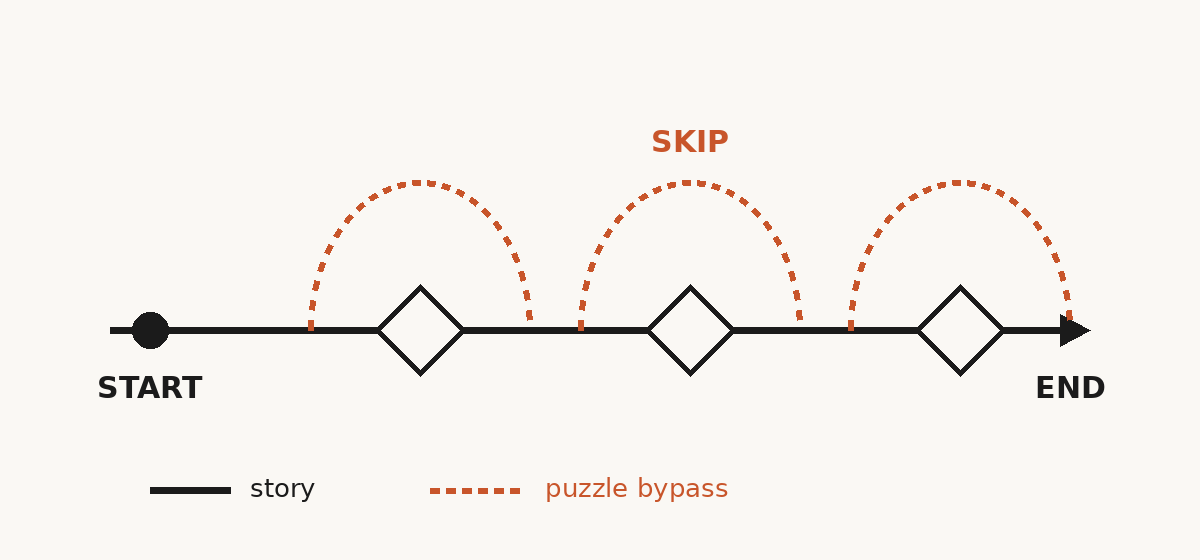 The story runs as one solid line; each puzzle node has a dashed bypass. The puzzles sit beside the spine, not on it (diagram)
What that shape declares is the reach of the design, stated up front. In a game like Stephen's Sausage Roll, where the puzzles are the road, a skip button would be self-refuting. Here the weight was always on the story side.
So the complaint that this is not a puzzle game is factually right and still not an indictment. In hint-system terms, showing the bypass in advance is itself a signal: this is not a place you are meant to get stuck.
Reviews Consulted
This article was written from the Steam user reviews as of 2026-09-16. No review text is quoted directly; recurring claims are reconstructed.
・Steam: The Last Campfire (20,032 of 20,547 reviews positive across all languages = 97%, Overwhelmingly Positive; 6,506 of 6,717 in English)
・Read: top 10 helpful positive, top 10 helpful negative, 6 recent, and 4 Japanese-language reviews
・Completion time estimated from the playtime spread of those reviewers, roughly 5 to 13 hours
・On images: this run could not reach Steam's image hosts, so I could not view the official screenshots. I do not write captions for images I have not seen, so no Steam imagery is included. The one figure here is my own, drawn to show the progression structure.
Closing
Steam sits at 97% positive; I give it 7.5. Lower than the aggregate, but not as a rebuke. The job this game takes on is narrow, and within that narrow range it is good.
All six recent reviews are positive, and the recurring words are "short and sweet" and "bought it on sale". A discount brought in players who read the brevity as a feature. The same property, revalued by price — common, rarely recorded.
It suits someone who wants to finish a quiet story rather than be made to think hard. Anyone shopping for resistance is being waved toward the bypass from the first contraption.
One ember stands in front of someone who has sat down, passes on a flame, and leaves. Then it happens again. The repetition is the subject — and once that lands, the easiness stops looking like an absence and starts looking like the width of a path chosen on purpose.
Where are you with this game?
Press one and the game goes on your shelf. You can see it on your account page.
Reactions (no login)
Anonymous • one of each per visitor per day
Read next

Related reviews
TOEM
A hand-drawn monochrome observation-puzzle adventure in which a child leaves home with their grandmother's camera, photographs whatever the villagers and townspeople ask for, shows them the shot, and uses the stamps earned to move on to the next region — rotating the view to hunt for subjects, from Something We Made.
Happy Game
A point-and-click adventure that walks a sleeping boy through three chapters of nightmare. You pull, turn and pick at the screen to open the way forward, and what waits there is smiley faces, pink bunnies and rooms the colour of blood. Amanita Design's first turn toward horror, scored by the Czech band DVA.
Röki
A point-and-click adventure through a snowbound forest drawn from Nordic folklore, following Tove as she gathers and combines objects to search for her sister. Polygon Treehouse's game has no combat and no fail state, carried instead by hand-drawn landscapes and a story about loss.


