REVIEW · 2021-09-17
TOEM
Reading the inside of a 99% Steam score on a monochrome photo adventure
Opening
A child inherits an old camera from their grandmother, leaves home, and heads north toward a mountain. In the villages and towns along the way, residents ask for things; you photograph what they describe and show them the shot. The stamps you earn that way serve as the pass into the next region, and at the end you go to photograph the phenomenon called TOEM. Hand-drawn black and white, 2D characters standing in 3D space, seen from above. Released 17 September 2021, made by the Swedish studio Something We Made and published by that studio together with popagenda.
I wrote this by reading the Steam review pool rather than by reporting a playthrough of my own. In the 2026-08-09 snapshot, 11,657 reviews across all languages split 11,555 positive to 102 negative. The 9,239 from Steam purchasers read Overwhelmingly Positive; the English score is 99% of 3,177, and the last 30 days sit at 98% of 408. On the press side, Metacritic reads 79 and OpenCritic aggregates 41 outlets at 80 with a 90% recommend rate.
Ninety-nine percent looks like unanimity. Read further, though, and you notice the positive reviews adding the same reservations over and over: short, easy, the requests are hard to parse, the controls are stiff. The vocabulary overlaps almost exactly with the complaints listed on the negative side. The disagreement here is not about good versus bad; it is about which column the same observation belongs in. The problem I took up in Observation as Play is folded into the inside of this number.
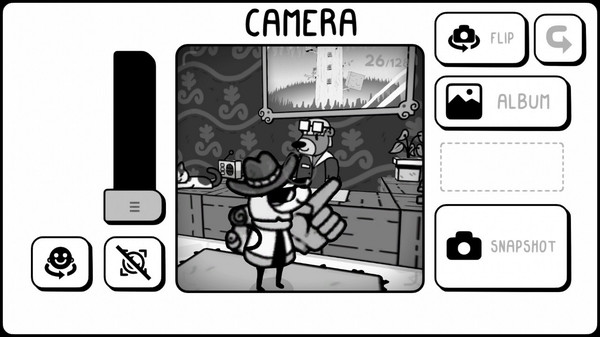 The camera viewfinder: CAMERA across the top, a 26/126 counter at upper right, FLIP and ALBUM buttons down the right side, and inside the frame an indoor scene with a figure in sunglasses holding a camera — Steam store screenshot
First Impressions
Line up the most helpful positive reviews and the vocabulary rhymes to an uncanny degree: cozy, chill, wholesome, charming, relaxing. One English reviewer reached for a chain of comparisons to explain the game's smallness — a snow-topped cabin, a sleeping cat, a plate of neatly cut cheese — arguing that this is not smallness as deficiency but smallness as completeness. The other stock phrase is 'finished in one sitting', written not as a complaint about length but as praise for a shape you can take in whole.
The negative vocabulary is just as consistent: surface level, tiresome, rinse and repeat, trivial, boring. The most quotable formulation is that the game is neither challenging enough to be rewarding nor calm enough to be genuinely restful. Four other complaints recur: the requests are deliberately roundabout, the world is too empty to sustain the urge to photograph, the PC controls are stiff, and twenty dollars is too much for what is here.
Both camps are pointing at the same place. The game deliberately keeps its amplitude low — no failure, no timer, and only a small swell when you close in on an answer. The positive side calls that low amplitude restful; the negative side calls it slack. The rest of this piece translates that fork into design terms.
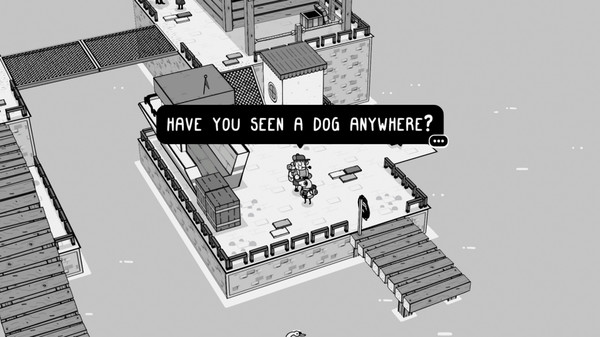 A top-down harbour with wooden piers and steps; above a small figure a speech bubble reads 'HAVE YOU SEEN A DOG ANYWHERE?' — Steam store screenshot
Putting the Mechanics into Words
There are really only two verbs: look and show. Walking, rotating the view, raising the viewfinder, pressing the shutter — the procedures divide, but each is a sub-item of looking. The praise positive reviewers keep repeating, that a single camera changes how you see the world, is in Puzzlebyrinth's terms the effect of pushing verb subtraction about as far as it will go. With so few verbs, all of the player's attention lands on the object instead.
What matters is that validation is not automatic. Several reviewers name the same point: the game does not grade your photograph for you. You choose which shot from the album to hand over. So the thing to be solved has two stages. The first is a translation from language into object — clients name their target in riddles, asking for 'bugs with little lamps' or 'little soldiers'. The second is where to put that object in the frame. Even among games that call themselves photography games, making observational resolution itself the thing you manipulate is unusual.
On top of that, tools arrive as passes rather than as verbs. Within the range reviewers list: a horn to scare off gulls, a water gun to pop balloons, gear for going underwater, boots for snowy slopes, a grabber for ropes. None of them adds a new way to solve; each grants the right to approach a new subject. The verb count stays flat while the pool of subjects grows. That distribution is how the game widens its surface area without triggering combinatorial explosion.
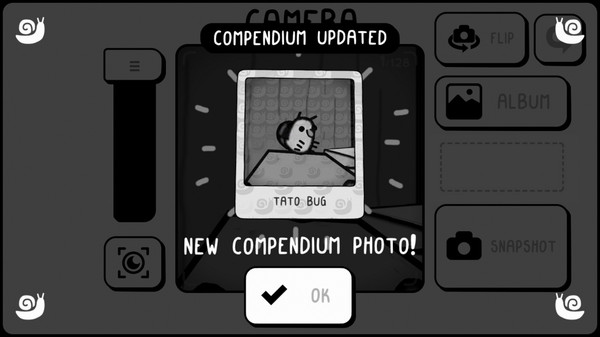 A popup layered over the camera screen reading 'COMPENDIUM UPDATED' and 'NEW COMPENDIUM PHOTO!', with the captured shot labelled TATO BUG — Steam store screenshot
The World
Black and white is the single most divisive element in the pool. The positive side writes that nothing is lost despite the limited palette, and that every screen is dense with drawn detail. The negative side writes that colour would have made it far prettier, that walking a monochrome forest or beach is not pleasant to look at, and in one case that the resolution is oddly low for a game built around a camera. What is interesting is that the negative reviewers make an exception for the city district, naming it as the place where the monochrome actually works.
Read as design, black and white is a form of subtraction. Remove colour and the only cues for telling objects apart are line and silhouette. Against a task that consists of finding the subject a client's riddle refers to, that is a decision to close off a shortcut. At the same time, that subtraction also removes the reward of simply enjoying the view. Dense man-made districts carry a lot of silhouette information; natural areas carry much less. That, I think, is why the two camps agree about the city and split over the forests and beaches.
There is a second structural choice: 2D characters standing in 3D space. Positive reviewers value it because subjects photograph well from any angle. A recent review, though, complains that because your own character is a flat billboard, you lose track of which way you are facing. A game about rotating the view to find hidden things and a rendering trick that always faces you are colliding in a narrow space.
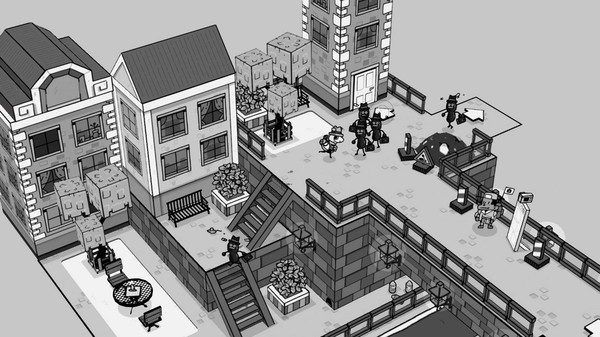 A top-down town square with multi-storey buildings, staircases, benches and planters, with figures scattered around — Steam store screenshot
Pacing and Length
The playtimes in the pool line up closely. Most reports land at three to four hours for the main path, five to six for a thorough run, and six to nine even with achievements. Nobody disputes the numbers. What was disputed is what those numbers are worth. The highest-voted negative review from launch argues, in effect, that the content is fine but not twenty dollars, and declines to recommend on price alone. Time has diluted that argument: recent positive reviews now say you cannot go wrong picking it up on sale, and as of August 2026 it carries a record 90% discount at $1.99. The material has not changed, but a different price tag removes one axis of the argument entirely.
What carries the length is the per-region stamp card. The number of stamps needed to move on is lower than the number of requests the region offers, which means the right to abandon an unsolved request is handed to you from the start. As subtraction goes it is clean, and it is the standard provision for keeping a stuck player from suffering.
Where that provision stops working is the completionist path. One positive review describes noticing the collectibles and achievements, playing on out of obligation, and continuing long after the enjoyment had gone — closing with the advice not to attempt full completion without a walkthrough. There is a structural gap here: the game names its targets in riddles but offers no tiered hint layer. With no mechanism for handing a stuck player the next step, what remains is brute force or an outside guide. Compared with short works like A Little to the Left or Unpacking, where you decide your own ending, this one lets the achievement list draw that line for you.
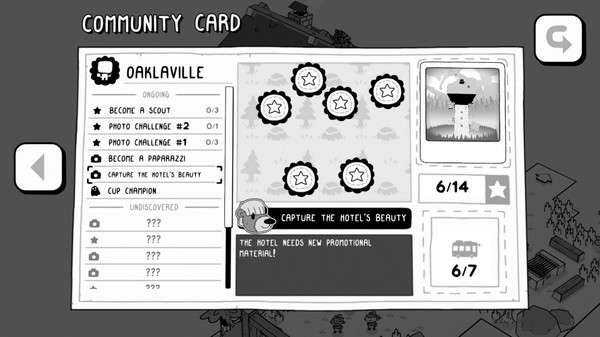 The COMMUNITY CARD for OAKLAVILLE, listing requests such as BECOME A SCOUT 0/3, PHOTO CHALLENGE #1 and #2, and CAPTURE THE HOTEL'S BEAUTY, with a 6/14 stamp sheet on the right — Steam store screenshot
Sources
This piece was written by reading the Steam user reviews as of 2026-08-09. Nothing is quoted directly; recurring claims are reconstructed.
- Steam: TOEM: A Photo Adventure (Overwhelmingly Positive; 11,657 reviews across all languages, 11,555 positive to 102 negative; 99% of 3,177 English reviews; 98% of 408 in the last 30 days)
- Read: roughly the top 10 all-time helpful positive reviews, the top 10 negative, and about 10 of the most recent, including three long-form reviews
- Press: OpenCritic (80 across 41 outlets, 90% recommend), the Metacritic aggregate of 79, IGN 8/10, Eurogamer's Essential, and the Rock, Paper, Shotgun review
Closing
Steam reads 99% positive; my score as design criticism is 7.5. Most of the gap points at exactly the reservations the positive reviews were already adding for themselves. First, a game that names its targets in riddles offers no tiered hint layer. Second, the PC bindings cannot be changed, and even opening and closing the camera is not a toggle — friction at the fingertips is a shame in a work sold on comfort. On the other side, cutting down to two verbs, distributing tools as passes rather than as new solving methods, and setting the stamp requirement below the number of available requests make for a genuinely strong model of short-form puzzle design.
The median completion time the reviews describe is around five hours, and even the achievement run stops short of nine. It suits people for whom raising the resolution of their own looking is itself the reward. People who want a climbing curve of difficulty, people who want colour in the scenery, and people who want to fill every entry without a guide are probably outside its range. What the 99% shows is not unanimity but the accuracy with which reviewers have identified who this game is for. Place it as the calmest possible blend of the searching pleasure of Hidden Folks and the view-rotating pleasure of FEZ.
 A top-down outdoor scene: a wooden cabin ringed by pines, fences and rocks, with small figures walking the paths — Steam store screenshot
Where are you with this game?
Press one and the game goes on your shelf. You can see it on your account page.
Reactions (no login)
Anonymous • one of each per visitor per day
Read next

Related reviews
The Last Campfire
A 3D puzzle adventure in which Ember, a small lost flame, walks an underground world and works through the small contraptions blocking the stranded souls it finds there. A storybook-shaped project from Hello Games, the studio behind No Man's Sky.
Machinika: Museum
A first-person puzzle box in which you scan alien devices of unknown origin delivered to a museum, peer inside them and reprint their missing parts until they run again. A short piece from Littlefield Studio that opens seven machines one at a time, with the touch of science-fiction archaeology.
The Room 4: Old Sins
A first-person contraption puzzler set inside an old dollhouse found in an attic: open the mechanism in one room, then carry what you find to the room that is missing a piece. The fourth entry in Fireproof Games' The Room series, rebuilt for PC.


