REVIEW · 2017-02-15
Hidden Folks
A hand-drawn hidden-object world voiced by human mouths
First Impressions
The first thing that strikes me in the Steam review pool is how uniform the positive vocabulary is: relaxing, cozy, charming, and "Where's Waldo, but alive." Most reviewers say it lets them unwind, and almost every one mentions that the sound effects are made with human mouths.
The numbers: 96% of 3,172 English reviews are positive; across all languages 7,557 Steam purchasers land on "Overwhelmingly Positive," with 317 negative reviews overall (2026-07-06 snapshot). It looks unanimous. Yet those 317, and the caveats tucked into positive reviews, cluster in a narrow band: short, a touch pricey, and "I just can't find that one thing."
A 96% score doesn't mean there's nothing to argue about. It means nearly everyone sees the same strength and the same weakness. What interests me is which design choice produces that agreement.
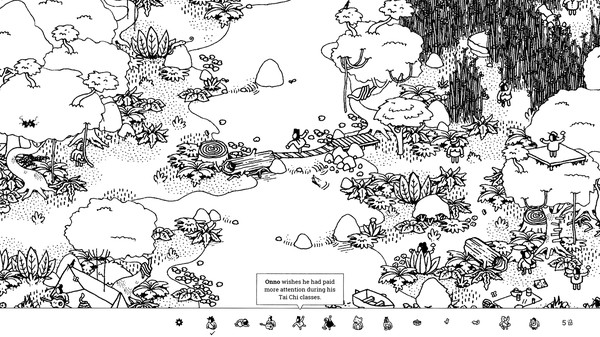 Poking a hand-drawn miniature landscape — Steam store
The World
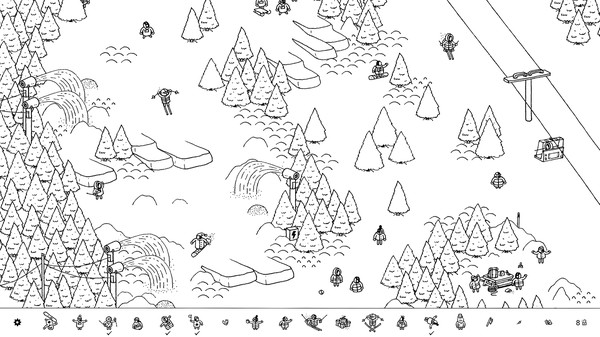
What the positive reviews praise most is the art and sound: hand-drawn monochrome line work, paper-fold animations, and the 2,000-plus mouth-made sound effects. The recurring words are alive, bursting with life, daft. RockPaperShotgun took the same line, calling the deceptively simple drawings full of life (per the store excerpt).
This is subtraction in the Puzzlebyrinth sense: drop color, strip the UI, refuse score and timers. What's left is monochrome density and one promise — touch anything and it reacts. The subtraction isn't there to starve you of information but to raise your observation resolution. With no color to lean on, you have to read shape and motion.
The sound reinforces that looking. Poke a dog and a human voice barks. It's feedback for a correct find, but also a second layer: your ears hunt for which parts of the frame are alive. The world is one of the few things the review pool agrees on without reservation.
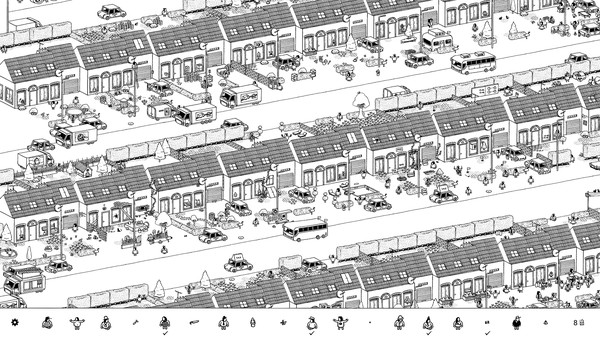 Monochrome density with color removed — Steam store
Putting the Mechanics into Words
The mechanics are startlingly few. The verbs are basically "look" and "touch." A strip of targets at the top shows what to find in the landscape. Positive reviews praise this as simple, intuitive, no fluff.
Verb subtraction again. What's clever is that Hidden Folks gives that single "touch" a grammar: unfurl a tent, cut a bush, slam a door — the same act yields different results per object, and objects chain (spook a bird, it flies off, revealing the person beneath). The learning curve is drawn gently, one new interaction per area.
But this never triggers combinatorial explosion. Unlike a sokoban or a programming puzzle, where a few rules breed exponential trouble, the difficulty here comes only from scene density — how deeply a target is buried. It's an observation task more than a mechanical one, closer to the tidying of A Little to the Left or the seeing-shift of The Witness.
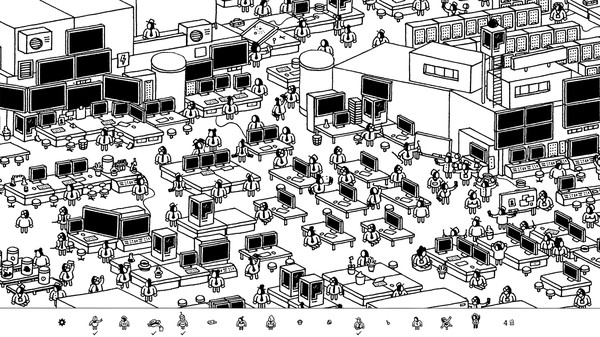 Finding targets from the strip in the scene — Steam store
The Texture of Difficulty
Opinions on difficulty split cleanly. The majority call it relaxing; a minority write frustrating about specific targets. Guide threads pile up (a "hints only" guide, a "where is that lizard" thread), and the forums keep a cry or two like "Beach area 4, can't find the crab."
It's a question of the kind of difficulty. Getting stuck isn't about logic but observation resolution, and when a target dissolves fully into the background, the single short text hint is the only lifeline — that's where the friction lives. The store copy says "take a break if you're stuck," but there's a gap between that gentle tone and that lone clue. That gap is the seam where positive and negative readings part.
Tellingly, the sequel Hidden Folks 2 (announced June 2026 at Wholesome Direct, slated for early 2027) lists a "second, non-text clue" as a headline feature. The makers have all but conceded the original's hinting was a friction point. The minority's complaint wasn't imagined; it was the honest voice of players just outside the design's reach.
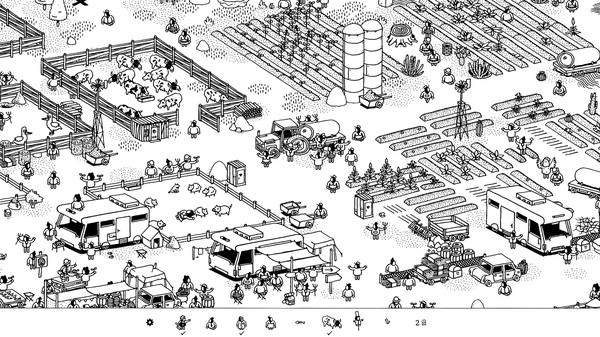 Friction appears when a target melts into the scene — Steam store
Sources
This piece was written by reading the user reviews on the Steam store page as of 2026-07-06. No review text is quoted directly; typical claims are reconstructed.
- Steam: Hidden Folks (Overwhelmingly Positive; 96% of 3,172 English reviews, 7,557 all-language Steam purchasers, 317 negative reviews overall)
- Read via WebFetch: helpful positive and negative reviews, several recent ones, and the community hub's discussions, guides, and developer posts (including the Hidden Folks 2 announcement)
- Reference: RockPaperShotgun preview, plus SteamDB's aggregate (~94% across all reviews)
Closing
In sum, Hidden Folks is that rare thing: near-unanimously loved, yet everyone sees the same weakness. Its strengths (a subtracted observation experience, living art, mouth-made sound) and its weaknesses (short, a single hint, price) are two faces of one design choice. It suits those who enjoy the act of quiet looking; it doesn't suit those who want a thick lifeline when stuck. That's reach, not merit.
Steam's overall is 96% (about 94% in SteamDB's all-review aggregate). From a design standpoint I give it 8.0 — the subtraction that raises observation resolution is lovely, but I docked a little for the thin escape route when stuck and the short length. Reviews and HowLongToBeat put a playthrough around 4-5 hours, and as reviewers keep saying, it shines on sale more than at its $14.99 list price. As a short, quiet observation piece, I'd set it beside Unpacking.
 A short, quiet observation piece — Steam store
Where are you with this game?
Press one and the game goes on your shelf. You can see it on your account page.
Reactions (no login)
Anonymous • one of each per visitor per day
Read next

Related reviews
Gorogoa
A hand-drawn 2×2 grid of paintings. Rearrange, zoom, connect — a picture-book puzzle.
RiME
A boy wakes on an unfamiliar island after a storm and runs, climbs, swims and shouts at the stonework, guided by a red fox toward the peak of a distant tower — a five-chapter puzzle adventure with no combat, no HUD and no dialogue, released by Tequila Works in 2017.
Syberia 3
A third-person adventure in which the lawyer Kate Walker joins a Youkol migration north, assembling clockwork devices along the way. Microïds' third Syberia, which trades the fixed painted screens of the first two games for a 3D space you walk around in.


