REVIEW · 2017-04-11
The Sexy Brutale
Unpicking a looping day of murders by watching
Introduction
At a masked ball, the guests are murdered one by one by the mansion's staff. Each midnight the day rewinds and the same killings play out identically. You are Boone, a bystander in a bloodstained mask, eavesdropping from the shadows and winding the clock back and forth to read each murder's choreography, then acting before the victim dies. An isometric mystery puzzle from Cavalier Game Studios and Tequila Works (2017).
I write this from the Steam review pool. The label is "Very Positive," 89% of 2,081 English reviews, 2,863 across all languages (snapshot 2026-07-06); Metacritic 83. By the numbers it leans hard to praise. Yet reading the top helpful positive and negative reviews side by side, both keep circling the same single trait — how gently the game guides you — and reading it in opposite ways.
The positive side repeats "Clue meets Groundhog Day," "attention to detail," "worth it for the soundtrack," "a work of art." The negative side repeats "not what the description promised," "plays like a long tutorial," "it never uses its own concept." My job is to translate both into Puzzlebyrinth's design vocabulary — not to judge who is right, but to see what the author chose.
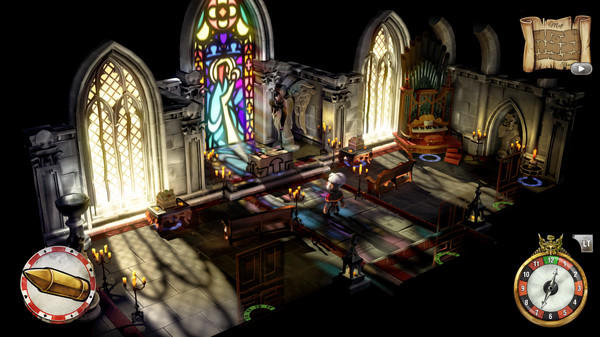 The masked-ball mansion, the stage of The Sexy Brutale — Steam store
First Impressions
The first thing you notice in the pool is how few reviewers talk about this as a puzzle at all. Most positive reviews lead with atmosphere, story and music, and touch the puzzles only with a caveat: "not especially hard, but." One top-helpful review prefaces with "the puzzles aren't very difficult and the replay value isn't high" and still closes by calling it a work of art.
That matters as a first impression. Most puzzles put the click of a solution at the center of the reward. The reward these reviewers describe is closer to the slow sensation of the whole mansion assembling into a single timetable in your head. In Puzzlebyrinth's terms, this is a design that makes rising observation resolution — not the search for a solution — the reward itself.
The negative side trips on exactly that thinness of challenge: "if you came for the mystery or the mechanic, you'll be sorely disappointed." The same guidance reads as "immersive" to one camp and "won't let me think" to the other. The axis of judgment forks in two before the game has really begun.
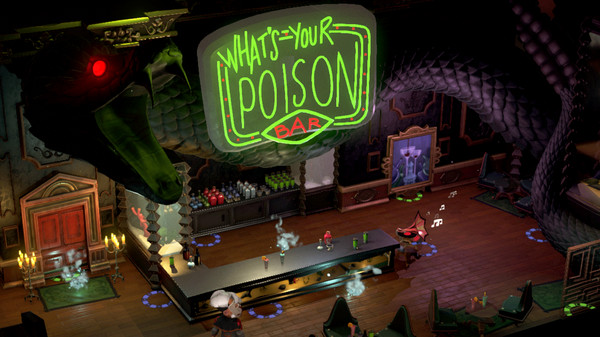 Eavesdropping from the shadows — Steam store
The Feel of the Story
Both camps agree the game is story-driven. The fight is over whether the story is the point, or a curtain over the puzzle that should have been the point. Positive reviewers say it is "short but dense," that they rewound the clock just to stay in the world. The closed mansion and the mask-swapped abilities mesh well with the story's momentum.
The negative side does not deny the story; it grants "fine if you're here for the story, short and neat," then adds "but it's a straight line wearing a mystery's costume." Recent reviews echo a late-game reservation even from fans: "the end drags," "I hated the final twist." The story peaks in the taut middle and slackens at the close.
I read this as a game whose story and design sit on different centers of gravity. Where Outer Wilds makes the loop itself the grammar of exploration, this game uses the loop as a theatre where you watch the same play again. The seats are comfortable; the room to step on stage stays small.
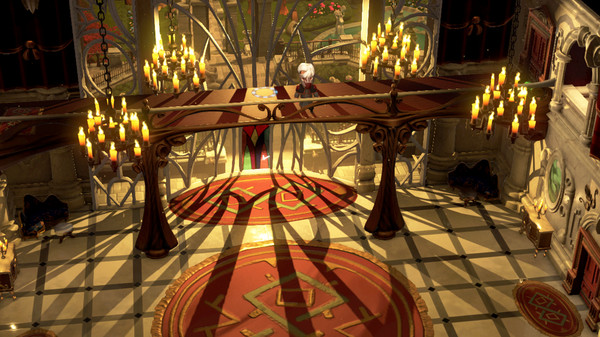 The mansion's guests and its masked staff — Steam store
Putting the Mechanics into Words
Boiled down, the game has two verbs: watch (eavesdrop) and wind the clock. While masked you are unseen and cannot interfere — you peer through doorways or wait for a room to empty. That total untouchability is what the positive side calls a "unique mechanic."
In Puzzlebyrinth's vocabulary this is aggressive subtraction. The pick-up / use / combine verbs of most escape and detective games are stripped away, leaving only observation and time travel. The map records each character's position by hour and lets you rewind it — a rewindable observation log handed to you as a tool. To the positive side, the scarcity of verbs is minimalist beauty.
But the core negative complaint is born from that same subtraction. Against a billboard promising "murders running simultaneously in a loop," each killing is actually quarantined into its own chapter, and earlier knowledge is barely tested later. An idea that should detonate into combinatorial explosion is deliberately folded into one tutorial at a time. "Plays like a long tutorial" is a precise reading of that folding.
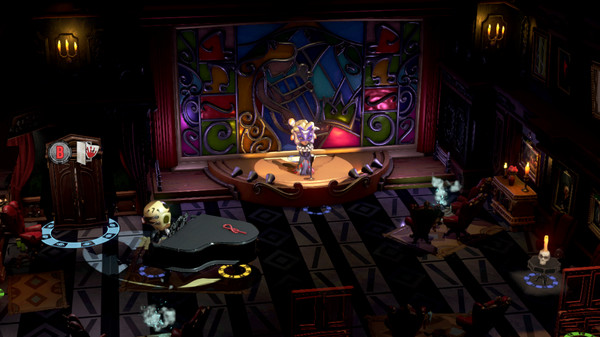 The mansion map, logging people hour by hour — Steam store
The Texture of Difficulty
On difficulty the top helpful reviews split almost evenly: "pleasantly solvable" faces "no room to think," across the same guidance. I read the split as a matter of the kind of difficulty, not the amount. What the game lowers is the difficulty of finding a solution, not the labor of covering everything there is to observe.
Each chapter hands you one new mask (ability) and one task that ability solves cleanly. As a learning curve it is very gentle; almost no one bounces off. The negative side never says "too hard" — the opposite. Their complaint is that the use of an ability is obvious the moment it's given: lock and key left in the same room.
Compare the same "people moving on a timetable" idea built as a systemic puzzle. Overboard! lets the player freely disrupt a board where everyone moves on the clock; this game fixes that board for viewing. The difference in feel equals how much right-to-disrupt the author handed the player.
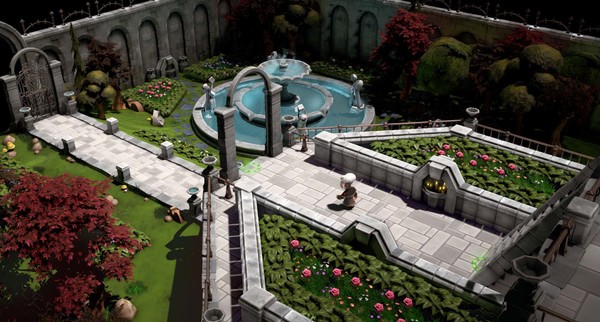 A new ability, granted one mask at a time — Steam store
Sources
This piece was written by reading the user reviews on the Steam store page as of 2026-07-06. No review text is quoted directly; typical claims are reconstructed.
- Steam: The Sexy Brutale (Very Positive, 89% of 2,081 English reviews, 2,863 across all languages)
- Read: the top ~12 helpful positive reviews, top ~9 negative, and several recent reviews
- Press: Metacritic (83), IGN 82/100, Push Square 9/10
Closing
Steam's verdict is 89% positive, "Very Positive." My design-critique score is 7.5, a touch harsher than the aggregate. The reason is plain: I weight not atmosphere or story but the delivery of the puzzle it advertised — "several murders running at once." By that yardstick, this is a game that dodged the very combinatorial explosion it promised.
Still, this is not a failing grade. Cutting the verbs down to observation and time travel is a clean subtraction, and doling out one ability per chapter is careful teaching. The mansion, the music, the mask designs earn the "work of art" the positive side reaches for. The design's range simply points at a comfortable observation-play, not deep deduction.
So the game splits cleanly on who it's for. Too thin for those who want to break the timetable with their own hands; just right for those who want to soak in one closed day and quietly gather everyone's secrets. Walk in expecting the hard deduction of Return of the Obra Dinn and you've mistaken the kind of thing it is. The reviews I read were, in the end, a record of that mismatch of expectations.
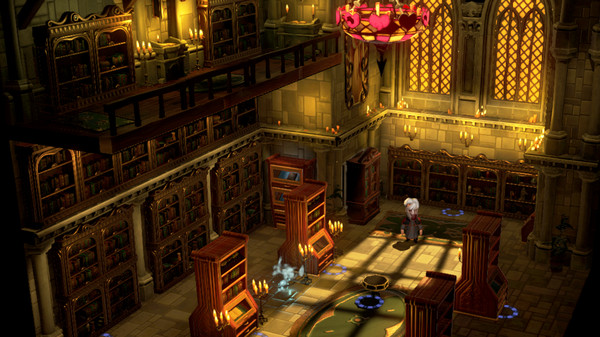 The rewinding twelve-hour loop — Steam store
Where are you with this game?
Press one and the game goes on your shelf. You can see it on your account page.
Reactions (no login)
Anonymous • one of each per visitor per day
Read next
Related reviews
RiME
A boy wakes on an unfamiliar island after a storm and runs, climbs, swims and shouts at the stonework, guided by a red fox toward the peak of a distant tower — a five-chapter puzzle adventure with no combat, no HUD and no dialogue, released by Tequila Works in 2017.
Thimbleweed Park
A point-and-click adventure about a 1987 small-town murder, switching between five characters — two FBI agents, a ghost, a foul-mouthed clown and an aspiring game developer. Its nine-verb SCUMM-style interface was rebuilt for modern machines by the creators of Maniac Mansion and Monkey Island.
Tangle Tower
A hand-drawn, fully voiced detective adventure: a painter's murder in a strange mansion, solved by interrogating suspects, pairing the clues you gather, and cracking the puzzles hidden through the tower. SFB Games' 2019 follow-up to Detective Grimoire.


