REVIEW · 2018-09-19
The Gardens Between
Reading the split verdict on a wordless, time-rewinding memory puzzle
First Impressions
Two arrow keys scrub time back and forth; a single button reaches out. That is the whole input, and with it Arina and Frendt climb islands of memory — a time-manipulation puzzle released in 2018 by The Voxel Agents. I write this from the Steam review pool. The label is 'Very Positive': 2,576 of 2,748 reviews are positive, about 94% (snapshot 2026-07-04), and 93% of 959 in English. Metacritic 80. On paper, a flawless small thing.
The first thing the helpful positive reviews reveal is that reviewers reach for the same metaphors: a 'pop-up book,' a 'playable Monument Valley,' 'rotation like Fez.' What they share is surprise at how few inputs do so much.
But the same 'simplicity' turns into its opposite on the negative side: 'too simple,' 'you see the answer and just wait.' Inside that 94%, praise and complaint look at one point from two directions — and that point is what I will read.
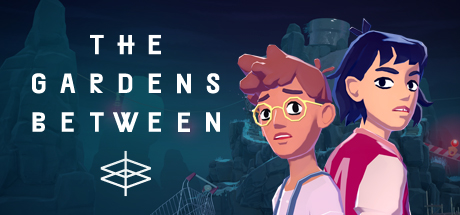 Climbing islands of memory by rewinding time — Steam store
Putting the Mechanics into Words
What the positive reviews name almost unanimously is the tiny control set. Left rewinds, right advances, space touches what is near. You move time, not the characters — many reviewers single out 'you manipulate time, not the avatars' as the invention.
In Puzzlebyrinth terms this is subtraction taken to an extreme: one verb, with even movement handed over to time. What Braid made a rewind 'ability,' this treats as the world's playhead. One verb means no controls to learn — you start on the thinking side at once.
Over that verb, though, the grammar swaps island by island: a fog-clearing lantern, light-eating flowers, gears that spin on their own. Reviews praise the lack of repetition — but unlike Patrick's Parabox, which digs one grammar deep, this hands out small grammars and drops them. The praise and the later 'not enough' come from the same structure.
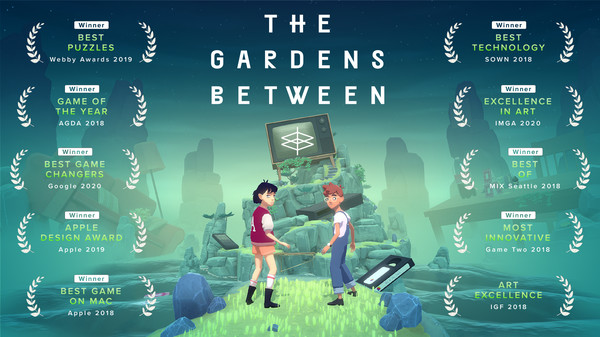 Two arrows and one action button — Steam store
The Feel of the Story
It is a wordless game — no dialogue, no subtitles — yet from the top helpful reviews to the most recent, most touch on the story. 'I teared up,' 'childhood memory itself,' 'you realise at the end a friend is moving away.' Reviewers reconstruct the arc — treehouse, playground, rain, memories ending as constellations — in their own words.
A minority read it the other way: 'the story was mundane,' 'I expected something more shattering.' The same quiet is read by most as space and by some as thinness.
To me the story is embedded in the verb, not in cutscenes: scrubbing time is itself the gesture of replaying a memory. So its resolution depends less on word count than on a reviewer's observational resolution — how much of the background they read. The gap between 'mundane' and 'wept' looks less like a flaw than like whether one stayed to look.
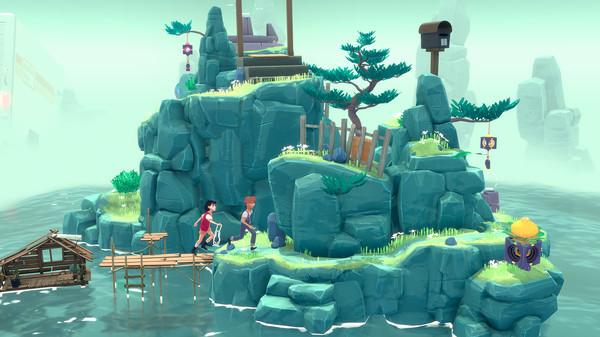 A wordless childhood, told through scenes — Steam store
Pacing and Length
The pool is near-unanimous on length and price: 'two to four hours,' 'beautiful but short,' '$20 is steep — buy it on sale.' Even positive reviews tack that caveat onto the end. The median completion time cited clusters around three to four hours.
What is flagged more than the length is how the time is spent. Several call the slow walk and the back-and-forth backtracking 'padding' — the wait between seeing the solution and watching the characters arrive.
The developer's store page promises 'a relaxed experience with no time pressure,' so the gap here is not with the game but with expectation. The slow tempo is clearly intended; there is no reward for speed. Anyone who wants to solve fast was placed outside the reach from the start.
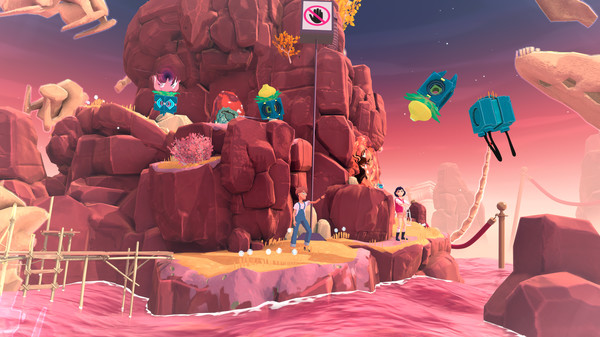 Each island passes in minutes — Steam store
The Texture of Difficulty
Difficulty is where opinion splits hardest. The most-upvoted negative review (122 votes) reduces to: 'I had solved it in my head long before the game let me act, and nothing made me think for more than thirty seconds.' The 'not-knowing' at the heart of puzzling is nearly absent here.
The positive side reads the same ease in reverse: 'no fail state,' 'I can play it with my kids,' 'want a grinder? go play Infinifactory — this is not that.' They receive the missing resistance as calm. (A separate complaint, 66 votes: the island rotation causes motion sickness — a bodily caveat, not a difficulty one.)
A puzzle has a 'find the answer' phase and an 'execute it' phase. This game thins the first and leans on the second and on observation. The curve does not climb so much as lay flat steps island by island, never building a peak. So most 'too easy' complaints are not about amount but about a design that does not compete on difficulty at all — a question of reach, not of flaw.
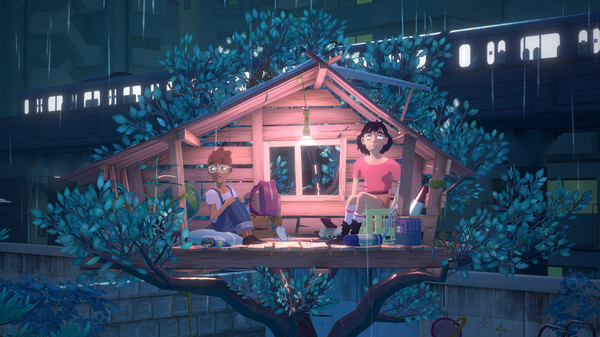 You see the answer before the walk catches up — Steam store
Sources
This piece was written by reading the user reviews on the Steam store and community pages as of 2026-07-04. No review text is quoted directly; typical claims are reconstructed.
- Steam: The Gardens Between (Very Positive, ~94% of 2,748 reviews; 93% of 959 in English)
- Read the top ~10 helpful positive reviews, representative negatives (incl. the 122- and 66-vote reviews), and several recent reviews
- Cross-checked counts against Steambase's review stats and Metacritic (80)
Closing
Steam reads about 94% positive; my design-critique score is 8.0, and the gap is small. It is less a deduction than a description: because this game bet on the feel of scene and time rather than on difficulty, its reach as a puzzle is narrow. The hand that subtracts to one verb and embeds story in the input is genuinely skilled.
The pool's near-unanimous verdict — 'buy it on sale, as a quiet few hours' — is fair. Outside its reach if you want hard knots; well within it if you want a wordless scene stroked by time. Where Cocoon showed nested worlds through the body, this shows them through memory. That a 94% game still splits its readers is the point: it quietly asks what you call fun.
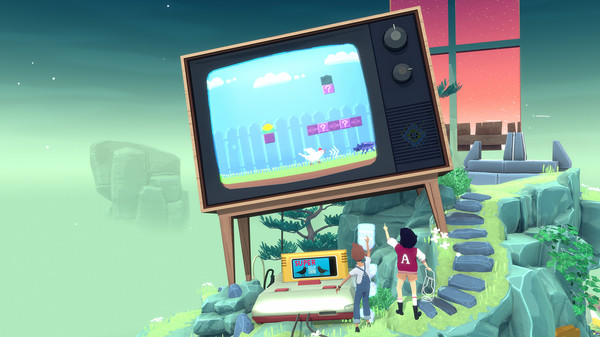 Late on, memories join as constellations — Steam store
Where are you with this game?
Press one and the game goes on your shelf. You can see it on your account page.
Reactions (no login)
Anonymous • one of each per visitor per day
Read next
Related reviews
Minit
A small black-and-white top-down adventure in which a curse ends every life after sixty seconds and sends you home. Only the items you picked up and the new houses you found carry over, so each minute reaches a little further than the last. Made by four developers including Vlambeer's Jan Willem Nijman, published by Devolver Digital.
CHUCHEL
A comedy adventure from Amanita Design in which a hairy little creature chases a single cherry through thirty short stages, helped and hindered by his rival Kekel. There is exactly one verb — click — and behind almost every press waits a hand-drawn gag.
Q.U.B.E. 2
A first-person puzzler where manipulation gloves grow colored cubes on white walls — red steps, blue springs, green movable blocks — recombined to cross a sand-buried alien structure. The sequel to Q.U.B.E., made by Toxic Games.


