REVIEW · 2018-03-13
Q.U.B.E. 2
Placing colored blocks to carve a path — a first-person puzzler in Portal's lineage
Introduction
On a white wall panel, your gloves grow a colored cube. Red is a step that juts forward, blue a spring that launches whatever touches it, green a block you spawn and carry. You paste these three colors onto walls and peel them off again, recombining step, spring, and block to cross a sand-buried ancient structure. A 2018 first-person puzzler from the UK's Toxic Games, published by Trapped Nerve Games — the sequel to Q.U.B.E.
I write this not as a play log but as a record of reading the Steam review pool — over a thousand of them. The label is 'Very Positive': 84% of 1,002 Steam-purchase reviews are positive (1,461 positive vs 277 negative across all 1,738; snapshot 2026-06-27). Metacritic sits at 76, Destructoid at 8. By the numbers, a sound game.
But open the reviews and one proper noun outnumbers all others — not the studio, not the genre, but Portal. 'If you liked Portal,' 'not quite Portal': where each writer places that word all but decides the verdict. As in my ChromaGun review, I read the pool along that line.
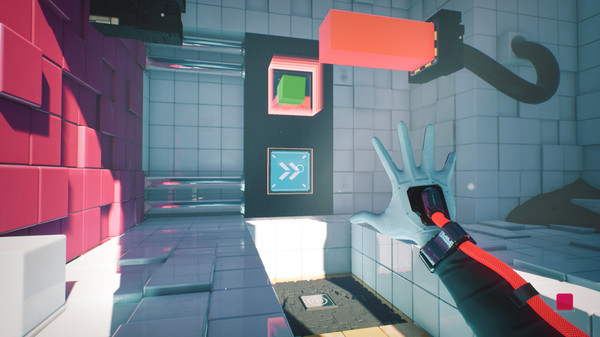 Looking up at the buried structure — series key art — Steam store
First Impressions
The first thing the helpful positive reviews agree on isn't the solving — it's the look. 'Beautiful,' 'great atmosphere,' 'vivid color.' White corridors lit with red, blue, and green photograph cleanly, and many say the opening rooms hooked them. David Housden's BAFTA-nominated score gets called 'meditative,' 'never distracting.'
A first impression built from image and sound rather than a verb is unusual for the Portal lineage. Portal teaches its verb in seconds; Q.U.B.E. 2 shows you a world first and hands you the verb quietly afterward. When reviewers keep saying 'relaxing,' they're naming that order — world first, task second.
The negative first impression converges on one thing: walking. Long, slow traversal between puzzles, no run button, sluggish elevators. That the earliest complaint targets movement rather than difficulty foreshadows the length problem below.
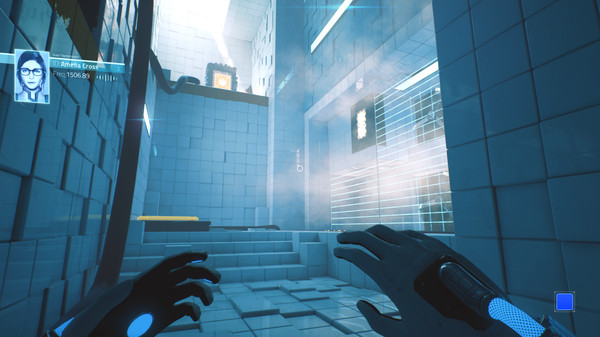 A white corridor lit by red, blue, and green cubes — Steam store
Putting the Mechanics into Words
What positive reviews praise in unison is how few verbs there are. 'Just three colors,' 'rules click instantly,' 'barely needs a tutorial.' The gloves make only red, blue, green cubes: red pushes a block out as a step, blue is a spring that launches whatever touches it, green is a movable cube you spawn and carry.
That praise — 'just three colors' — is what Puzzlebyrinth calls subtraction of verbs. Each color means exactly one thing; solutions emerge only in combination. Build height with red, set a green block on it, fling it elsewhere with blue. Three words, deep grammar. Later, spotlights, magnets, fans, and balls fold physics into color. Several note the symbols printed on each color for colorblind play.
The negative side names the same scarcity differently: 'no new ideas after the midpoint,' 'recycled solutions.' What one camp calls 'clean,' the other reads as 'shallow.' Not a ranking — just where each player hit the built-in trade-off of a small vocabulary: keeping the prose going with few words.
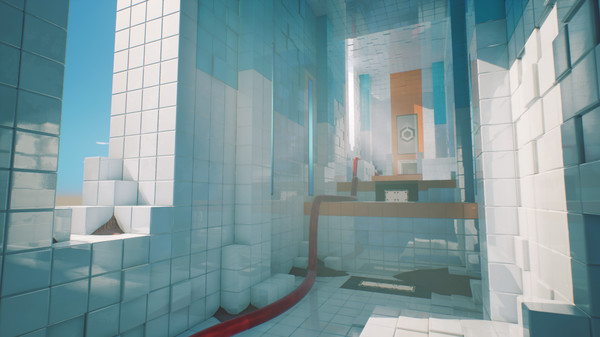 Stacking a green block on a red step to gain height — Steam store
The World
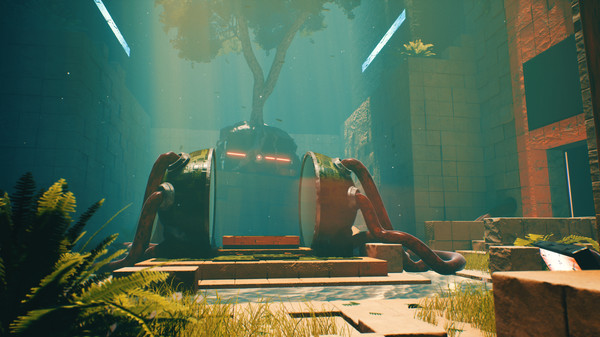
The stage is a vast alien structure half-buried in sand. From the first game's sealed test chambers, Q.U.B.E. 2 opens 'outward' — daylight, broken ruins, rooms with plants. Reviewers largely welcome it: 'the world expanded,' 'a pleasure just to look at.' A thin story is laid in: archaeologist Amelia Cross, guided by radio from another survivor.
World first, task second — continuous with the order noted earlier. Where Portal let a voice (GLaDOS) narrate inside a white lab, Q.U.B.E. 2 tries to let the scenery speak. Its observation resolution sits in how light falls and how big the ruins feel, not in text — one foot in the The Witness lineage of folding meaning into environment.
But the negative side returns to story and voice: 'thin plot,' 'confusing ending,' and even a recent review that quit over a 'muffled, unintelligible' radio voice. The power to show a world is widely granted; what that world is saying lands very unevenly.
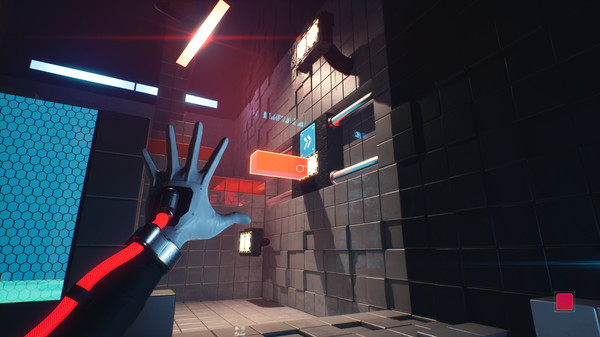 Ruins at night — the outward views that set it apart from Q.U.B.E. — Steam store
The Texture of Difficulty
Difficulty is where opinion splits most cleanly. 'Pleasantly judged,' 'never got stuck, very comfortable' appears about as often as 'too easy,' 'no challenge in the main game.' Many testify to solving a puzzle in 5–10 minutes and note the gap with the store's 'mind-bending' pitch.
Pool the sticking points and difficulty sorts into three kinds. Conceptual — which color goes where (light here, the 'easy' camp's point). Execution — timing a blue-spring carry. And traversal — the length of the walking. Ironically, reviewers agree the main game's biggest time sink is the third, not the first two.
And many in the 'too easy' camp add that the paid DLC (Aftermath) spikes the challenge. So this is less a flaw than a question of design range: the main game prioritizes flow and scenery over the pain of being stuck. Too light for those who want bite first, just right for those who want to solve while relaxed — close to the gentle 'oh, of course' feel of Superliminal.
 Placing colors to build a route — flow over puzzle bite — Steam store
Sources
This piece was written by reading the user reviews on the Steam store page as of 2026-06-27. Nothing is quoted directly; typical claims are reconstructed.
· Steam: Q.U.B.E. 2 (Very Positive — 84% of 1,002 Steam-purchase reviews; 1,461 positive vs 277 negative across all 1,738).
· I read helpful positive and negative reviews plus Most Recent ones, tallying praise words (beautiful / atmosphere / clean / relaxing) against complaints (too easy / too much walking / thin story / unintelligible voice).
· I also checked the critics (Metacritic 76, Destructoid 8/10, PCGamesN and Heavy 'Recommended') to see where pro and user axes diverge.
Closing
Read the pool whole and Q.U.B.E. 2 is a game that chose a different road under Portal's long shadow. Not density of insight, but three colored verbs and a widened world that keep you flowing and looking. The split only looks like conflict: 'clean / easy,' 'relaxing / no challenge' are two faces of subtracted verbs and a world-first order.
Against Steam's 84% (Very Positive), from a design view I give it 7.5. The staging of the world and the tidiness of the verbs are plainly skilled; I docked it honestly for the main game's light conceptual load and the long traversal that papers over it — the price of the 'calm' it chose. Reviewers put the main story at roughly 5–6 hours. Want bite first? Stay for the DLC, or take the harder edges of Q.U.B.E. 10th Anniversary.
It's for those who'd rather have a solvable dusk than an unsolvable night. Whiskey in hand, placing red, blue, green on white walls — as a quiet hour, this structure is well made.
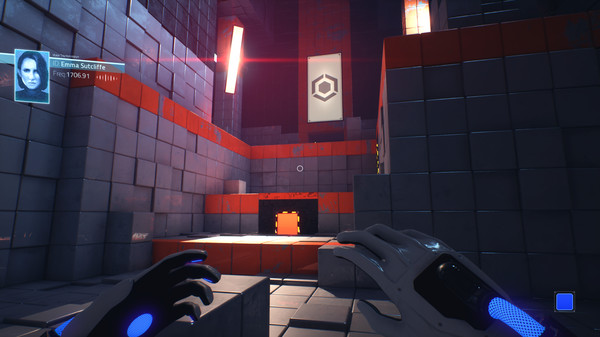 Heading for the exit — a structure that lets you solve calmly — Steam store
Where are you with this game?
Press one and the game goes on your shelf. You can see it on your account page.
Reactions (no login)
Anonymous • one of each per visitor per day
Read next
Related reviews
Minit
A small black-and-white top-down adventure in which a curse ends every life after sixty seconds and sends you home. Only the items you picked up and the new houses you found carry over, so each minute reaches a little further than the last. Made by four developers including Vlambeer's Jan Willem Nijman, published by Devolver Digital.
CHUCHEL
A comedy adventure from Amanita Design in which a hairy little creature chases a single cherry through thirty short stages, helped and hindered by his rival Kekel. There is exactly one verb — click — and behind almost every press waits a hand-drawn gag.
The Gardens Between
A time-manipulation puzzle in which two arrow keys and one action button rewind and advance time as Arina and Frendt climb islands of memory. You move time itself rather than the characters, unspooling wordless scenes of childhood. From The Voxel Agents.


