REVIEW · 2018-04-03
Minit
The sixty seconds are not difficulty - they are the price of a retry. Reading 2,867 Steam reviews
First Impressions
I read the Steam review pool for Minit as it stood on 2026-08-24. Of 2,867 all-language reviews, 2,559 are positive - about 89%, labelled Very Positive. The English store page shows 91% of 1,814, and 94% of 19 over the last thirty days.
The premise first. A black-and-white top-down adventure in which a curse kills you after sixty seconds and returns you home, keeping the items you found and the houses you unlocked. It is credited to JW, Kitty, Jukio and Dom - a 2012 jam piece by Vlambeer's Jan Willem Nijman and Kitty Calis, rebuilt with composer Jukio Kallio and artist Dominik Johann. Released 3 April 2018, published by Devolver Digital.
Across the helpful positive reviews, the praise does not point at difficulty. It points at relief. You are never annoyed, they say, because you know the answer is minutes away, and a large world is cut down to a size you can hold.
The negative column converges on one line instead: the timer is not used as a puzzle. Several reviews count only two places where the sixty seconds actually mattered. Both sides are measuring the same design decision with different rulers, and this piece reads that difference.
 Screenshot #1 as published on the Steam store page
Putting the Mechanics into Words
The verbs are few: walk, swing a sword, pick things up. The sixty-second timer does not join that list, because it is not a verb. It is a measurement of the board.
Progress works like this. Leave the house, go as far as one minute allows. Pick up a tool and next minute reaches further. Find a new house and it becomes your respawn point, so the measuring starts again from there. The placement of houses is what rewrites the meaning of the time.
This is where the two columns split. The negative side calls that rewrite a cancellation of the timer: the more respawn points exist, the more the sixty seconds becomes a signal to be teleported home rather than a budget for solving. English and Japanese reviews make the same observation.
I would not file it as a fault. The minute is not a difficulty dial; it is a ruler that fixes the size of one district. As argued in our article on time-loop puzzle design, a loop normally carries only knowledge across the reset. Minit adds material carry-over - tools and houses - so the sense of progress is refreshed every sixty seconds.
 Screenshot #2 as published on the Steam store page
The Texture of Difficulty
Both columns agree that the puzzles themselves are easy. Japanese reviews say the same: nothing here is hard, though the hidden content raises it a little.
Why so easy? Because a run is cut off at sixty seconds. Once the price of failure is fixed at one minute, running is cheaper than thinking. The steps of the learning curve are cut so finely that no vertical wall can stand. Difficulty shows up as distance walked, not as height climbed.
The negative complaints are the same fact inverted: too much backtracking, no consequence to dying, and a timer that turns into pure nuisance whenever the objective is unclear. That last one is exact. A minute with a plan is comfortable; a minute without one is irritation.
One thing outside the design: unfixed script errors that stop the game launching are reported in both the English and Japanese negative columns. Not many votes, but they are a real part of the pool.
 Screenshot #3 as published on the Steam store page
Pacing and Length
The length cannot be dodged. Playtimes shown next to the reviews cluster around two to four hours, with one report of finishing in eighty minutes, and another of about five hours for full completion.
What is interesting is that "buy it on sale" is not only a negative-column line. Several strong recommendations add that ten dollars is steep. The judgement about price is the one thing shared across the split.
Reviews describe a Second Run unlocked after the ending that shortens the limit to forty seconds, plus a mode with no limit at all. Rather than extending the map, it re-measures the same map with a shorter ruler - which means the authors did understand that shortening the ruler is what makes it hard.
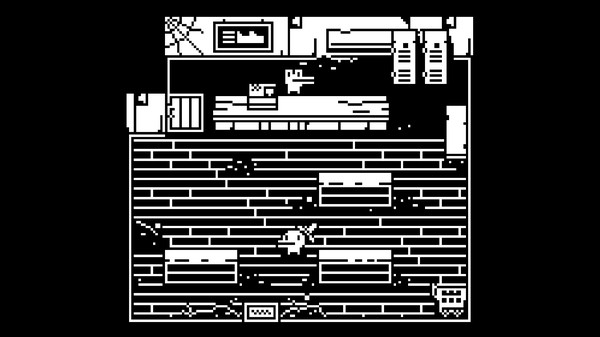 Screenshot #4 as published on the Steam store page
Sources
This piece is written from the Steam user reviews as they stood on 2026-08-24. No review text is quoted; recurring claims are reconstructed instead.
- Steam: Minit (2,559 positive of 2,867 all-language reviews, about 89%, labelled Very Positive; the English store page shows 91% of 1,814, and 94% of 19 in the last thirty days)
- 44 reviews read in full: the top 12 helpful positive, the top 12 helpful negative, the 10 most recent, and 10 Japanese-language reviews
- Metacritic (81 from 27 critics; user score 6.6 from 77 ratings; Destructoid 100, GameSpot 80, Easy Allies 80, PC Gamer 69)
- Credits, origins and per-platform scores come from the Wikipedia entry (PC 79, PS4 81, Switch 80, Xbox One 74)
- The developers' remarks about constraints come from an interview published on itch.io
- The images are store screenshots returned by Steam's official API. The image CDN is unreachable from where this was written, so they were not inspected; captions state only the asset type and its position on the store page.
Closing
The aggregate once more: Very Positive, about 89% of 2,867 all-language reviews (2026-08-24 snapshot). Metacritic shows 81 from 27 critics and a user score of 6.6 from 77 ratings, with the critics ranging from Destructoid at 100 to PC Gamer at 69.
In interview the developers say the restriction was strongly motivating, and that finishing something small matters more than planning something big. The sixty seconds were first a constraint on the makers. On the player's side they arrived as a device that lowers the price of failure. The "solve it against the clock" puzzle the negative column wanted was never the goal.
From a design standpoint I give it 7.4. Credit for fixing the cost of a retry at one minute, and for letting the placement of houses rewrite what that minute means. The deduction is that almost none of this is wired to difficulty. Where Outer Wilds and Twelve Minutes make the loop a vessel for deduction, this loop only shaves friction off an adventure.
I have marked it easy. It is not for someone who wants to be stuck for hours. It is for someone who wants a whole adventure in one evening, walked without any fear of failing. Most of that 89% looks like it was cast from that seat.
 Screenshot #5 as published on the Steam store page
Where are you with this game?
Press one and the game goes on your shelf. You can see it on your account page.
Reactions (no login)
Anonymous • one of each per visitor per day
Read next
Related reviews
Röki
A point-and-click adventure through a snowbound forest drawn from Nordic folklore, following Tove as she gathers and combines objects to search for her sister. Polygon Treehouse's game has no combat and no fail state, carried instead by hand-drawn landscapes and a story about loss.
La-Mulana 2
A 2D exploration-puzzle action game in which Lumisa Kosugi descends into the ancient ruins of Eg-Lana with a whip and a notebook. You copy down the inscriptions on the walls and match them to contraptions several rooms away. NIGORO's sequel to La-Mulana.
CHUCHEL
A comedy adventure from Amanita Design in which a hairy little creature chases a single cherry through thirty short stages, helped and hindered by his rival Kekel. There is exactly one verb — click — and behind almost every press waits a hand-drawn gag.


