REVIEW · 2021-08-19
Twelve Minutes
A twelve-minute loop, where knowledge is the only weapon
Introduction
A night in with your wife turns into a nightmare: a detective forces his way in, accuses her of murder, beats you to death — and you snap back to the moment you opened the door, looping the same twelve minutes, armed only with what you now know. A real-time, top-down thriller set in a single apartment, made by Luis Antonio and published by Annapurna Interactive in 2021, voiced by James McAvoy, Daisy Ridley, and Willem Dafoe.
I write this from the Steam review pool and the pieces written about it. English reviews are 'Mixed,' 68% of 3,483 (snapshot 2026-06-26); all languages total 7,298 'Mostly Positive,' and the last 30 days sit higher at 76% of 39. Critics scored it above the crowd — Metacritic 76, GameSpot 9, IGN 8, The Guardian 4/5. The gap is what interests me.
The pool doesn't split on whether the loop concept works — almost everyone grants that. It splits on execution: the ending, the controls, the repetition. So I won't referee who's right. I'll read it as a question of design reach — who it's for, and who it isn't.
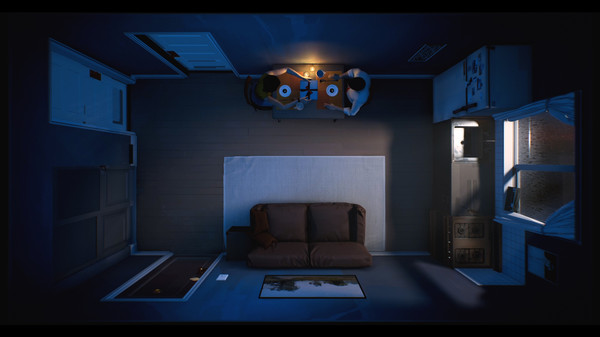 A single apartment, locked inside a twelve-minute loop — Steam store
First Impressions
The positive first impression is consistent: claustrophobic tension, the pressure of a ticking twelve minutes, the 'Rear Window' and 'Memento' comparisons. The first few loops grip hard. The dev's own pitch — a game that never lets you relax — works early.
The negative first impression arrives once the hook fades. Knowing the beats, re-running them edges toward chores; 'I fast-forwarded the same dialogue over and over' recurs across the pool. That the first impression splits is itself a design signal: the hook is front-loaded, and the question is whether the loop can sustain it.
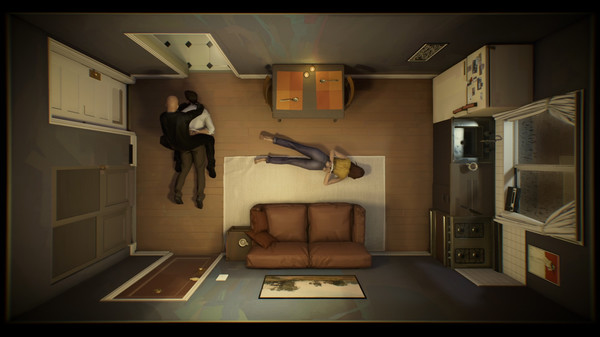 The twelve minutes start the moment you open the door — Steam screenshot
Putting the Mechanics into Words
The verbs are few — look, take, use, talk, wait — worked through a click-and-drag interface. One room, twelve minutes. The positive side keeps saying 'what you carry between loops isn't items, it's knowledge.' The real inventory lives in the player's head.
In Puzzlebyrinth's terms that is subtraction of verbs plus knowledge-as-state. The loop itself is the grammar: same verbs, but new knowledge unlocks a new sentence — a line of dialogue, an action. The spatial combinatorics stay small while the dialogue branches sprawl.
The negative side calls it 'guess-and-check' and 'moon logic.' The game under-signals which knowledge is load-bearing, so the learning curve has gaps and players brute-force them. The same thin signposting reads as 'earned deduction' to one side and 'obtuse' to the other.
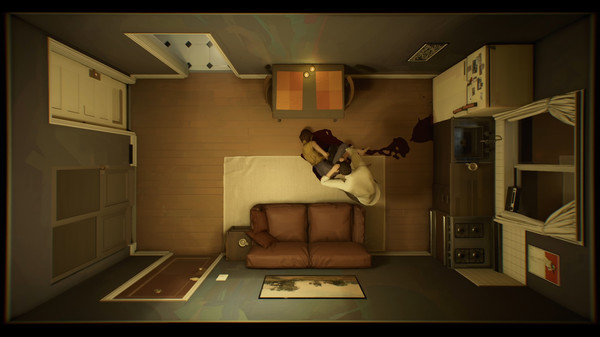 The clues are in the room's details and in pockets — Steam screenshot
The Feel of the Story
The pool spends the most words on the story, above all a single late turn (I withhold the specifics). The positive side calls it a bold, Memento-like landing; the negative side calls it 'forced, edgy, shock for its own sake,' robbing a carefully built setup of its payoff. One user's 'more unbelievable than shocking' names the wound.
A mystery is a contract: the more you withhold, the sharper the discovery — but the revealed answer has to cover the debt. The disappointment in the pool is the sound of that contract breaking, the rope every deduction game walks, the one Return of the Obra Dinn and Annapurna's own Lorelei and the Laser Eyes managed to cross.
The other recurring note is discomfort at being made to choose violence against the wife to progress. When a system demands a distasteful act as a puzzle input, some read it as authored meaning, others as harm instrumentalized. Coolly put, that's a question of design ethics, not staging.
 Three characters, a story that closes in one night — Steam store
The Feel of the Controls
The store calls it an 'accessible click and drag interface.' The most-repeated complaints target exactly that: dragging one object onto another slips, combining is clumsy, the word 'unwieldy' keeps coming back. The official self-description and the players' experience part ways here.
In a real-time loop, control friction is taxed twice: a fumble costs seconds, and the lost seconds cost a re-loop. Interface noise raises the floor of difficulty without raising its quality. Friction that isn't part of the puzzle is just friction.
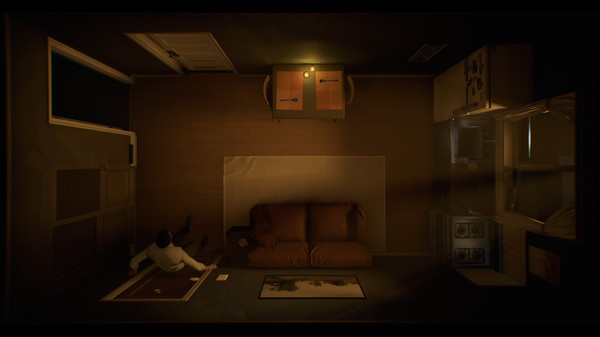 You drag objects to use them — and that becomes the argument — Steam screenshot
Sources
This piece is written from the Steam store's review aggregate and rating label as of 2026-06-26, plus articles discussing the split in the game's user reviews. The individual review pages sit behind a mature-content gate that blocked their body text, so I corroborated the fault lines with the aggregate data and press/secondary coverage.
・Steam: Twelve Minutes (English reviews Mixed, 68% of 3,483 / all languages 7,298 Mostly Positive / last 30 days 76% of 39, snapshot 2026-06-26)
・On why opinion splits: ScreenRant, "Why Twelve Minutes' Reviews Are So Conflicting", PC Gamer; critic scores (Metacritic 76 / GameSpot 9 / IGN 8 / The Guardian 4-5)
Closing
Let me settle the score. Steam's English reviews sit at 68%; on design grounds I give it 7.0. Treating the loop as grammar and swapping items for knowledge is a genuinely sharp idea. But control friction and an ending out of scale with its setup cap it. Critics scored higher because they judged launch-day craft; repetition and the ending only bare their teeth after long play — that is where the gap with the user score comes from.
So it's a question of reach. It hits hard for players who love a tight conceptual loop and can stomach repetition and a divisive ending; it isn't for those who want clean controls and a payoff proportional to the build-up. If you want to see the loop-as-knowledge idea fully realized, Outer Wilds still stands as the benchmark. Twelve Minutes challenges it and drops half a step on controls and ending.
One room, three people, twelve minutes. The craft of raising bottomless tension from that much subtraction is real, and that opinion splits at all is proof the game didn't play it safe. To read a divisive game and leave it divided — that is my conclusion in front of seven thousand-plus reviews.
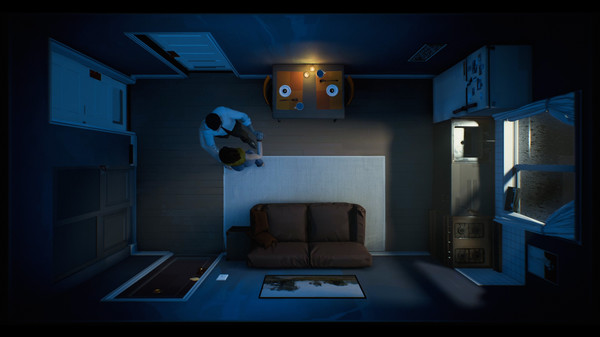 The key out of twelve minutes is in memory, not the room — Steam store
Where are you with this game?
Press one and the game goes on your shelf. You can see it on your account page.
Reactions (no login)
Anonymous • one of each per visitor per day
Read next

Related reviews
Overboard!
A reverse detective game aboard a 1930s ocean liner: as Veronica, who has just pushed her husband overboard, you have a few hours before the ship docks to bury the evidence and pin the crime on another passenger. Lie, bribe, seduce, or murder again — inkle (80 Days, Heaven's Vault) build countless perfect crimes from a handful of verbs.
Moncage
A wordless optical-illusion puzzle adventure. Each face of a glass cube holds a different world, and rotating your view until two silhouettes line up locks them into a single mechanism. You move between a factory, a lighthouse, an amusement park and a church, picking up scattered photographs that assemble the story of a father and a son. From Optillusion.
The Forgotten City
A first-person mystery-adventure set in an underground Roman city bound by a golden rule — if one person sins, everyone dies — where you relive a single day through a time loop, unravelling the city's doom through conversation and moral choice. By Modern Storyteller.


