ESSAY · 2026-08-02
Solving the Time Loop — Designing Games Where Knowledge Is the Only Save Data (from Majora's Mask to Outer Wilds)
In a repeating world, the only thing you carry over is what's in your head
Introduction
Every morning, the world resets. In The Sexy Brutale, the same guests are murdered by the same procedures; in Outer Wilds, the solar system is swallowed by a supernova every twenty-two minutes. Whatever you accomplish, the board rolls back to its initial state. And yet these games unmistakably progress. What carries over is not items or experience points but the knowledge inside the player's head. I have long wanted to reread this structure in the vocabulary of puzzle design: before it is a narrative device, a time loop is a machine for making knowledge the only save data.
In this essay I want to line up loop-driven games as design, from The Legend of Zelda: Majora's Mask in 2000 to The Forgotten City in 2021. Why does a repeating world function as a puzzle? How does the length of one loop change the experience? And where does progression gated purely by knowledge shade into unfairness? I have traced the lineage of designs that turn looking itself into progress in Puzzles That Turn Looking into Play; the loop game is, in a sense, that grammar extended along the axis of time.
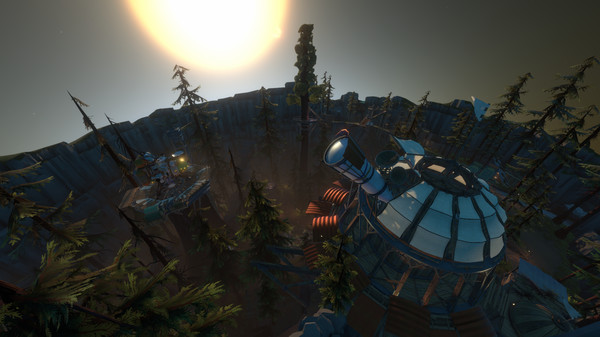 Outer Wilds (from the official Steam screenshots)
Knowledge as the Only Save Data — from Majora's Mask to Outer Wilds
The Legend of Zelda: Majora's Mask, released by Nintendo for the Nintendo 64 in April 2000, is an early prototype of this design. Each time you play the Song of Time to rewind the three days before the moon falls, consumables and errands in progress are mostly lost—but the masks you earned, the songs you learned, and the Bombers' Notebook recording the townsfolk's schedules remain. The residents repeat their three-day routines like clockwork, and knowing who does what, where, at what hour is the key that unlocks the side quests. The skeleton—discard the world's state on rewind, keep only knowledge—is already complete here.
That skeleton was pared to its limit by Outer Wilds, released by Mobius Digital in May 2019. Your ship and equipment are fully assembled from the first loop; there is not a single upgrade. What blocks you from the deepest secrets of the solar system is not ability but ignorance. If you knew how every mechanism on every planet worked, you could in principle reach the ending within the first twenty-two minutes. The in-game ship log auto-diagrams the clues you gather, but it is not flag management—it is merely an external backup of the save data in your head.
This design is colloquially called knowledge-gating, or a metroidbrainia: where a metroidvania unlocks space through acquired abilities, these games unlock it through knowledge. The elegant part is that by discarding the world's state every loop, soft locks structurally cease to exist. I wrote about making a puzzle's dead ends visible in Legible Failure, but a loop game never lets failure persist past twenty-two minutes in the first place. Because knowledge is never lost, the loop functions not as punishment but as permission to experiment.
Observing the Clockwork Mansion — The Sexy Brutale and NPC Schedule Design
The Sexy Brutale, released in April 2017 by Cavalier Game Studios and Tequila Works, is perhaps the purest construction of the loop as an observation puzzle. In a masked-ball mansion, guests are murdered one after another across the twelve hours from noon to midnight. You cannot enter the same room as a victim; you can only watch the procedure of each killing through keyholes and from behind cover. When does the servant pour the poison, when does the victim pick up the glass? The mansion is a single clockwork machine, and your job is to read how its gears mesh and intervene at exactly one point to derail the chain.
The same grammar appears in 2019's Elsinore, which replays Hamlet from Ophelia's point of view. Information gained in conversation accumulates as discrete facts, inventory-like, and can be presented to other characters on later loops—a rare case of knowledge handled with the grammar of items. Twelve Minutes, released by Luis Antonio in August 2021, compresses the loop into a twelve-minute apartment and makes dialogue branching itself the knowledge gate: which words you know turns the same conversation with the same person into a different door.
What these games demand is the observational resolution I described in Walking and Deducing, extended along the axis of time. Where Return of the Obra Dinn had you observe moments of death frozen in space, loop games have you observe a machine that keeps moving through time—you read not a static picture but a dynamic structure called a schedule. Difficulty tuning therefore lives in the balance between the machine's complexity and the width of the window you are given to watch it. Show too much and it becomes busywork; hide too much and it becomes brute force.
Designing the Question Before the Answer — The Forgotten City's Dialogue Gates
The Forgotten City, released by Modern Storyteller in July 2021, grew out of a Skyrim mod published in 2015. In an underground Roman city bound by a Golden Rule—if one person sins, everyone is punished—the world loops each time someone transgresses. Your weapon is almost entirely dialogue. Facts drawn out of residents unlock new dialogue options, and those options draw out deeper facts. The knowledge gate is embedded inside the grammar of conversation itself.
The truly hard part of knowledge-gated design, I think, is not hiding answers but getting the player to form questions. Outer Wilds has no quest markers; instead, its landscapes and clues are arranged so that a question—where does that planet's sand actually flow?—becomes the destination itself. If questions arise naturally, exploration stays driven even when answers are far away. A knowledge gate that fails to plant the question forces the player into brute-force interrogation. The learning curve of a loop game is carved not by the order of levels but by the order in which questions occur to you.
And this design carries a structural fragility. If the save data exists only in your head, a single spoiler sentence can overwrite hours of progression. The problem I examined in If You Look Up the Solution, Did You Solve It? appears here in its sharpest form. A knowledge-gated game can, in principle, be played only once. That one-shot nature is a weakness, and at the same time the scarcity that underwrites the experience's value. The designer accepts the fragility and bets everything on the density of the first playthrough.
Loop Length and the Cost of Repetition — 12 Minutes, 22 Minutes, 12 Hours, 3 Days
The most concrete variable in loop design is the length of one cycle: Twelve Minutes' twelve minutes, Outer Wilds' twenty-two, The Sexy Brutale's twelve hours, Majora's Mask's three days. Shorter loops lower the cost of a single experiment and speed up hypothesis testing, but thin out the world. Longer loops thicken the world but make the re-run to your point of interest heavy. Outer Wilds' twenty-two minutes is tuned to be just enough to fly to a planet at the system's edge, test one question, and take a small detour. Loop length is a declaration of the size of hypothesis the designer expects you to hold.
So the craft of a loop game shows in how it subtracts the re-execution of the known. Majora's Mask lets you advance, rewind, and halve the speed of time with songs. The Sexy Brutale lets you rewind to noon at any moment with a pocket watch. The Forgotten City opens shortcuts across the city and lets you skip heard conversations via summaries. These devices—extracting only the boredom from repetition while accelerating verification—are unglamorous, yet they determine the learning curve of the entire design. A loop with heavy re-runs breaks the second playthrough's back no matter how beautiful the world.
Written out this far, the loop reveals itself as a relative of Undo. If Undo is a local rewind that cancels the last move, the loop is a global Undo that returns the whole world to its initial state. Both are permissions to experiment, and the question I raised in In a World with Undo, Do Choices Mean Anything? reaches loop games intact. But the loop pre-empts the answer by preparing exactly one thing that does not rewind. The world returns as many times as it takes; what you have come to know never does. That irreversibility is what gives repetition its meaning.
Closing
A time loop is a machine that turns only the inside of the player's head into progression, by discarding the world's state without regret. Majora's Mask designed a notebook, The Sexy Brutale a clockwork mansion, Outer Wilds a ship log, The Forgotten City a set of dialogue options—each as a place to keep knowledge. What they share is the subtraction of visible progression, items and abilities, entrusting everything to the invisible progression of observation and inference. It is the grammar of the observation puzzle extended along the axis of time, and at the same time an attempt to banish both soft locks and punishment from the game.
If I were to build a time-loop puzzle next, I would start by fixing the length of one cycle, because that is the same as fixing the size of hypothesis I expect the player to carry. Then I would design so that the same loop feels shorter as loops accumulate—the twenty-two minutes once filled with exploration becomes, by the end, the shortest path to a single confirmation. The growth of the player's knowledge changes the felt density of time. With a machine that rewinds the world, you craft the texture of the one thing that does not rewind. In the last loop game you solved: what rolled back, and what remained?
Reactions (no login)
Anonymous • one of each per visitor per day
Learn — Curriculum
LearnPart 3 Verbs — The Grammar of MechanicsChapter 8 Perspective, Time, Clones3 / 7
Part of these series
Read next

Related reviews
Please, Don't Touch Anything
You are covering a colleague's bathroom break in front of an unmarked console with a single red button, and you have been told not to touch anything. A pixel-art point-and-click puzzle by Four Quarters about reading the clues hidden in the posters and the wiring to dig out its 25 endings.
Machinika: Museum
A first-person puzzle box in which you scan alien devices of unknown origin delivered to a museum, peer inside them and reprint their missing parts until they run again. A short piece from Littlefield Studio that opens seven machines one at a time, with the touch of science-fiction archaeology.
Minit
A small black-and-white top-down adventure in which a curse ends every life after sixty seconds and sends you home. Only the items you picked up and the new houses you found carry over, so each minute reaches a little further than the last. Made by four developers including Vlambeer's Jan Willem Nijman, published by Devolver Digital.


