REVIEW · 2015-03-26
Please, Don't Touch Anything
One red button you were told not to press, and 25 endings
First Impressions
The Steam pool holds 5,591 reviews, 4,959 of them positive: 88.7%, "Very Positive" as of 2026-09-07. Generous numbers for an eleven-year-old five-dollar game.
Read them in helpfulness order, though, and both camps are describing the same single screen. One console. One red button you were told not to press. A notepad beside the keyboard. The top positive review calls it a perfect capture of the old ARG-style browser games. The most-voted negative review calls it overpriced for a one-screen flash game.
One side sees a forest of clues, the other sees one screen. They barely disagree about the facts. They disagree about what the facts are worth.
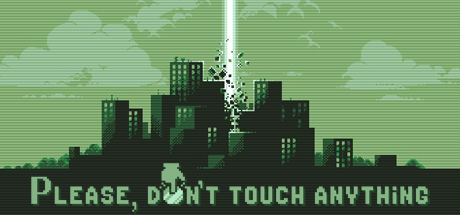 Please, Don't Touch Anything — Steam store key art
Putting the Mechanics into Words
Count the verbs and you get three: look, press, type. Add pulling the lever that resets everything and you have four. When the top positive review sums the game up as a panel, a button, and a lot of hints you are probably missing already, it is praising the smallness of that set.
In Puzzlebyrinth's terms this is verb subtraction taken to its limit. The console grows more buttons as you go, but the player's vocabulary never grows. Only the amount of information on screen does, which puts the whole weight of the difficulty on observation resolution. Every clue reviewers name — poster digits, wiring order, notes in the background music — sits on the noticing side, not the doing side.
Subtraction has a bill, though. With three verbs and twenty-five endings, the differences have to come from somewhere, and here they come from input length. The negative side keeps naming the same thing: one ending wants 276 presses of a button, another 666. That is not combinatorial depth. It is labour, and it is where the load the verbs shed ends up.
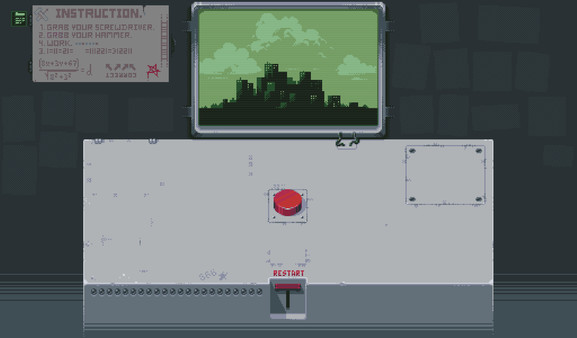 Please, Don't Touch Anything in play — first screenshot listed on the Steam store page (Steam store screenshot)
Place in the Lineage
Every review reaches for a comparison: the pixel art of Papers, Please, the irony of The Stanley Parable, the puzzle box of The Room. The sharpest positive review points further back, to the ARG-style browser games where you combed a page for the clue to the next URL.
That observation cuts. ARGs were built as collective work; their difficulty assumes people pooling fragments. This game is single-player with no way to pool anything, and the same reviewer says so, which is why looking up solutions becomes structural rather than shameful. One highly rated review describes inviting four friends over and finishing in five hours — a player supplying the vessel the design left out.
The press sits closer to the negative side. Metacritic's PC average is 75. PC Gamer gave it 70, calling it an enjoyable little puzzle box that lacked the meaning of Papers, Please. Gamezebo gave three out of five and called the puzzles obtuse. Eleven years on, the gap between 88.7% and 75 has not closed.
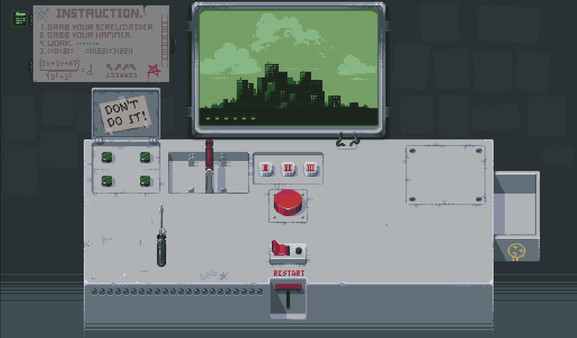 Please, Don't Touch Anything in play — second screenshot listed on the Steam store page (Steam store screenshot)
Design Craft
The most design-literate negative review names the problem precisely: what the game invites you to do and what it requires you to do are two different things. It looks and feels like a toy where you press every button to learn what it does. What it actually wants is for you to solve first and press once.
The same reviewer gives the case. One clue fitted two different input pads equally well. Having found only one of them, they could not tell why their entry did nothing, and concluded they had misread the clue. They had read it correctly and put it in the wrong place.
I read that as the bill for the subtraction. Three verbs also means three failure modes — wrong pad, wrong value, haven't looked yet — and the console does not distinguish between them when it stays silent. Shipping without a hint system is a clean choice, but cleanliness only holds when the board can tell you which kind of wrong you are.
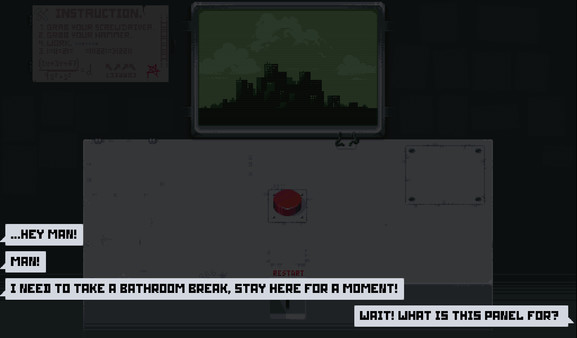 Please, Don't Touch Anything in play — third screenshot listed on the Steam store page (Steam store screenshot)
The Texture of Difficulty
When "too hard" and "just right" both collect hundreds of votes, treating difficulty as one substance gets you nowhere. Gather the places reviewers got stuck and this game's difficulty splits three ways.
First, observation: read a poster sideways, catch the one misspelled word, hear that the notes in the background are a code. This is the layer the positive side means by pay attention to detail, and it is the good one. Second, knowledge: the Fibonacci sequence, a name out of Russian literature, references to films and cartoons. How fun that layer is depends on what a player already carries. Third, labour — one review reports having to set the computer's clock to midnight to reach an ending.
Only the first is puzzle difficulty. The second measures how fast you can look things up; the third measures patience. Both camps agree the first four or five endings come easily. What splits them is which of the three layers they fall into afterwards.
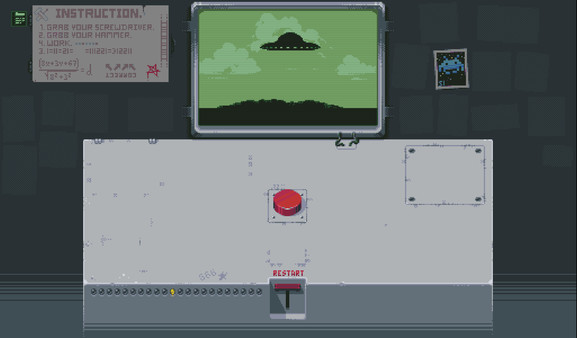 Please, Don't Touch Anything in play — fourth screenshot listed on the Steam store page (Steam store screenshot)
Reviews Consulted
This piece was written by reading the user reviews on the Steam store page as of 2026-09-07. No review text is quoted directly; recurring claims are reconstructed.
・Steam: Please, Don't Touch Anything (Very Positive, 4,959 of 5,591 reviews positive = 88.7%; Very Positive over the last 30 days on 37 reviews)
・Read: the top 15 positive reviews and top 10 negative reviews by helpfulness, plus the 8 most recent (33 in total), via both the Steam review API and the store review listing.
・Pocket Gamer's review (Alysia Judge, 2015-10-22). The Metacritic PC average of 75, PC Gamer's 70 and Gamezebo's 3/5 were confirmed via the reception section on Wikipedia.
・This session's environment could not reach Steam's image servers directly, so the images could not be opened and inspected. Captions and alt text are therefore kept generic and make no claim about what each frame shows. Every image URL was copied from Steam's appdetails API and checked one by one for existence.
Closing
Steam's aggregate is 88.7% positive. I give it 6.8, well below that, and not because of taste. We are measuring different axes. On the axis of satisfaction per five dollars and a few hours, this game works: reviewers put completion at roughly two to four hours, and the complaint that it is too short stands on the same length as the praise.
What I take off is for one thing: the console does not answer the player's mistakes. A game solved by observation needs the player to be able to tell whether they missed a clue, misread it, or put it in the wrong place. Next to Antichamber, where a wrong turn immediately becomes a different view, this red button is too quiet. Most of the negative complaints are aimed at that silence rather than at the difficulty.
Who it suits is clear: people who enjoy distrusting details, who have someone to pool answers with, and who do not read looking things up as defeat. Who it does not suit is equally clear, and for anyone wanting a solution that closes inside the board, it stays thin even eleven years later. That the reviews settle at 88.7% is, I think, because the game declared its narrow range from the first screen. As a declaration, a red button you are told not to press is very well made.
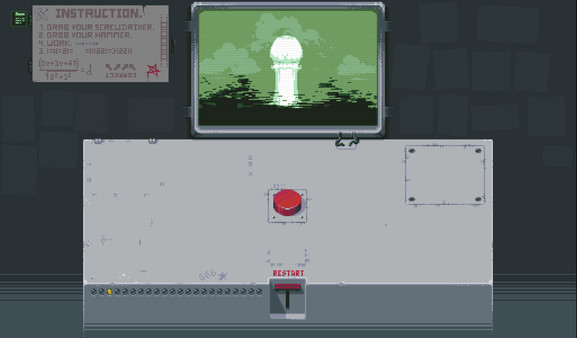 Please, Don't Touch Anything in play — fifth screenshot listed on the Steam store page (Steam store screenshot)
Where are you with this game?
Press one and the game goes on your shelf. You can see it on your account page.
Reactions (no login)
Anonymous • one of each per visitor per day
Read next
Related reviews
Grim Fandango Remastered
A 3D point-and-click adventure in which you play Manny Calavera, a skeletal travel agent in the Land of the Dead, following a journey and a conspiracy told across four years. Double Fine's rebuild of a film-noir-meets-Day-of-the-Dead world, with repainted textures, dynamic lighting and a re-recorded live score.
The House of Da Vinci
A first-person escape puzzler set in Florence, 1506: in the workshop of a vanished Leonardo you use a lens that sees inside objects and a device that replays the past, opening one wood-and-brass contraption after another. Built around nesting — every solved mechanism opens into a further one — by Slovakia's Blue Brain Games, 2017.
Human Resource Machine
A puzzle game where you feed a dozen commands to a tiny office worker between an inbox and an outbox, building 'programs' from sorts to multiplication to prime factorization. From World of Goo's Tomorrow Corporation, it hands you assembly-style thinking via drag-and-drop.


