REVIEW · 2017-11-24
The House of Da Vinci
A lens into the workshop, and reviews that split over getting close enough
About the Game
Florence, 1506. Leonardo has vanished and his apprentice works through the contraptions left in the workshop. You carry the Oculus Temporis, a device that both sees the mechanism inside an object and replays actions performed there in the past. A first-person puzzle adventure: you click to shift viewpoints and open boxes and machines. Released 24 November 2017 by Slovakia's Blue Brain Games, developer and publisher; the store page states it was funded on Kickstarter in late 2016 by 2,391 backers.
I write this from the Steam review pool. Across all languages there are 7,265 reviews, 6,258 of them positive — about 86%, labelled 'Very Positive.' English only drops to 81% of 2,740, and the last 30 days sit at 71% of 90, 'Mostly Positive' (snapshot 2026-08-05). A long high average with a small recent dip inside it.
The most frequent proper noun in that pool is neither the studio nor Leonardo. It is The Room. Praise and complaint alike are laid on that reference line.
 A room of bookshelves and patterned floor, light through stained glass — Steam store screenshot
First Impressions
Line up the most helpful positive reviews and the vocabulary rhymes. The top-voted one is a single line: the only way to get more Room. The next says 'The Room quality and then some.' The longer recommendations keep reaching for nesting metaphors — Russian dolls, a Pandora's box, puzzleception: a room holds three objects, and solving them keeps producing new puzzles.
The writers themselves stand out too. A reviewer who gives their age as 75 recommends it to seniors specifically, as complicated logic and problem solving that helps hold off cognitive ageing; that review has 326 helpful votes. Another senior calls it a good workout for the little grey cells. Praise here is built around having time to think slowly.
The negative side returns to: tedious, clunky, anti-intuitive, 'just go play The Room.' Thin story, abrupt ending, and above all not knowing how to get close enough to a thing. What interests me is how often both sides point at the same feature. One reviewer's astonishing nesting is another's tedium. My job isn't to stage that as a fight but to translate where the fork is.
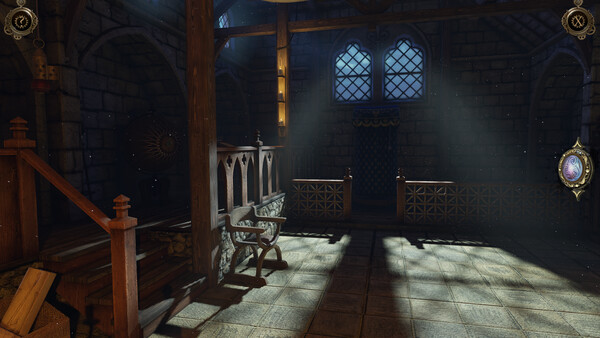 A dim stone interior, pale light through a gothic window, wooden railing — Steam store screenshot
Putting the Mechanics into Words
There are few verbs: peer, turn or pull, combine what you carry. On top of that the Oculus Temporis has two modes — see the mechanism inside an object, and replay what was done there in the past — which give the verb 'peer' two levels of resolution. When positive reviews keep reporting that a solved puzzle opens into another puzzle, that isn't more verbs. It is nested observation resolution.
The most useful thing in the pool is a review that breaks progress into three stages: locate the puzzle, solve it, then take the object out and manipulate it. The same writer adds that locating is harder than solving. Another recommendation admits that nothing highlights where a puzzle is, so much of the time goes to zooming twice or three times, hunting. The difficulty sits at the boundary of the board rather than inside it. Where The Room 3 used the outline of a box to promise 'this is the board,' this game scatters that promise across a whole room.
The tiered hint system carries the cost. Press it and you get a little; wait minutes for the next tier; some contraptions have two tiers, some four. Positive reviewers praise it as design, and a recent review notes it hands over enough to work it out without stating the answer. An un-subtracted observation cost, caught by a time-gated safety net — as hint design goes, careful work.
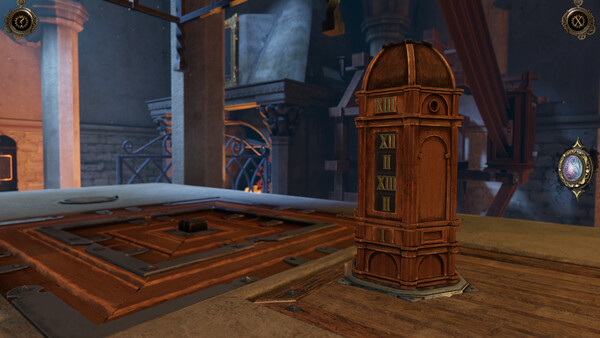 A wooden tower-shaped box marked with Roman numerals on a workbench, beside a grooved wooden board — Steam store screenshot
Place in the Lineage
Nearly every review measures this against The Room. For the positive side, 'if you liked The Room you'll like this' is the highest praise: the lens, the handled objects, the feel of the contraptions all read as reassurance. Myst and Riven come up too — same era of atmosphere, fewer arbitrary levers, a smaller space. One reviewer positions it against Quern - Undying Thoughts as the shorter option.
The negative side uses the same ruler for the opposite verdict: the lens is lifted wholesale, this is a lesser Room, and — knowing the comparison is unfair — they make it anyway. Some sign off by telling you to play The Room 1 and 3 instead, which do all of it better. Both camps point at one shelf; they differ only on whether this belongs on it.
Read as lineage, what this game borrows from The Room isn't the lens but the contract about where the board is. The Room used the outline of a box to limit what you could touch and to promise that something inside it would respond. This game extends the promise to a whole room. The reach grows, the Pandora's boxes multiply, and the guarantee thins. The split is less about quality than about how you price that trade.
 Through a wooden doorframe: a metal spherical device over a patterned floor, a lit torch at left — Steam store screenshot
Feel of the Controls
The most repeated claim on the negative side isn't difficulty, it's the controls. One reviewer names it 'you're not close enough' syndrome: you know the answer but you haven't reached the distance where the game will let you act, and nothing tells you so. A spot needs two zoom steps, you have one, and you keep clicking for the right pixel. The description recurs, almost word for word, across different writers — along with levers that won't fire unless moved 'far enough,' and parts that slip out of your grip.
What matters is that the complaint also comes from the positive side. The senior recommendation quoted above adds a caveat about the astrolabe: it asks for dexterity with the mouse rather than an idea in the head, and some of us don't have the dexterity. A recent review gives up at a set of winches because dragging wheels up and down made their arm hurt, while they could see the solution.
The 71% of the last 30 days reads like this point being rediscovered rather than a change in the game: complaints written in 2026 argue almost exactly what 2019 argued. Some writers guess it would sit better on a touchscreen, which I can't verify. In design terms this is bandwidth, not curve. The verbs are few, but the steps before a verb fires — right viewpoint, right distance, right amount of drag — have quietly become required. A subtracted verb set, with an unsubtracted gate in front of it.
 A large dark-blue disc set in a timber space, concentric rings of zodiac signs and moon phases — Steam store screenshot
Sources
Written by reading the user reviews on the Steam store page as of 2026-08-05. No review text is quoted directly; typical claims are reconstructed.
- Steam: The House of Da Vinci (Very Positive; 6,258 of 7,265 reviews positive across all languages, about 86%. English only: 81% of 2,740. Last 30 days: 71% of 90, 'Mostly Positive')
- Read: roughly the top 10 helpful positive reviews, the top 12 negative, and the 8 most recent (community review listing plus Steam's appreviews data)
- Compared the store's official description (Oculus Temporis, Kickstarter funding, supported languages) against what reviewers actually report
Closing
Steam reads about 86% positive across all languages; my design-critique score is 7.5. Credit for nesting observation resolution so that contraptions open into contraptions, and for the care in the time-gated tiered hints. Marks off for extending the board to the whole room while thinning the guarantee about what can be touched, and for making that search depend on mouse dexterity and two-step zoom hitboxes. The gap between the numbers lives there.
The median completion time mentioned in reviews is roughly 7-8 hours, with writers ranging from 80 hours to giving up at three. Difficulty verdicts split evenly between 'just right' and 'not hard, only long.' If you enjoy sitting with a mechanism and spending hints slowly, it still holds up. If you want your hands to move the moment you see the solution — if The Room's tactile snap is your baseline — the gate in front of each verb will keep bothering you. Few review pools state so plainly who a game is for.
 A large wooden disc-shaped machine standing in a brick arched space — Steam store screenshot
Where are you with this game?
Press one and the game goes on your shelf. You can see it on your account page.
Reactions (no login)
Anonymous • one of each per visitor per day
Read next

Related reviews
The Room Two
A first-person escape puzzler in which you peer at, rotate, and pry open strange clockwork boxes, using a special lens to reveal hidden marks. The second Room game widens from a single box to several interlocking contraptions, from the UK studio Fireproof Games.
Thimbleweed Park
A point-and-click adventure about a 1987 small-town murder, switching between five characters — two FBI agents, a ghost, a foul-mouthed clown and an aspiring game developer. Its nine-verb SCUMM-style interface was rebuilt for modern machines by the creators of Maniac Mansion and Monkey Island.
The Room Three
A first-person escape puzzler set in a mansion on a remote island, where you peer through a lens at the boxes and mechanisms left by the Craftsman, uncovering hidden layers one at a time. The third Room game expands the series from a single box to a whole estate, built on one tactile verb and an eyepiece that multiplies what you can observe.


