REVIEW · 2017-03-30
Thimbleweed Park
Nine verbs, five characters, and why the reviews split at the ending
First Impressions
I am writing this from the pool of Steam user reviews for Thimbleweed Park. The label is 'Very Positive.' Open the filters to all languages and all purchase types and 3,869 of 4,164 reviews recommend it; narrow to English and 90% of 2,221 are positive, with the last 30 days at 85% of 21 (all as of 2026-07-30). Metacritic sits at 84. On the numbers alone, the verdict looks settled.
The vocabulary of the helpful positive reviews rhymes: throw-back, love letter, 'a lost LucasArts game,' and 'not a single leap in logic.' A map that cuts down walking, multiple routes to a solution, dense detail, full voice acting. The pattern is clear — the more you remember of 1980s adventure games, the harder you push this one.
The negative vocabulary is tedious, combination space, hint line, and ending. What stands out is the asymmetry. The positive reviews barely mention the ending, while the single most helpful negative review (161 found it helpful) is entirely about it. Two camps are looking at different parts of the same game.
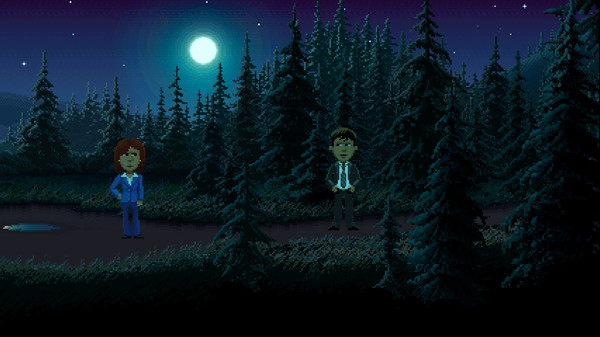 Thimbleweed Park main capsule image — Steam store key art
Putting the Mechanics into Words
The game lines its verbs along the bottom of the screen: Open, Close, Give, Pick up, Look at, Talk to, Push, Pull, Use. You pick a verb, aim it at an object, and build a sentence. It is the 1987 SCUMM interface rebuilt by the people who first shipped it, and when positive reviews call the game 'authentic,' that sentence-building is what they mean. In Puzzlebyrinth terms it sits on the far side of the idea I traced in When Fewer Verbs Make a Richer Game: rather than subtracting verbs, it keeps the whole list and carries it as grammar.
The negative side reads the same list as arithmetic. One reviewer lays it out: eight verbs besides Use, dozens of items with no purpose, five separate inventories. Verbs times objects times characters. That is combinatorial explosion in textbook form, and what they call tedious is not depth but the sheer volume of things to try.
Both camps are describing one table from different angles. Read the verb list as a vocabulary and it is expressive range; read it as a search space and it is labour. The LucasArts tradition softened that friction by answering wrong combinations with a joke. 'More gags miss than land, but the script is so dense I laughed anyway' and 'there is simply too much to try' are two views of the same shock absorber.
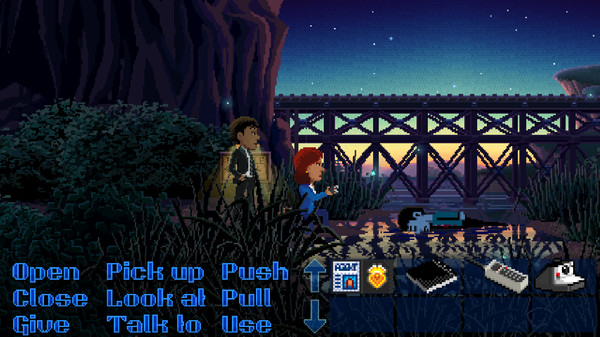 Thimbleweed Park store header image — Steam store key art
The Feel of the Story
The store page promises 'satisfying puzzles intertwined with a twisty-turny story that will stay with you.' Reading the negative pool, it is the second half of that promise that is contested. Late in the game the frame of the story shifts and the place you had put your attention moves. No spoilers here, but the recurring complaint is not 'I was surprised' — it is 'my investment was marked down.' Like the in-game hint line, this is something the authors put there on purpose.
What is interesting is that the positive side does not argue back. They talk about characters, voices, detail, joke density, and barely score the ending at all. The two camps are less in conflict than weighting 'resolution' differently. Boiling Steam takes a third position, aiming earlier: five strangers are handed no reason to cooperate, and the to-do list in each inventory stands in for motive. Users blame the ending; the critic blames the foundation.
As design, the to-do list is a legibility device. It exists to show which thread is live, and it genuinely supports the positive reviewers' habit of switching characters when stuck. But once the same list also has to carry a character's motive, it is holding weight it was not built for. I wrote about that load-bearing problem in Narrative Puzzles and Storyless Puzzles; this game is the rare case where the wiring is switched once, near the end.
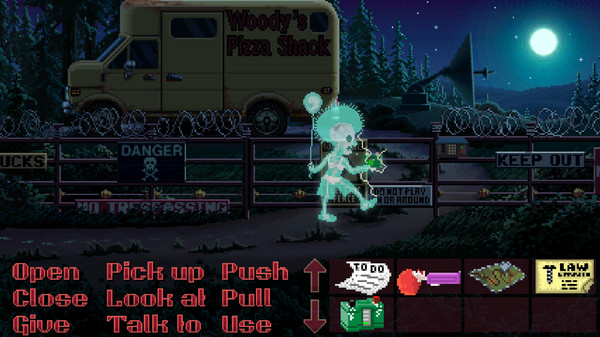 Thimbleweed Park library hero image — Steam store key art
The Texture of Difficulty
Sort the stuck points out of the pool and there are three kinds. First, the logic of individual puzzles — and here the pool is broadly happy. 'Never consulted a walkthrough,' 'not a single puzzle felt like a leap,' and this from players on Hard. Second, not knowing where the live thread is. One reviewer put it plainly: the whole town is open from the start, there are too many places and people, and it is hard to notice that someone you thought you were done with is needed again.
Third, cultural assumption. A critic notes a point where you are stuck without knowing that a US store refunds a nickel for an empty bottle. Two of these three kinds are not about logical depth but about observation resolution and prior knowledge — which is why one game reads as 'just right' to some and 'tedious' to others. The experience of difficulty here varies sharply by player.
The modes are worth reading too. The store page neutrally offers 'Casual and Hard modes with varied difficulty,' but reviewers are blunter: Casual strips out roughly half the puzzles and items, so it is content excision rather than a difficulty slider, and several positive reviews warn you to play Hard. There is also an in-game hint line; one negative reviewer wrote that they used it so often they were ashamed. I sorted through showing and hiding in Designing Hint Systems — but the friction here is not hint quality, it is the missing device that would tell you where to look.
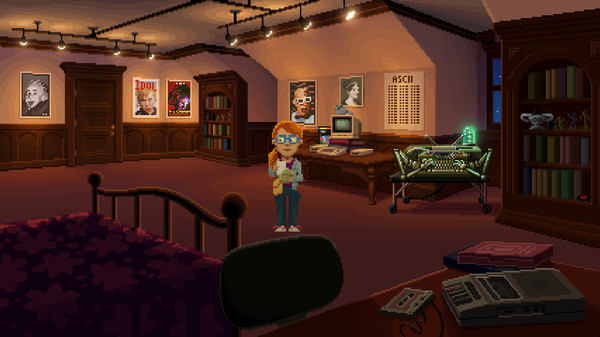 Thimbleweed Park hero capsule image — Steam store key art
Sources
This piece was written by reading the user reviews on the Steam store page as of 2026-07-30. No review text is quoted directly; typical claims are reconstructed.
- Steam: Thimbleweed Park (Very Positive; 3,869 of 4,164 reviews recommend across all languages and purchase types, 90% of 2,221 English reviews positive, 85% of 21 in the last 30 days)
- Read via WebFetch: the top 9 helpful positive reviews, the single most helpful negative review, the 10 most recent negative reviews, and 2 Japanese reviews (22 in total)
- Press and data: Boiling Steam, 'Thimbleweed Park: Unsatisfying-a-boo', and public metadata from SteamDB (Metacritic 84, released 2017-03-30, Terrible Toybox)
Closing
Steam reads 'Very Positive,' with 90% of English reviews positive. My design-critique score is 8.0 — a little below the aggregate. The credit goes to running an old grammar, the verb list, as a working tool rather than nostalgic decoration, and to the joke density that absorbs wrong attempts. The marks come off twice: the devices that show where the live thread is never catch up with the size of the town, and the to-do list built for progress legibility is also made to carry motive.
Completion times mentioned in the pool cluster around 12 to 15 hours, with playtime on record among the top helpful reviews spread from 12 to 27. I wrote about the author's stated philosophy in Inside Ron Gilbert's Philosophy — Never Waste the Player's Time; this game stands, deliberately, at the spot where that philosophy is hardest to hold.
The reach is unusually legible. If your hands remember 1980s adventure grammar, or if you like games such as Machinarium and The Case of the Golden Idol where examining is itself the play, then across these 22 reviews this one lands almost every time. If you score a story mainly on its resolution, you will walk straight into the complaint the negative side keeps repeating. The split at the ending is not a defect but a statement of where the authors placed their bet — and the pool shows very clearly who that bet is for.
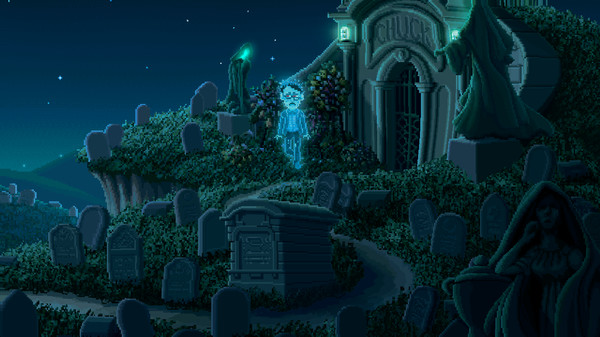 Thimbleweed Park library capsule image — Steam store key art
Where are you with this game?
Press one and the game goes on your shelf. You can see it on your account page.
Reactions (no login)
Anonymous • one of each per visitor per day
Read next

Related reviews
Return to Monkey Island
A point-and-click adventure in which series creator Ron Gilbert returns, three decades on, to the pirate comedy he left unfinished. It replaces the old verb menu with a single context-sensitive interaction, adds an in-world hint book that opens solutions in stages, and sends Guybrush Threepwood after the Secret of Monkey Island once more.
Syberia 3
A third-person adventure in which the lawyer Kate Walker joins a Youkol migration north, assembling clockwork devices along the way. Microïds' third Syberia, which trades the fixed painted screens of the first two games for a 3D space you walk around in.
Zero Escape: The Nonary Games
Two Spike Chunsoft mystery adventures in one package: nine people are locked inside a facility and must pass through numbered doors to get out. It bundles the DS-born Nine Hours, Nine Persons, Nine Doors with its sequel Virtue's Last Reward, alternating first-person escape-room sections with branching novel sections.


