REVIEW · 2022-09-19
Return to Monkey Island
It drops the verb menu and hands you a hint book — reading a sequel the critics agreed on and the players did not
First Impressions
I did not play this one; I am reading how its verdicts piled up. The numbers first. Steam shows 'Very Positive': 91% of 8,392 reviews across all languages, 89% of 4,877 in English, and 85% of 27 in the last 30 days (snapshot taken 2026-08-16). Metacritic's critic side sits at 87 from 54 reviews — 50 positive, 4 mixed, 0 negative.
What makes the game worth reading is the second tally sitting beside the first. Metacritic's user score is 7.5 from 376 ratings: 252 positive, 73 mixed, 51 negative. Zero negatives among critics; roughly three in ten players withholding approval. The critics agreed and the players did not, and that asymmetry is the line I want to follow.
The split also has a shape. Sort the low scores and they collapse into two subjects: the art and the ending. Very few of them call the puzzles unfair. Instead 'too easy' and 'I still got stuck' sit side by side — the same design producing opposite complaints at the same time.
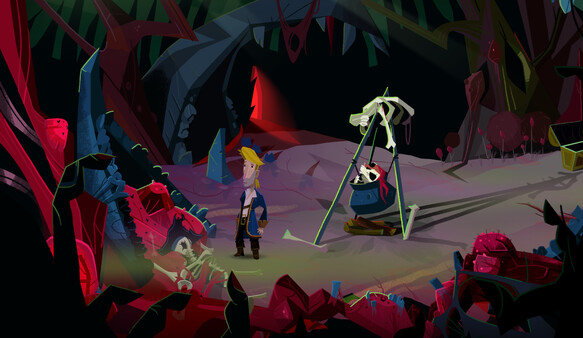 Return to Monkey Island in-game view — Steam store screenshot
Putting the Mechanics into Words
The first thing this sequel does is throw away its verbs. The 1990 original lined Open, Close, Push and Pull along the bottom of the screen and had you build sentences out of a verb and an object. There is no such list here. Touching a thing produces the contextually appropriate action, and the inventory has been tidied. When the press notes 'improved inventory management' and quick movement that helps the pacing, this is what they mean.
In Puzzlebyrinth terms that is subtraction, the thread I followed in When Fewer Verbs Make a Richer Game. Fold the verb axis down to one and the combinatorial explosion of verbs times objects simply goes away. It is the opposite answer, from largely the same people, to the one Thimbleweed Park gave when it kept all nine verbs and carried them as grammar.
Subtraction always has a price. The sharpest design complaint in the low scores was that you can only interact with objects the puzzles need, which makes the world feel empty. Fold the verbs away and the witty replies to wrong combinations go with them — and those replies were both a place for jokes and a signal that a thing was not relevant. When the set of touchable objects matches the set of candidate answers, search gets fast and the reason to look around gets thin. The trade between speed and resistance is sitting right on the surface here.
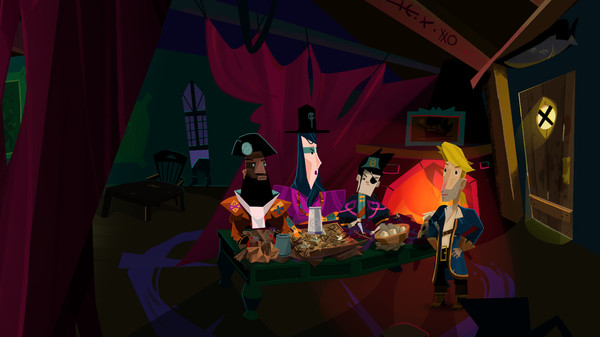 Return to Monkey Island in-game view — Steam store screenshot
The Texture of Difficulty
The game carries a hint book as an in-world object, and it opens solutions in stages rather than all at once. Critics praised it for helping without sending you out to a walkthrough — the help stays inside the fiction. Per published completion guides, the main story runs roughly 10 to 15 hours on Hard with no hints and no guide, and about 3 to 6 hours if you use them. The same content, stretched or compressed by a factor of three.
That range explains most of the coexisting verdicts. The low scores include 'it hand-holds far too anxiously' and 'unchallenging and repetitive.' The positive ones include 'some puzzles really are puzzling' and 'I had the right idea, the hint agreed with me, but the game wanted it done its way.' The first group opened the book; the second either did not, or opened it and hit the single-path problem instead. They are grading different difficulties.
As design, this moves the learning curve off the levels and into the player's hand. Difficulty is not fixed in the work; it is handed over as a dial. As I set out in Designing Hint Systems — How to Show, How to Hide, staged disclosure is the safest way to resolve a stall without spending the discovery. But the moment you hand over the dial, difficulty stops being a property of the game and becomes self-reported. These reviews talk past each other because everyone played at a different setting and used the same word for it. I looked at the fairness side of this in Is Difficulty Unkind? The Philosophy of Fairness.
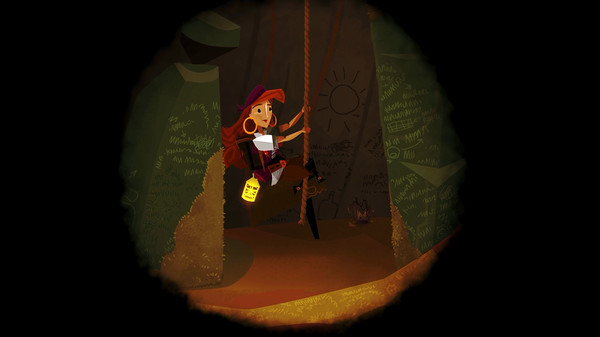 Return to Monkey Island in-game view — Steam store screenshot
The Feel of the Story
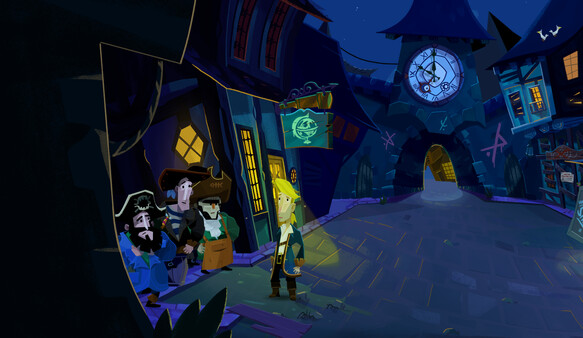
The other half of the low scores goes after the art. The words that recur on the boards are 'looks like a bootleg,' 'the noses and hands are unsettling,' 'the safe route,' 'semi-corporate vector art aimed at children's books.' The defence is just as consistent: vivid colour, dense background detail, objects that pop out of the scene, and the narrative justification — Guybrush is telling this story to his son, which is why it looks the way it does. One player wrote that they hated the screenshots and then found the game gorgeous in motion.
What interests me is that both sides are pointing at the same property. Flat fills and simplified outlines separate the interactable from the backdrop. That raises observation resolution and supports fast searching. The same treatment also strips out the texture and shading that make a scene worth staring at. It is the trade from the previous section, run a second time on the picture. The art argument looks like a clash of taste; it is really an argument about where the design aimed — legibility or feel.
The ending has the same structure. The frame of the story shifts at the last moment and the characters' fates are not spelled out, and the recurring player complaint is not surprise but the absence of resolution: 'we never find out what happens,' 'why not just end it normally.' The lowest-scoring press review named the ending as its reason. Against that, the boards carry a reading in which the frame itself is the answer. A game that came back to the Secret after thirty years chose to handle the appetite for an answer rather than the answer. The reviews are quite honest about who that works for.
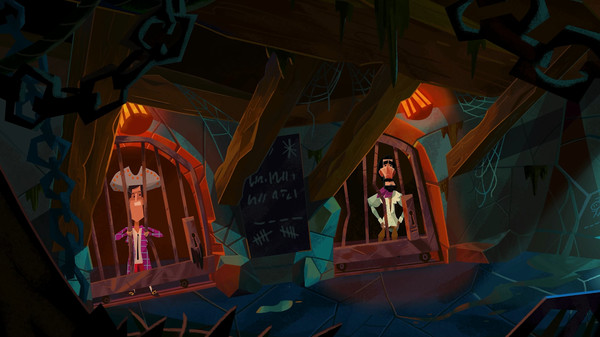 Return to Monkey Island in-game view — Steam store screenshot
Sources
This piece was written from the body of published verdicts as of 2026-08-16. No review text is quoted directly; recurring claims are reconstructed.
- Steam: Return to Monkey Island (Very Positive; 91% of 8,392 across all languages, 89% of 4,877 in English, 85% of 27 in the last 30 days)
- Note: the individual Steam review cards could not be retrieved from the environment used for this piece, so the Steam material here is the aggregate plus the recurring arguments on the store's community boards (art, ending, puzzle resistance).
- Metacritic user reviews, 376 ratings (7.5; 252 positive / 73 mixed / 51 negative), read from both the high and low ends
- Press: PC Gamer, PC ZONE, and the Metacritic critic aggregate (87 from 54 reviews, 0 negative); completion times from gamepressure's game-length guide
Closing
Steam reads 'Very Positive' at 91% across all languages; the critic aggregate is 87 with no negatives. My design-critique score is 8.4 — below Steam's tally, above the players' 7.5. Two things earn credit. The decision to fold the verb menu away and kill the combinatorial explosion, taken without hedging for nostalgia. And the choice to concentrate difficulty adjustment into one device, the hint book, and to keep that device inside the fiction. The mark comes off because folding the verbs made the set of touchable objects match the set of candidate answers, leaving thin reason to look around.
Completion runs about 10 to 15 hours on Hard without hints, 3 to 6 with them. That spread is the specification, not a defect, and most of the disagreement in the reviews falls out of it. I wrote about the author's stated position in Inside Ron Gilbert's Philosophy — Never Waste the Player's Time; this is arguably its most literal implementation. To avoid wasting your time, it handed you the stall and the dial together.
The reach is legible. If you remember the grammar of Day of the Tentacle Remastered or Thimbleweed Park fondly but have no wish to brute-force a verb table again, this lands almost every time. If you score a story mainly on its resolution, or weigh painted texture above legibility, you will walk into the complaint the low scores keep repeating. Critics agreed and players split not because the game is uneven, but because what it cut and what it handed over read as a strength or a weakness depending on who is holding it.
 Return to Monkey Island in-game view — Steam store screenshot
Where are you with this game?
Press one and the game goes on your shelf. You can see it on your account page.
Reactions (no login)
Anonymous • one of each per visitor per day
Read next

Related reviews
Thimbleweed Park
A point-and-click adventure about a 1987 small-town murder, switching between five characters — two FBI agents, a ghost, a foul-mouthed clown and an aspiring game developer. Its nine-verb SCUMM-style interface was rebuilt for modern machines by the creators of Maniac Mansion and Monkey Island.
Lost in Play
A hand-drawn point-and-click adventure told entirely without words. The siblings Toto and Gal make their way home through fifteen scenes built out of a child's imagination, picking things up, combining them, and solving a different little minigame in almost every room. From Happy Juice Games.
Tiny Room Stories: Town Mystery
An escape-room puzzle game in which a private detective, summoned to the deserted town of Redcliff, inspects diorama-like rooms that can be rotated and viewed from any angle, opening keys and combination locks while searching for his father. Made at a very small scale by Kiary Games and ported from mobile.


