REVIEW · 2022-08-10
Lost in Play
Drop the words and the drawing carries everything
First Impressions
What struck me first in the Steam review pool was the vocabulary. Charming, cozy, beautiful, wholesome, nostalgic. Read the helpful positives from the top and puzzles barely come up. The praise points at the drawings, the sound and the way the two children move.
The numbers are lopsided: 98% of 9,383 reviews are positive, labelled Overwhelmingly Positive (2026-09-29 snapshot). Metacritic sits at 82 for the PC version. This is not a divided game, so I started with the 2%.
The negative side converges on one complaint: you are not reasoning, you are guessing what the author had in mind. Irritation at unskippable minigames sits on top of it. As we will see, the thing the positives call easy and the thing the negatives call illogical come out of the same design decision.
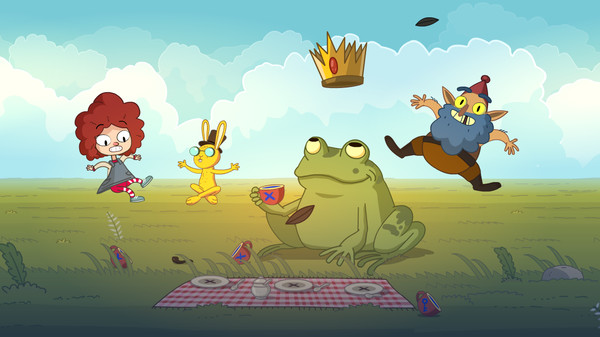 Lost in Play in play — image 1 as listed on the Steam store page (Steam store screenshot)
The Feel of the Story
There is no dialogue here, and almost no text. Toto and Gal speak only in wordless sounds. The journey home is told across fifteen scenes through drawing and gesture alone.
The comparisons reviewers reach for are not games but cartoons: a Ghibli-ish hand-drawn look, Over the Garden Wall, Alice in Wonderland. Rock Paper Shotgun's line, as quoted on Wikipedia, about it feeling like controlling a high-quality cartoon lands almost exactly where the user reviews do.
In the Puzzlebyrinth vocabulary this is subtraction applied to language. The authors threw away an entire channel of explanation, so drawing and motion carry all of the information. The story reaches players so well because that bet pays off — the same direction Machinarium took with its picture balloons, one notch further.
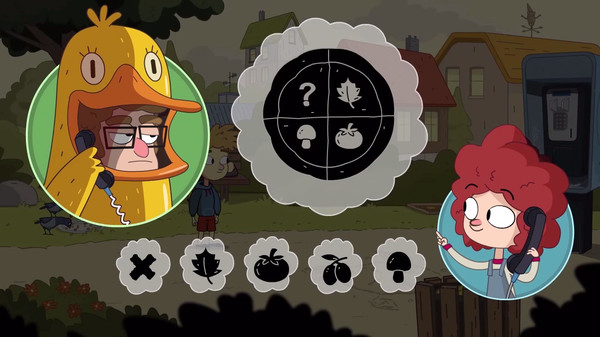 Lost in Play in play — image 2 as listed on the Steam store page (Steam store screenshot)
Putting the Mechanics into Words
The verb list is remarkably short: look, pick up, combine, hand over. Almost nothing is added to the point-and-click baseline. That skeleton is why reviewers shelve it next to Botanicula.
The bulk sits in the minigames instead. Every scene drops in a small toy, and the kind of toy changes each time. The positive side calls that fresh and varied; the negative side calls it a pile of minigames. Same object, different name.
My reading is that the minigames patch a hole in the vocabulary. With four verbs you cannot build a grammar that accumulates across levels, so each scene gets its own local rule instead. The learning curve does not stack — it resets room by room.
That has an upside. A scene you struggled with carries nothing forward, and nothing can be lost for good. The frequent recommendation to play it beside a child or a partner is a consequence of the design, not a coincidence.
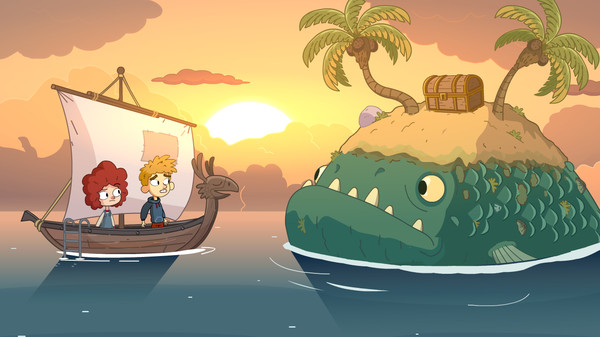 Lost in Play in play — image 3 as listed on the Steam store page (Steam store screenshot)
The Texture of Difficulty
Judgements about difficulty split cleanly in two: it is easy, you can play it beside a child — against it makes no sense, I ended up looking it up. What is interesting is that the two groups are not talking about the same moments.
Collect the negative phrasings and the sticking point is not I cannot solve this but I cannot tell what is being asked. There are hints, but they withhold the answer, and there is no skip. The escape hatch is narrow.
That, I think, is the price of dropping language. If a goal cannot be stated in words, it has to be readable from the picture. When the picture reads, the puzzle falls instantly and gets called easy; when it does not, there is no second channel and it gets called unfair. Two opposite verdicts, one design decision.
One more number: reviewers who mention completion time mostly land between three and six hours. Difficulty is not being converted into length here, which counts in the game's favour.
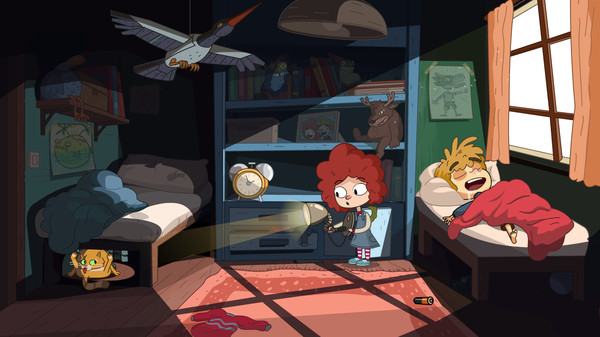 Lost in Play in play — image 4 as listed on the Steam store page (Steam store screenshot)
Reviews Consulted
This piece was written from the Steam store page's user reviews as of 2026-09-29. No review text is quoted directly; recurring claims are reconstructed.
・Steam: Lost in Play (Overwhelmingly Positive, 9,197 of 9,383 reviews positive = about 98%)
・Read via the appreviews API: the top 30 helpful positives, 100 negatives across all languages (English, Russian, Chinese, Korean among them), and the 20 most recent
・Wikipedia: Lost in Play (used for Metacritic 82 PC / 84 Switch, the Rock Paper Shotgun line, and the awards)
・The images are the screenshot URLs returned by Steam's appdetails API, used as-is. This environment could not reach Steam's image hosts, so the contents of the images could not be checked by eye; the captions therefore do not identify what is shown.
Closing
Against Steam's 98% I give it 7.6 as a matter of design. What I subtract is that the puzzles are subordinate to carrying the story. Anyone who came for the pleasure of learning rules and stacking them gets less resistance than the attention they pay.
And yet the 98% is not wrong. What this game promises is not hard problems but an animation you operate, and a game whose promise matches its delivery ends up with numbers like these. A gap in criteria should not be read as a gap in quality.
It suits people who like the air of Botanicula or Röki, and people playing beside a child. It does not suit players who want to learn a grammar and build with it. That is a question of range, not of fault.
 Lost in Play in play — image 5 as listed on the Steam store page (Steam store screenshot)
Where are you with this game?
Press one and the game goes on your shelf. You can see it on your account page.
Reactions (no login)
Anonymous • one of each per visitor per day
Read next
Related reviews
Röki
A point-and-click adventure through a snowbound forest drawn from Nordic folklore, following Tove as she gathers and combines objects to search for her sister. Polygon Treehouse's game has no combat and no fail state, carried instead by hand-drawn landscapes and a story about loss.
Return to Monkey Island
A point-and-click adventure in which series creator Ron Gilbert returns, three decades on, to the pirate comedy he left unfinished. It replaces the old verb menu with a single context-sensitive interaction, adds an in-world hint book that opens solutions in stages, and sends Guybrush Threepwood after the Secret of Monkey Island once more.
Genesis Noir
A hand-drawn black-and-white point-and-click adventure in which you play No Man, a watch peddler diving through the history of the universe to save his love from the Big Bang — a gunshot fired by a jealous god. Feral Cat Den built it out of tactile puzzles: turn a dial, touch a thing, see what happens.


