REVIEW · 2012-05-07
Botanicula
As long as a wrong click still pays
First Impressions
The vocabulary on the positive side is not game vocabulary. An animated painting. The feeling of turning over a log in the garden as a child to look at the insects. Cute. Silly. Trippy. Line up the helpful positive reviews and the praise points not at the puzzles but at what the screen gives back when you touch it.
The negative vocabulary is procedural. You just click on random stuff. There is no order and no reason. This is an interactive art piece rather than a game. One negative review needs a single line: it makes no sense.
The numbers, as of 2026-09-22: across all languages, 6,401 of 6,714 reviews are positive. That is 95 percent, labelled Overwhelmingly Positive. The English pool alone sits at 95 percent of 3,109 reviews, so the ratio does not move. The negatives are under five percent of the whole.
Open that five percent, though, and something odd appears. The recorded playtimes split cleanly into two clusters. This piece follows that split.
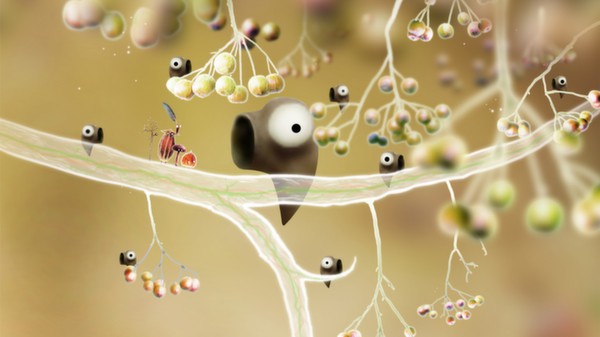 Botanicula in play — image 1 as listed on the Steam store page (Steam store screenshot)
The World
There is no dialogue here. The five protagonists communicate in chirps, squeaks and hums. One positive review calls the hours spent playing beside a parent a secret ecosystem shared by two people. The music is credited to the Czech band DVA; another reviewer describes it as a very strange band rehearsal.
The setting is a single tree, and the store copy claims more than 150 locations. What the positive side repeats is the sheer number of hidden animations. Push something and it moves. Push something and it sings. The screen answers every time. In Puzzlebyrinth's vocabulary, that is fuel for raising observational resolution.
The developer describes the game as relaxed and suitable for hardcore players, their families and seniors alike. Reading the review pool, that description is half right. Plenty of people did relax. Others, in front of the same restful screen, opened a search box.
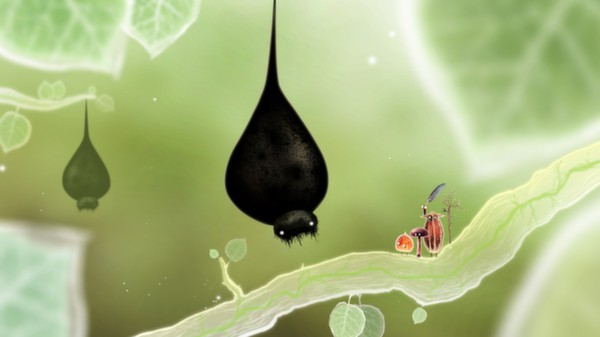 Botanicula in play — image 2 as listed on the Steam store page (Steam store screenshot)
Putting the Mechanics into Words
Count the verbs and there is only one again. Click. No undo, and almost no trick of swapping tools. In terms of subtracting verbs, this goes as far as CHUCHEL does.
The difference lies in what each game put in the space the subtraction opened. CHUCHEL put a gag in every stage. Botanicula put density of response. Richard Cobbett of PC Gamer scored it 82 and described the solving as a process of elimination rather than deduction. It reads as criticism, but as a description of the design I think it is exact.
Elimination only works as play under one condition: a miss has to give something back. If a wrong click returns a small movement or a sound, trial stops being a loss and becomes collection. The positive side's report that something happens every time you click is evidence that the condition holds.
Turn that around and the moment the condition fails, the same design looks like brute force. Almost all of the disagreement below follows from this single point.
 Botanicula in play — image 3 as listed on the Steam store page (Steam store screenshot)
The Texture of Difficulty
I sorted the negative reviews by subject. Among the twenty most helpful, the largest group — eight — complains that the puzzles have no logic and come down to trying everything. Four say it is not a puzzle game at all, four report save-related bugs, and two object to the length and the price.
Re-sort the same twenty by recorded playtime and a different picture appears. The people who wrote that it is not a game got off at 9, 10, 23 and 26 minutes. The people who wrote that it has no logic spent between 106 and 485 minutes — two to eight hours. The five percent is not one bloc.
My reading: the first group left before noticing that misses are paid for. The second group went on to the place where the payment stops. As the story advances, the combinations of creatures, carried items and locations multiply. When candidates grow by multiplication, the cost of one wrong click rises with them. Combinatorial explosion. One negative review says it went to video walkthroughs twice an hour.
The positive side contradicts itself too. An easy game you can finish with all achievements in three hours sits in the same pool as a game of demanding puzzles that reward attention. That is because what stops you is not difficulty but oversight, and how easily one overlooks things varies from person to person. So I rate the difficulty as Easy, with the caveat that some players will get stuck anyway.
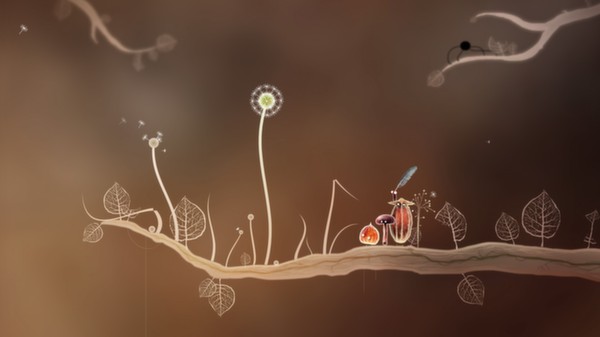 Botanicula in play — image 4 as listed on the Steam store page (Steam store screenshot)
Place in the Lineage
The proper noun that appears most often in the review pool is not a genre but an older game from the same studio: Machinarium. The positive side names it to mean that Amanita can be trusted; the negative side names it to mean that the other one drew them in further. One title serves as both guarantee and rival.
Line the shelf up and the position becomes clear. Samorost 3 handed you a single tool: blow the flute, choose your way by what answers. Creaks laid down one rule, light. CHUCHEL laid down no rule and put a gag in its place. Botanicula puts density of response where the rule would be.
The gap between critics and players narrows to the same point. PC Gamer counted the staggering vagueness against the game and wished for a hint system. The positive players take that same vagueness as permission to touch every corner. The studio's habit of dropping dialogue and turning the world into a toy you handle is easier to place after reading the philosophy of Jakub Dvorský. The designer of this game is credited as Jaromír Plachý.
 Botanicula in play — image 5 as listed on the Steam store page (Steam store screenshot)
Reviews Consulted
This piece was written by reading the user reviews on the Steam store page as of 2026-09-22. No review text is quoted directly; typical claims are reconstructed.
・Steam: Botanicula (6,401 of 6,714 reviews positive across all languages = 95%, labelled Overwhelmingly Positive; the English pool is 95% of 3,109)
・Read in full: the 10 most helpful positive reviews, the 20 most helpful negative reviews, and 8 recent ones (38 in total). Aggregate figures come from the query_summary returned by Steam's review API.
・PC Gamer: Botanicula review (Richard Cobbett, 82)
・The images are the store screenshot URLs returned by Steam's appdetails API, used verbatim. This environment could not reach Steam's image hosts, so their contents could not be inspected; the captions therefore do not identify what is depicted.
Closing
Against Steam's 95 percent I give it 7.8 from a design standpoint. The density of the hand-drawn work and the sound design have not aged since 2012. What I subtract sits in the later stretch, where the candidate space grows and the payment for a miss no longer covers its cost.
This is a question of range rather than a defect. It suits people who enjoy poking at a screen for its own sake, people watching alongside a child, people buying it for the sound. It does not suit people who came to buy the pleasure of reasoning out a procedure and landing it.
What the playtimes on the negative side show is that this game sorts people within the first thirty minutes. Complaints from those who passed that mark come from somewhere else entirely. Before buying, the number to look at is not the score but which of the two clusters you are likely to fall into.
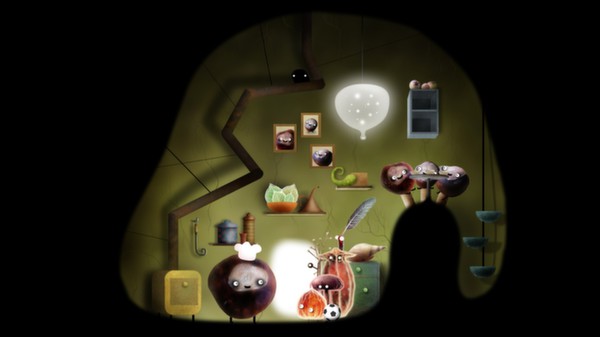 Botanicula in play — image 6 as listed on the Steam store page (Steam store screenshot)
Where are you with this game?
Press one and the game goes on your shelf. You can see it on your account page.
Reactions (no login)
Anonymous • one of each per visitor per day
Read next

Related reviews
Happy Game
A point-and-click adventure that walks a sleeping boy through three chapters of nightmare. You pull, turn and pick at the screen to open the way forward, and what waits there is smiley faces, pink bunnies and rooms the colour of blood. Amanita Design's first turn toward horror, scored by the Czech band DVA.
CHUCHEL
A comedy adventure from Amanita Design in which a hairy little creature chases a single cherry through thirty short stages, helped and hindered by his rival Kekel. There is exactly one verb — click — and behind almost every press waits a hand-drawn gag.
Samorost 3
A point-and-click adventure across nine tiny worlds with no dialogue and no text, where a hooded figure carries a found brass flute and opens the way by playing notes at rocks, creatures and machines. From Amanita Design, the studio behind Machinarium.


