REVIEW · 2021-02-25
Tiny Room Stories: Town Mystery
A town you can turn around, and the keypads waiting behind it
First Impressions
The positive vocabulary is mostly counting. Loads of puzzles. It never stops. A hidden gem. Line up the helpful positive reviews and the praise points not at any single lock but at the sheer quantity of them. The fact that something stays shut for thirteen to twenty hours is itself treated as a virtue.
The negative side is looking at the same quantity. It just uses different words. Cheap padding. It drags on. One negative review settles it in a line: it starts to feel like work.
Steam's aggregate is 756 of 865 reviews positive across all languages and purchase types. That is about 87%, labelled Very Positive (2026-09-25 snapshot). By the numbers the positive side wins easily. Even so, the negative case is short, consistent with itself and easy to read. The same thing is being counted, and only the sign has flipped.
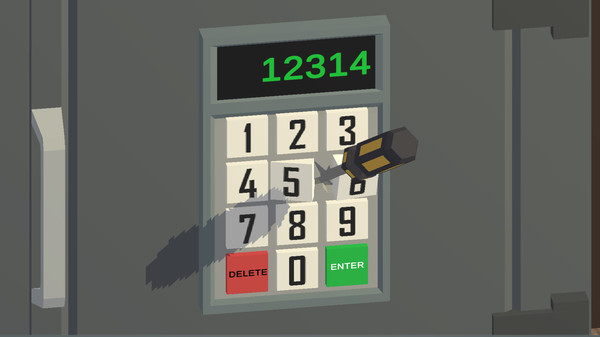
 Tiny Room Stories: Town Mystery in play — image 1 as listed on the Steam store page (Steam store screenshot)
Putting the Mechanics into Words
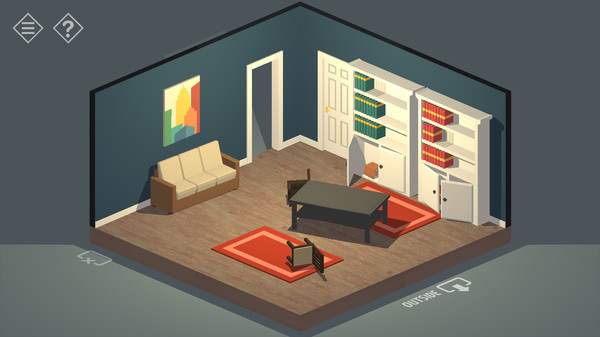
There are very few verbs. Touch. Rotate. Enter a number. That is close to all of it. What the developer puts front and centre on the store page is the same thing: levels you can turn around and inspect from any angle, like picking up a diorama to look at its back.
As an exercise in subtracting verbs this looks like the right call. Change the angle and faces that were not visible before — the underside of a desk, the side of a shelf — keep appearing. It turns looking itself into a verb. Moncage started from a similar place when it joined the faces of a box into a single image.
What is missing is the compression that should follow the subtraction. Whatever you find by rotating is converted, almost every time, into a three or four digit number. The yield of observation gets swallowed by a keypad. The gap between the positive side calling this thinking outside the box and the negative side calling it hunting and pecking probably opens right here.
The machinery for raising observational resolution is in place. The locks then flatten that resolution back down to one number, over and over. Where The Room kept deforming the puzzle box itself, the only thing that deforms here is the camera angle.
 Tiny Room Stories: Town Mystery in play — image 2 as listed on the Steam store page (Steam store screenshot)
The Texture of Difficulty
The two sides mean different things by hard. For the positive reviewers, hard means the solution sits off to one side of what you expected; the obvious move fails and you have to turn the idea once. For the negative reviewers, hard means there is nothing on screen telling you which way to turn it.
The split verdict on the hint system follows directly from that. One side praises a very complete hint system. The other says it hands over the answer rather than a nudge, so the satisfaction of solving disappears. When hints are not staged, a stuck player is left with two options: look it up, or stop.
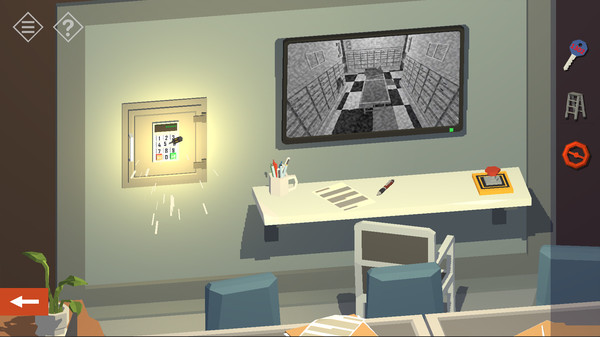
The lock as a form is doing its share too. One answer, judged instantly, with wrong attempts leaving no trace. There is no room to be wrong in an interesting way. When the negative side writes memorisation rather than logic, what it is pointing at is probably not the difficulty of any single puzzle but the coarseness of that judgement.
 Tiny Room Stories: Town Mystery in play — image 3 as listed on the Steam store page (Steam store screenshot)
Pacing
The negative reviews point at the same spot with surprising consistency. All of them grant that the opening is good. Then they say that from around chapter two onward a chapter becomes a count of how many keypads you open. The positive side often carries the same reservation about the back half. What is split is not the verdict on the game but how much of the back half a player will forgive.
A learning curve and a scaling of quantity are not the same thing. Having finished teaching its grammar by chapter two, this game increased the number of locks rather than the kinds of them. No new verb arrives. The rooms get larger and the keys multiply. Nothing combinatorially explodes; the same question is stacked in parallel.
Several negative reviews independently raise the absence of a note-taking tool. The numbers you have to hold keep accumulating, and there is no way to put memory outside your head. The feeling of labour comes from that asymmetry rather than from difficulty. When Escape Simulator let you leave items and scribbled notes on screen, it was answering the same problem.
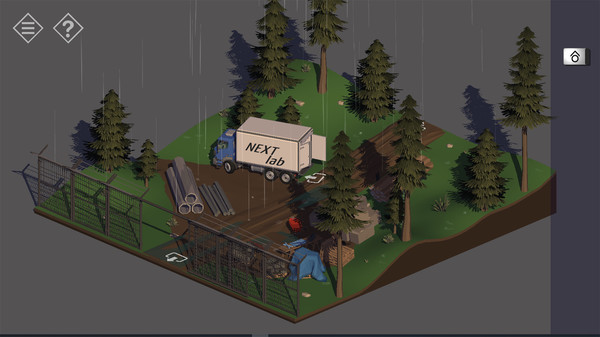
 Tiny Room Stories: Town Mystery in play — image 4 as listed on the Steam store page (Steam store screenshot)
The Reviews I Read
This piece was written by reading the user reviews on the Steam store page as of 2026-09-25. No review text is quoted directly; typical claims are reconstructed.
・Steam: Tiny Room Stories: Town Mystery (756 of 865 reviews positive across all languages = about 87%, labelled Very Positive)
・Read in full: the 12 most helpful positive reviews, the 15 most helpful negative reviews (including Chinese and Russian ones), and 8 recent reviews — 35 in total. Aggregate figures come from the query_summary returned by Steam's review API.
・The developer's own framing was taken from the store description returned by Steam's appdetails API.
・The images are the store screenshot URLs returned by Steam's appdetails API, used verbatim. This environment could not reach Steam's image hosts, so their contents could not be inspected; the captions therefore do not identify what is shown.
Closing
As a design judgement I give it 7.0. That is harsh next to Steam's 87%, and the reason is simple. The front half is well built. Rotating a room to look at it properly does turn observation into a verb. The back half never spends that verb.
It suits players who will not binge it. Taken a chapter at a time, with numbers written down on paper, this is straightforwardly enjoyable. It does not suit players who want to sit with one mechanism for a long time. Anyone hoping for the sensation of The House of Da Vinci, where the apparatus itself keeps transforming, will be puzzled by the row of keypads.
Completion times mentioned in reviews run from thirteen to twenty hours, with a median around thirteen. That a team this small sustained that much content deserves plain credit. Worth knowing before buying, though: reports that the Mac build does not start from a clean save have been standing for more than five years.
 Tiny Room Stories: Town Mystery in play — image 5 as listed on the Steam store page (Steam store screenshot)
Where are you with this game?
Press one and the game goes on your shelf. You can see it on your account page.
Reactions (no login)
Anonymous • one of each per visitor per day
Read next

Related reviews
Machinika: Museum
A first-person puzzle box in which you scan alien devices of unknown origin delivered to a museum, peer inside them and reprint their missing parts until they run again. A short piece from Littlefield Studio that opens seven machines one at a time, with the touch of science-fiction archaeology.
The Room 4: Old Sins
A first-person contraption puzzler set inside an old dollhouse found in an attic: open the mechanism in one room, then carry what you find to the room that is missing a piece. The fourth entry in Fireproof Games' The Room series, rebuilt for PC.
Moncage
A wordless optical-illusion puzzle adventure. Each face of a glass cube holds a different world, and rotating your view until two silhouettes line up locks them into a single mechanism. You move between a factory, a lighthouse, an amusement park and a church, picking up scattered photographs that assemble the story of a father and a son. From Optillusion.


