REVIEW · 2021-11-15
Moncage
Beautiful, but not much fun — reading a cube of optical illusions through 5,534 Steam reviews
First Impressions
The first thing the Steam pool shows is a split by language rather than by opinion. Across all languages and purchase types, 5,114 of 5,534 reviews are positive and the label reads Very Positive. Narrow it to English and it drops to 87% of 619. More than seven in ten reviews are in Simplified Chinese, and the most-helpful entries there look nothing like the English ones (snapshot 2026-07-28; the last 30 days sit at 94% of 18).
The top Chinese reviews are short, and some are written as poems — one lists cube-face pairings line by line, lighthouse and rotation, machinery and accretion, photograph and suture, and lands on a father and son forgiving each other. Another simply says to treat it as a dream you are still moved by long after waking. What they are measuring is picture and feeling.
The English top is shaped differently. The single most helpful review calls it a masterfully crafted puzzle told across five faces of a cube, but the second and fourth most helpful are both thumbs-down, and they say nearly the same sentence: beautiful, carefully made, clever, and not much fun to play. Two different rulers are being held against one object, and a meta-review has to separate them before anything else.
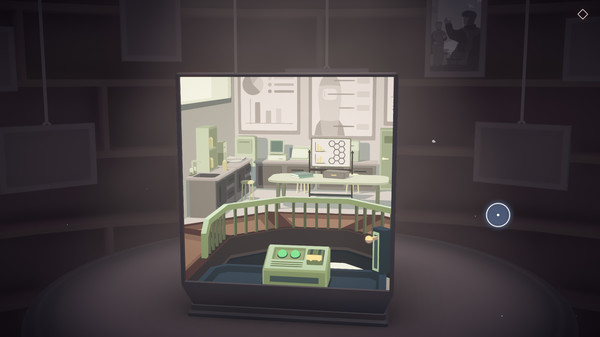 A glowing glass cube on a plinth in a dark gallery: the upper face shows a pale-green room of desks and cabinets, the lower face a green control panel and a curved railing — Steam store screenshot
Putting the Mechanics into Words
There are three verbs: right-drag to rotate the cube, left-click to interact, left-click to zoom in. Hold space and everything interactable lights up. A long Japanese review lists exactly those and nothing else — no inventory, no dialogue options. In Puzzlebyrinth terms, verb subtraction is carried all the way through.
Both camps also describe the grammar identically. A ladder on one face and a grate of the same shape and colour on the next become one object once your viewpoint lines them up — and the reviewer who writes that clearest is one of the negatives. He grants that the mechanic is simple and fun, then says the fun ran out in the first ten minutes.
What separates them, I think, is that the board never combinatorially explodes. Five faces, few visible adjacent pairs, and although rotation is continuous, the positions where things line up collapse to a small discrete set. A small search space means brute force stays viable to the end. The recurring negative line — I rotated at random until something clicked, and still didn't know why — is less player laziness than a consequence of that size. The verbs were subtracted; the observation resolution that tells you where to aim them was not held steady.
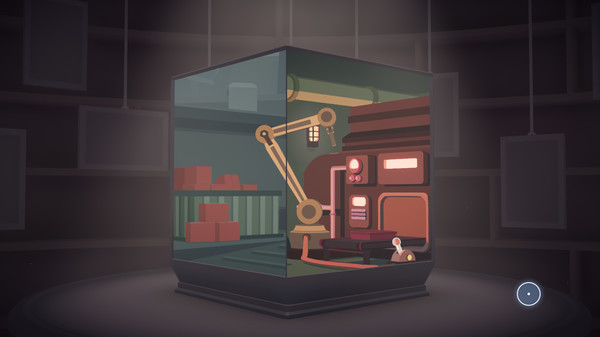 Two adjacent faces of the cube: a shelf of red crates with a yellow crane arm on the left, a machine room of red pipes and glowing gauges on the right — Steam store screenshot
Design Craft
Across all three language cohorts, the most consistently praised element is the hint system. A space-key layer that only marks what is interactable; a text-hint layer that unlocks after a few minutes stuck; three to five staged reveals inside it; and a video walkthrough as the floor. The store page promises exactly this multi-layer guidance, so marketing and experience line up for once.
What is striking is that the praise also comes from inside the negatives. A Japanese reviewer who concludes that the game is monotonous and not recommended still writes, in the same review, that every puzzle game should copy how hints are handed out here. Staged hints translate 'I couldn't solve it' into 'I missed something' — the point I set out in Designing Hint Systems — and Moncage does that translation well.
It has a side effect. When hints are always within reach and the search space is as small as it is, the motivation to keep looking runs out before the puzzle does. One negative review says the hint system mercifully finds things for you, and in the next breath that watching a playthrough on YouTube would probably be more satisfying. A good hint layer resolves the stall and, at the same time, makes the searching itself outsourceable.
Against that care, the replay design is a blank. No chapter select, one autosave slot. The moment you notice you missed a photograph, your only option is to start over. This is the single largest deduction in Chinese, Japanese and English alike; one reviewer sums it up as a game that hurts you in the places that are not the puzzle.
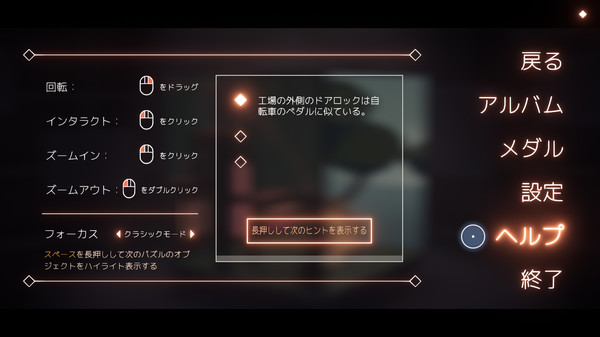 The Japanese-language menu screen: a control legend on the left, a hint panel that unlocks in stages in the middle, and Back / Album / Medals on the right — Steam store screenshot
The Feel of the Story
The story carries no dialogue. It advances through what appears on the cube's faces and through 28 photographs hidden around them; collect them all, play once more, and you reach the true ending. The pool splits by language here too. Short Chinese reviews that end on being moved dominate the top; English and Japanese reviews keep adding the same caveat — the plot is vague and I am not confident I understood it.
Several Japanese reviewers independently write almost the same sentence: my head was on the puzzle, so the story never landed; I must have missed photographs, because the middle onward stopped making sense. I read that as story and puzzle competing for one resource. Observation resolution is finite, and the time spent looking at a face in order to solve it is not time spent reading it.
Moncage deliberately abandons the separation I described in Narrative Puzzles and Storyless Puzzles. Putting both on the same faces of the same cube creates an asymmetry: the more a player stalls, the more story they drop. The missing chapter select then makes that asymmetry permanent. The weak point is not how the story is written but that access to it runs one way only.
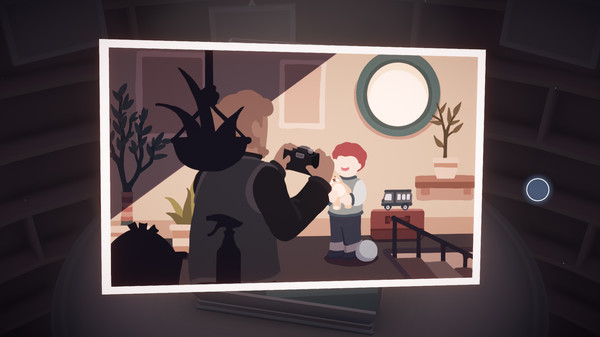 A single framed photograph shown large: an adult raising a camera at a small red-haired child holding an animal, in a room with a round mirror, potted plants and a toy bus — Steam store screenshot
Place in the Lineage
The pool volunteers two names before you ask: Gorogoa and Monument Valley. One long English review frames it as a loop heavily inspired by Gorogoa, done in 3D rather than 2D, which brings in some Monument Valley flavour. Japanese reviewers just say 'the 3D Gorogoa.' The Chinese side reaches for the same comparisons. On this, everyone agrees.
Set inside The Vocabulary of Perspective Puzzles, the shared grammar is treating pieces of two separate pictures as one object. What differs is dimensionality. Gorogoa rearranges four tiles in a discrete space; Moncage rotates continuously. Continuity puts the tolerance near the solution on trial, which is exactly where the complaint 'I had it lined up and it didn't connect' comes from — and on timed puzzles it converts straight into frustration.
One more thing. The negative vocabulary here closely matches what I collected in Counterpoint on Gorogoa: beautiful, clever, and I don't feel like I solved anything. When two games inherit a grammar and inherit the same complaint with it, the fault is likelier in the grammar — silhouette-matching as the main verb — than in either game's execution. Maquette and Superliminal are probably looking for ways around the same hole.
 Under the MONCAGE logotype, an adult and a red-haired child stand inside a glass case with their backs turned, pale butterflies drifting around them — Steam store key art
Sources
This piece was written from the Steam store page's user reviews as of 2026-07-28. No review text is quoted directly; typical claims are reconstructed.
- Steam: Moncage (Very Positive; 5,114 of 5,534 positive across all languages and purchase types, 87% of 619 in English only, 94% of 18 in the last 30 days; snapshot 2026-07-28)
- Read: the ten most helpful English reviews of all time (six positive, four negative, posted between 2021 and December 2025)
- For the larger non-English cohorts: the ten most helpful Japanese reviews (seven positive, three negative, 2021–2024) and the ten most helpful Simplified Chinese reviews. Thirty in total
- Developer statements: the store page copy (layered hints, photograph collection, fifteen medals) and the pinned FAQ plus the save/replay threads on the official forum
- Press: the Eurogamer, Rock Paper Shotgun and Game Informer pull quotes carried on the store page — all of them praising the art and the idea, none touching the replay design
Closing
The store copy sells layered guidance that keeps you from getting stuck. What the most helpful reviews actually describe is not getting stuck but getting bored. The developer designed against the stall; the reviewers reported the grind of rotating. The failure mode that was anticipated and the failure mode that occurred are not the same one, and that mismatch is the most interesting thing in this pool.
Time has barely moved the verdict. A December 2021 negative complains that goals are unclear and interactables under-marked; a December 2025 negative writes almost the same sentence. Four years, one spot. Completion times mentioned in reviews cluster around three hours, recorded playtimes scatter from 2.0 to 12.8, and a full clear takes three passes.
Against 92% across all languages I give it 7.5 on design grounds. Credit for holding three or four hours together on three verbs and silhouette-matching, and for a staged hint system good enough that even the negatives praise it. Two deductions: brute force was never closed off on a board that does not combinatorially explode, and the replay design is a blank. Translated into my own vocabulary, the negative summary — beautiful, not much fun — reads as verbs successfully subtracted, with neither the resolution to aim them nor a structure that rewards searching. It suits people who came for the picture at the moment two worlds lock together, not people buying the feeling of having solved something. The split is a record of range, not of failure.
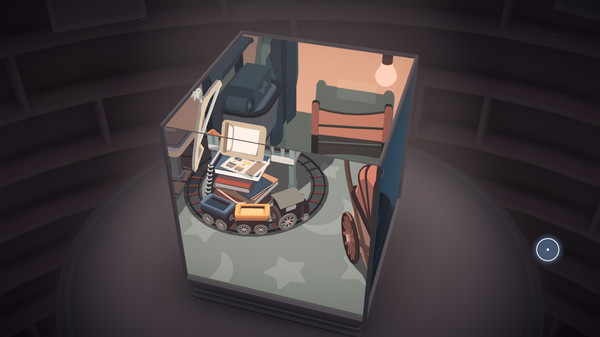 The cube seen from above: a star-and-moon rug on the floor face with a circular train track, a stack of books and an orange toy train; an armchair under a bare bulb on the far face — Steam store screenshot
Where are you with this game?
Press one and the game goes on your shelf. You can see it on your account page.
Reactions (no login)
Anonymous • one of each per visitor per day
Read next

Related reviews
Genesis Noir
A hand-drawn black-and-white point-and-click adventure in which you play No Man, a watch peddler diving through the history of the universe to save his love from the Big Bang — a gunshot fired by a jealous god. Feral Cat Den built it out of tactile puzzles: turn a dial, touch a thing, see what happens.
Happy Game
A point-and-click adventure that walks a sleeping boy through three chapters of nightmare. You pull, turn and pick at the screen to open the way forward, and what waits there is smiley faces, pink bunnies and rooms the colour of blood. Amanita Design's first turn toward horror, scored by the Czech band DVA.
Machinika: Museum
A first-person puzzle box in which you scan alien devices of unknown origin delivered to a museum, peer inside them and reprint their missing parts until they run again. A short piece from Littlefield Studio that opens seven machines one at a time, with the touch of science-fiction archaeology.


