REVIEW · 2021-02-11
The Room 4: Old Sins
Reading the “it got easier” verdict on a dollhouse full of contraptions
First Impressions
The review page opens with a wall of numbers: 17,927 reviews across all languages, 17,657 of them positive and 270 negative — 98%, labelled Overwhelmingly Positive (snapshot 2026-07-30). The last 30 days sit at 96% of 88. Five years on, the verdict has barely moved.
Yet the helpful positives use a narrow vocabulary: relaxing, no stress, polished, and the recurring shape of “it makes me feel smart, then dumb, then smart again.” One line near the top — an escape room for people who don't want other people — says plainly what the game is selling.
The 270 negatives are just as consistent: easiest in the series, tedious, backtracking, chores, “more where's-waldo than puzzle.” They are a small minority, but they point at the same design the positives do. I read that agreement not as a fight but as two readings of one set of choices.
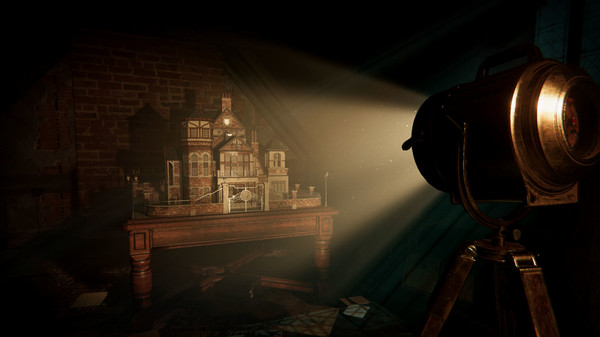 A dollhouse on an attic table, lit from the right by a large lamp — Steam store screenshot
The World: A Dollhouse as a Container
The first thing the positive reviews praise is almost always the dollhouse itself: well crafted, pleasing to look at, rooms that connect to each other. Several reach for the word Inception. You lean into a model on an attic table and find yourself standing inside one of its rooms — that nesting is what their words circle.
The negative side counts the same structure as a loss. Moving between small rooms, they say, cost the series its large-scale machines and set pieces: a ship model solved aboard a ship, ruins, a room-filling orrery. Against those, a kitchen and a study and a garden look ordinary.
As design, this trades scale for observational resolution — no longer surprising you with size, but with depth of nesting. The dollhouse is also a subtraction device: the room frame crops how much you can see at once, so the author controls how much you carry. Calling this the weakest entry is really refusing the exchange rate.
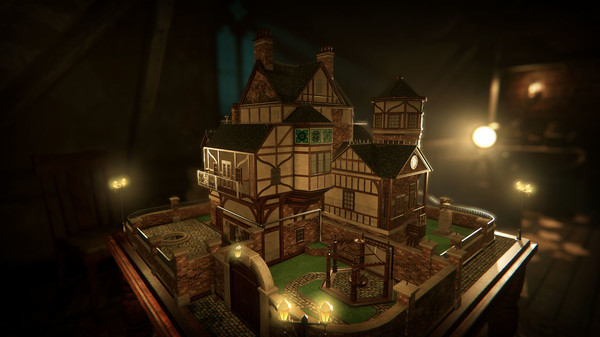 The whole Tudor-style dollhouse, garden and all, seen from above — Steam store screenshot
Putting the Mechanics into Words
One reviewer sums the puzzles up in two words: observation and manipulation. Collect the verbs from the pool and there really are only a few — look, then turn, pull, insert. It is the vocabulary the series has always used, and this entry adds nothing to it. On verb subtraction, it is the cleanest game of the four.
What moved instead is the unit the grammar operates on. The positives keep explaining the same structure: what you pick up in one room is used in another. Seven-odd rooms mesh together and progress stops being a single line. The combinatorial explosion is pruned not by board size but by which rooms adjoin.
The negatives name that shift precisely: with two or three rooms open at once, it becomes a game about remembering which room you saw a thing in. To me that is weight moving from inference to indexing — less tracing a chain of logic, more filing what you saw on the right mental shelf. The argument about difficulty starts here.
 A metal box studded with gears and dials, sitting on a wooden workbench — Steam store screenshot
The Texture of Difficulty
The dispute is about the kind of difficulty, not the amount — both sides agree the game is easy. Barely ever stuck; nothing is timed; safe to recommend to newcomers. Hints come in stages, cost nothing to use, and can be switched off. Not punishing the player for being stuck is a clear, deliberate choice.
Sort the pool's sticking points and they fall into three kinds: the logic of a mechanism, the hunt for something overlooked, and memory across rooms. The first is thin, the other two thick — which is how “easy” and “tedious” can both be true of one game. “Where's waldo” and “chores” are complaints about that ratio.
The learning curve barely climbs. The verbs you learn in the first room carry you to the last; only the number of rooms grows. Call that gentle or call it flat, and the verdict flips. The author aimed at not losing anyone to a wall — which places the players who treasure being stumped for days outside the target.
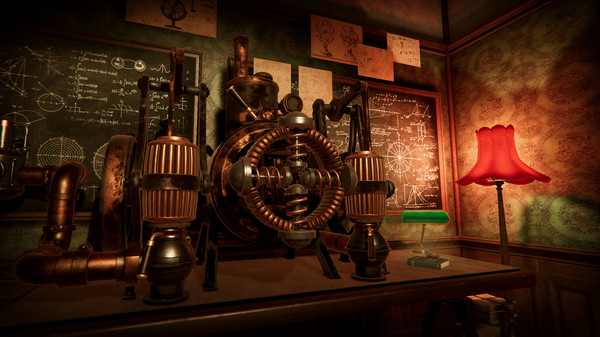 A brass apparatus of gears and rings on a desk, in front of a blackboard of equations — Steam store screenshot
Place in the Lineage
These reviews have a house style: ranking the four games. 4>1>2>3, 4=3>2>1, “the only one of the four worth playing.” Top-helpful and recent alike reach for it. The interest is less in this game's quality than in which seat it takes in the lineage.
What's telling is that the same element decides the ranking either way. Players who found The Room Three sprawling and its late backtracking tiresome welcome this game's smaller scale and rank it first. Players who loved the density of digging into a single box in The Room read the room-hopping as diffuse.
One negative measures from outside the lineage entirely, invoking Riven and Outer Wilds: the puzzles aren't tied to world or story, they are puzzles for their own sake. Is opening a mechanism the pleasure itself, or a means to understanding a world? The Room has always bet on the former, and this complaint lights that bet from the other side.
 A green-walled room with cherry-blossom panels, a wooden spiral stair and a nested wooden cabinet — Steam store screenshot
Sources
This piece was written by reading the user reviews on the Steam store page as of 2026-07-30. No review text is quoted directly; typical claims are reconstructed.
- Steam: The Room 4: Old Sins (Overwhelmingly Positive — 17,657 of 17,927 reviews positive, 98%; 8,851 English reviews; 96% of 88 in the last 30 days)
- Read: the top 10 helpful positive reviews (all time), the top 10 helpful negatives, and the 10 most recent
- SteamDB: The Room 4: Old Sins (release date, developer and genre tags)
- No press reviews were consulted; this piece is limited to reading the user review pool.
Closing
Steam reads 98% positive; my design-critique score is 8.0. The gap isn't a disagreement but a difference in axis: 98% is the share of buyers who didn't regret it, not a measure of puzzle resistance. Even inside that 98% sit caveats — no leap forward like the earlier sequels, and a slightly higher price.
Credit for finding novelty in nested rooms without adding a single verb, and for hints that never punish you. Marks off for difficulty shifting from inference to indexing, and for unskippable room transitions that sit badly with a structure built on going back and forth. Reviews cluster completion around four to six hours.
It suits anyone who wants the feel of an escape room, quietly and alone, or a newcomer wondering where to start. It doesn't suit anyone after the large machines of the first three, or the memory of a puzzle left unsolved for days. What 98% reports is less absolute quality than the fact that this game turns nobody away.
 A stone gazebo and fountain in a brick-walled courtyard — Steam store screenshot
Where are you with this game?
Press one and the game goes on your shelf. You can see it on your account page.
Reactions (no login)
Anonymous • one of each per visitor per day
Read next
Related reviews
Machinika: Museum
A first-person puzzle box in which you scan alien devices of unknown origin delivered to a museum, peer inside them and reprint their missing parts until they run again. A short piece from Littlefield Studio that opens seven machines one at a time, with the touch of science-fiction archaeology.
The Room Two
A first-person escape puzzler in which you peer at, rotate, and pry open strange clockwork boxes, using a special lens to reveal hidden marks. The second Room game widens from a single box to several interlocking contraptions, from the UK studio Fireproof Games.
Genesis Noir
A hand-drawn black-and-white point-and-click adventure in which you play No Man, a watch peddler diving through the history of the universe to save his love from the Big Bang — a gunshot fired by a jealous god. Feral Cat Den built it out of tactile puzzles: turn a dial, touch a thing, see what happens.


