REVIEW · 2015-01-26
Grim Fandango Remastered
The game everyone admits they opened a guide for
Introduction
The setting is the Land of the Dead. You play Manny Calavera, a skeletal travel agent at the Department of Death whose job is selling newly arrived souls their passage to the Ninth Underworld. The story is cut into four chapters, Year 1 through Year 4, and each year swaps the locations and the cast. The original is a late-1990s LucasArts title; the store's copyright line still reads Lucasfilm Ltd. This Remastered edition shipped on 26 January 2015 under Double Fine Productions and Shiny Shoe.
I write this from the Steam review pool. The label is 'Very Positive' — 91% of 7,078 reviews across all languages (snapshot 2026-08-07). Unfiltered, that is 8,037 positive against 836 negative out of 8,873. The English subset is 88% of 3,798; the last thirty days, 88% of 60. A Metacritic 84 badge sits on the page beside pull quotes from IGN (9.3) and Destructoid (9.5).
What makes the pool interesting is that the people recommending it keep making the same confession. I looked it up. Play it with a walkthrough open. Bookmark the hint page before you start. One single-line recommendation says the puzzle logic makes perfect sense once you have looked up the answer and cried. A 91% score buries that confession almost completely. This piece lifts the cover and translates the confession into design terms.
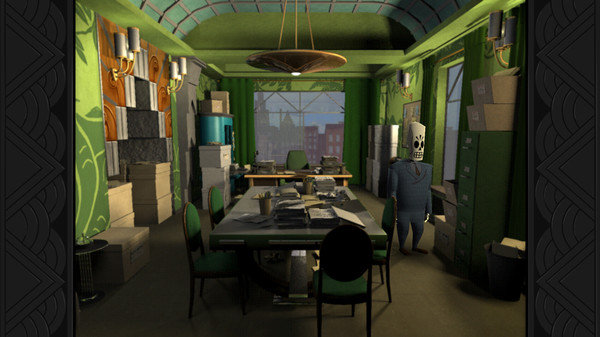 a green art-deco interior with a long table, chairs, filing cabinets and a window onto the city, a skeleton figure in a grey suit standing at the right — Steam store screenshot
First Impressions
The positive vocabulary rhymes: charm, style, timeless, atmosphere — and the voice acting and the soundtrack always get named. Art-deco architecture, figures shaped like Mexican paper dolls, a score that folds jazz and bebop into South American folk. One writer says this is the thing people are missing when they call modern games soulless. Another says that if it were made today it would cost 450 million dollars and be one of the worst games ever made, and thank god it came out in the nineties.
None of that is in dispute. The negative side does not attack it. One of the most helpful pans opens by calling Grim Fandango one of the best video games ever made, then declines to recommend this edition: a progression bug rolled the writer back two hours from Year 4 to Year 3, and he watched the last hour on YouTube instead. Praise and refusal share one review.
So the fault line is not the art or the story. There are exactly two disputes: how the puzzle clues are placed, and how stable an eleven-year-old port is. The rest of this piece takes them in order.
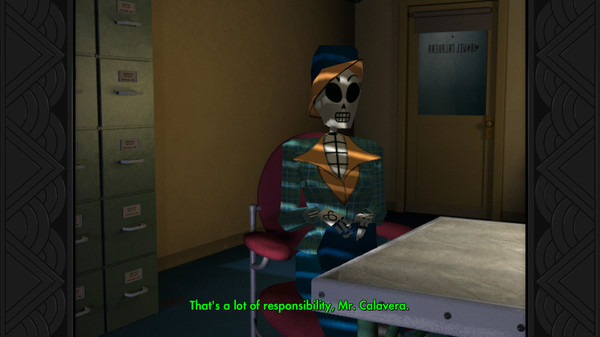 a room lined with filing cabinets, a skeleton in a blue checked jacket and orange scarf seated in a chair, green subtitle text along the bottom — Steam store screenshot
The Feel of the Story
The structural feature the pool names most often is the division into four years. Each year swaps the setting and the cast, and reviewers say they have not seen the shape anywhere else. One pan describes the same shape as a cost: every year you have to work out again who the new characters are and how they relate to Manny. The same design lands as freshness on one side and cognitive load on the other.
Several reviewers call Manny close to a blank slate, then add that the voice and the writing give him a personality anyway, and that his replies stay coherent with the world. In design terms, the observational resolution has been spent on the world rather than on the protagonist's interior. What you read is the architecture, the signage, the way colleagues talk. Which is why so many recommendations mention exhausting every dialogue option just to hear what people say.
The positive side does grant that the story is a straight line. Extremely linear, almost no replay value — that hedge appears inside the recommendations. It matters. If the story does not branch, then whether the story advances is identical to whether the puzzle yields. That identity is what makes the next section heavy.
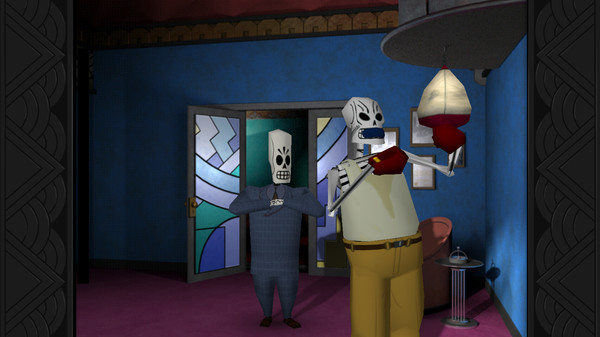 a blue-walled room with a magenta floor: a skeleton in a grey suit stands before stained-glass double doors while a figure in yellow trousers holds a red object — Steam store screenshot
Putting the Mechanics into Words
The verb count is small: look, talk, pick up, use. What the Remastered edition added is not a verb but an input scheme. Mouse-driven point-and-click sits alongside the original tank controls, and reviewers note that both are well implemented and can be swapped at any moment in play. The old and new graphics toggle with a keypress too.
When positive reviews say hidden objects and exits became easier to find, they are describing a rise in observational resolution. Under tank controls, the direction Manny's head turned was the only signal that something was there. The cursor made that implicit signal explicit; one reviewer expects the dead-end highway scene to finally get the attention it deserves. Several simply state that the pixel hunting is gone.
The same change introduces new friction. One pan notes that in some situations you cannot interrupt Manny's walk, so a misclick means waiting for him to finish. The same writer objects that the inventory is slow to open and that items cannot be combined with each other. Searching was subtracted; walking time was added.
That missing item-on-item combination is quietly holding back the combinatorial explosion: you can only try inventory against world, never inventory against inventory. The search space is narrow for this kind of adventure. If people still cannot see the solution, the problem is not the size of the space. It is the density of the clues, and whether you can get back to them.
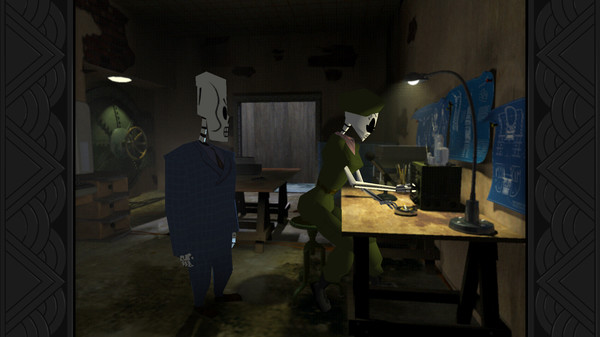 a dim workshop: a skeleton in a dark blue checked suit at the left, a figure in green overalls at a workbench of tools under a desk lamp, blue drawings pinned to the wall — Steam store screenshot
The Texture of Difficulty
This is the main dispute, and it runs inside the positive camp rather than between the camps. One conditional recommendation says the puzzles are extremely convoluted even by LucasArts standards, that half of them make no sense, and that you should play for the story and characters with a walkthrough beside you. Another writer takes the blame himself: difficult puzzles, mostly a skill issue on my part. A third, highly rated, pushes back — people who complain simply are not listening; everything has a legitimate reason, and if you cannot see it you are not paying attention.
Collect where reviewers got stuck and the difficulty separates into three layers. First, finding the object — lowered by the Remastered cursor. Second, working out what the object is for — this is the body of it, and it is high. Third, execution — essentially absent; nothing here fails because your hands slipped. What people call moon logic lives entirely in the second layer.
Why is that layer so high? The pool agrees on the answer. You need to remember a small line of dialogue from two chapters ago. You carry items around with no idea what they are for. The distance between clue and solution is long — and, decisively, most clues sit inside dialogue that plays once. One pan notes that some conversations skip cleanly, some make you wait for the character's mouth to stop moving, and some cannot be skipped at all, with no apparent logic to which is which. That complaint is the same complaint as the difficulty complaint: there is no route back to a clue you missed.
So the defenders are right too. The reasons are there; they are just stored in conversation and cannot be reread. That is not a quantity-of-difficulty problem but a clue-reaccess problem. Return of the Obra Dinn can carry the same volume of information because it hands you a ledger you can open at will; Thimbleweed Park can make puzzles from the same lineage feel gentle because it gives you a hint line. Grim Fandango has neither a notebook nor a hint system. The walkthrough page is doing that job — which is exactly why its admirers all mention one.
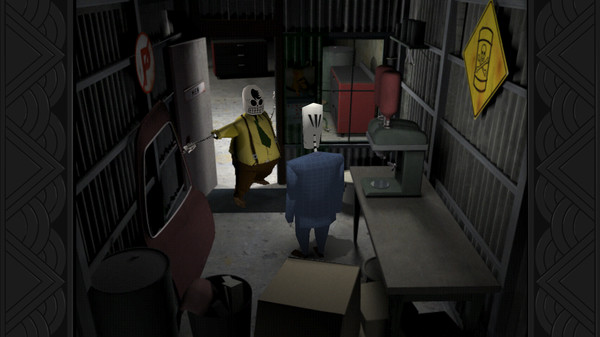 a dark room of metal walls and pipes hung with yellow warning signs, two skeleton figures on either side of a workbench — Steam store screenshot
Sources
Written by reading the user reviews on the Steam store page as of 2026-08-07. No review text is quoted directly; typical claims are reconstructed.
- Steam: Grim Fandango Remastered (Very Positive; 91% of 7,078 reviews positive across all languages. Unfiltered: 8,037 positive and 836 negative out of 8,873. English, 88% of 3,798; last thirty days, 88% of 60)
- Read 21 reviews via WebFetch: the top 10 by helpfulness (all time), the top 10 by helpfulness (last six months), and negative reviews opened on their own pages. Three were negative, and all three cited progression-breaking bugs and control friction
- Compared the Metacritic 84 badge and the IGN (9.3) / Destructoid (9.5) pull quotes on the store page against what users complain about
- Consulted the official store description ('look, sound, and control even better', repainted hi-res character textures, new dynamic lighting, a score re-recorded with a full live orchestra, over two hours of developer commentary) and the user tags (Adventure / Point & Click / Puzzle / Difficult / Escape Room)
- For the progression and saving reports, confirmed the existence of the relevant Steam Community bug board and threads
Closing
Steam reads 91% positive across all languages; my design-critique score is 8.0. Three things to its credit: the four-year chapter structure as a unit of storytelling, the decision to spend observational resolution on the world rather than the protagonist, and a remaster that introduced a cursor and thereby subtracted only the difficulty of searching. Two marks off: there is no route back to a clue you missed, and eleven years after release the progression-breaking reports have not stopped arriving.
The gap between the developer's framing and the players' experience has a clear location. The store says 'look, sound, and control even better', and on control the pool agrees. But the absence of autosave, and the possibility of getting stuck, appear nowhere in the official copy. Across both the most helpful and the most recent reviews, the habit of saving often keeps coming up, along with reports of the game failing to launch under Linux and Proton. What you need to know before buying lives in the review column, not on the store page.
One more number: the median playtime shown on the reviews I read was about fourteen hours, with a low of 6.2 and a high of 29.3. And the split with the professional press is legible. Metacritic 84, IGN 9.3, Destructoid 9.5 — the critics measure the work's standing as an adventure not to be missed, and take nothing off for the clue design. Users writing about the same game say a walkthrough is effectively mandatory. The critics are measuring the work; the users are measuring their fourteen hours. Neither is lying.
So the reach can be stated. It suits anyone who listens to every line and takes notes, anyone who enjoys the detours in the Broken Age and Machinarium lineage. It does not suit anyone who wants to look at a board and think — who wants to assemble a solution from what is placed in front of them. A structure that buries clues in dialogue and never replays them does not meet that way of playing. A 91% score hides the distinction. In a game everyone admits they opened a guide for, whether you read the confession as a virtue or a defect is the whole of the disagreement.
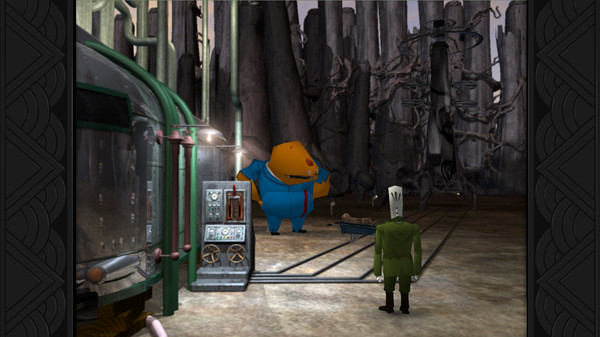 a dark cavernous space where a locomotive-like machine clad in green pipes sits on rails, a large orange and blue creature and a figure in an olive coat standing beside it — Steam store screenshot
Where are you with this game?
Press one and the game goes on your shelf. You can see it on your account page.
Reactions (no login)
Anonymous • one of each per visitor per day
Read next

Related reviews
Please, Don't Touch Anything
You are covering a colleague's bathroom break in front of an unmarked console with a single red button, and you have been told not to touch anything. A pixel-art point-and-click puzzle by Four Quarters about reading the clues hidden in the posters and the wiring to dig out its 25 endings.
Quern - Undying Thoughts
A first-person puzzle adventure: stranded on an island with no way back, you open some fifty doors by working gears, crystals and alchemy, and solved contraptions return, reused, so the whole island reads as one machine. A 2016 homage to Myst and Riven from the four-person studio Zadbox.
The Magic Circle
A first-person meta-puzzle set inside a fantasy game that has been in development for twenty years and is still unfinished. You steal behaviours from creatures and objects, paste them onto other things, and rewrite your way toward the exit. Puzzles have no single intended answer. Released in 2015 by Question, a studio whose members are credited with work on Thief and BioShock.


