REVIEW · 2014-01-28
Broken Age
A Grammar That Snaps in Two: Reading the Split
First Impressions
Broken Age is a point-and-click adventure played by switching between two protagonists: Vella, a girl chosen as a sacrifice, and Shay, a boy aboard a spaceship managed by an overprotective onboard computer. Act 1 shipped on 28 January 2014 and Act 2 in April 2015; developed and published by Double Fine Productions in the US, with Xbox Game Studios later listed as a publisher. I am writing this from the Steam review pool rather than from a playthrough of my own.
The numbers first. Of 8,181 reviews, 6,840 are positive and 1,341 negative; the 4,587 Steam-purchaser reviews carry the label 'Very Positive'; the 3,477 English reviews sit at 82% (snapshot 2026-08-02). The last 30 days are also 82% of 17. Metacritic is 73 for the PC release of Act 2. Twelve years of aggregate holding at the same level means the split is structural rather than a passing accident.
Sort the pool by date and you notice two peaks: praise for Act 1 clustered in January 2014, and verdicts on the whole game from April 2015 onward. The first peak talks about art, voices and script. The second converges almost entirely on one topic — how Act 2's puzzles are built. Neither the helpful positives nor the helpful negatives step around it.
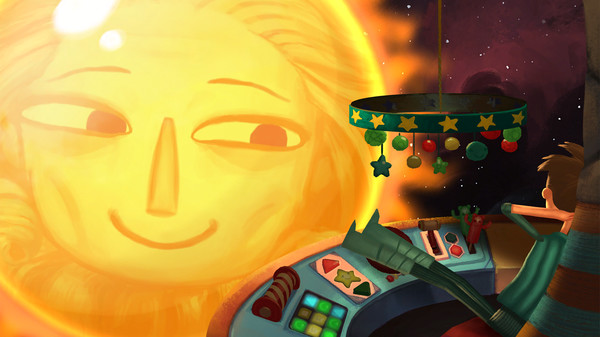 A spaceship cockpit with a huge smiling sun face outside the window, a console of colourful buttons in the foreground and a boy seen from behind — Steam store screenshot
The Feel of the Story
The positives almost always start with the art and the voices: chalk-textured hand-painted backgrounds, a screen that looks like a children's book set in motion, and performances that reach even the smallest roles. The single most upvoted review in the pool (3,042 helpful votes) settles the matter in one line about a spoon here having more personality than most blockbuster protagonists. Many also single out Vella as the spine of the whole thing.
The negatives aim at the back half. The two leads finish as the same people they started as; the weight of what gets revealed is not matched by any change in them; the length looks like a third act folded down into the finale. Those three claims recur across languages. The press draws the same line: TheSixthAxis gives it 7/10 while noting that Act 2 redresses Act 1's locations and cast and that the ending arrives abruptly.
What is interesting as design is that switching between the two leads is at once a narrative and a mechanical device. What you see in one world becomes a precondition for a puzzle in the other. Early on that reads as a story hook — how will these connect? Later it turns into a mechanical demand: you cannot solve this without looking at the other side. Where Thimbleweed Park organised its multiple leads as parallel information sources, this game asks one action to carry both the hook and the demand. Much of the negative reaction reads as a response to that double duty tilting to one side in the second half.
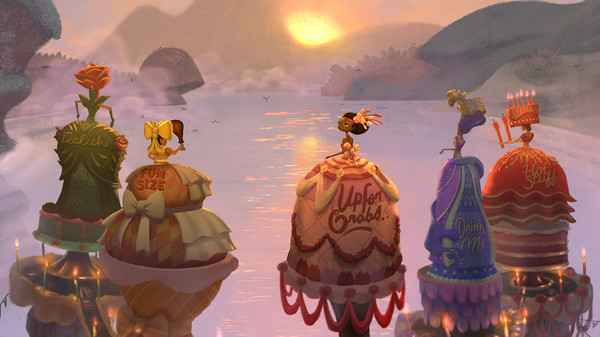 Girls in enormous cake-shaped dresses standing in a row by a lake at dusk — Steam store screenshot
How the Game Teaches
On Act 1's puzzles the two camps essentially agree: good work that never stops the flow, with the reservation that it is too easy. Helpful positives say they never got stuck, never needed a walkthrough, and that the adventure kept rolling; one prominent negative opens by saying Act 1 was genuinely lovely before turning. That degree of consensus is unusual.
The split happens at the door to Act 2. Difficulty jumps by an order of magnitude, the absence of a hint system becomes fatal, you end up reaching for pen and paper. In design terms this is less a learning-curve problem than a grammar problem: the grammar taught in Act 1 is not the grammar demanded in Act 2. Four verbs sufficed in the first half — look, take, combine, talk. The second half adds new layers (read a diagram, cross-reference between the two leads, keep to an order of operations) without a single level dedicated to teaching them.
The vertical wall described in carving the learning curve is not bad in itself. What matters is whether a small step sits in front of it, letting the player rehearse the climb. Act 2 removes the step and keeps the wall. A stuck player therefore cannot tell whether the fault is their own observation, a precondition they never picked up, or an input that is not registering. This is where the missing hint design bites: what several negatives are asking for is not the answer but the sentence that would let them separate those cases.
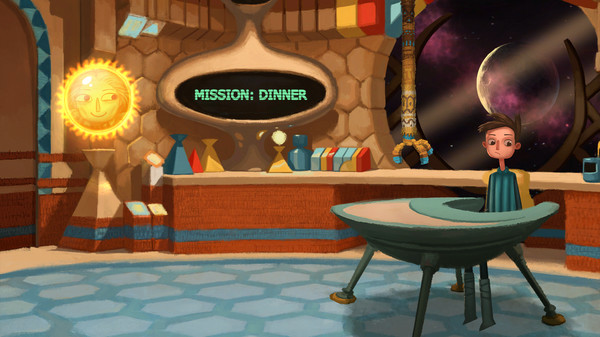 A spaceship dining room: a green display panel reads "MISSION: DINNER" and the boy sits at a round table beneath a smiling sun lamp — Steam store screenshot
The Texture of Difficulty
Collect the places where reviewers got stuck and the difficulty sorts into three kinds. First, procedural: miss a precondition — talk to someone first, carry a particular tool — and the board looks solvable when it is not. Second, notational: a diagram on a wall against a machine's wiring, a sheet of music against an arrangement of stars, where nothing moves until you find the correspondence yourself. Third, input: hard to tell whether to click or drag, and actions that roll back if you are not quick enough.
What is striking is that both camps list the same three in the same order and simply invert the verdict. On the notational kind, positives call the moment it meshes the best thing Act 2 has to offer; negatives call the same scene logical but badly designed. They are looking at the same phenomenon; what differs is how much friction they accept as part of the work. One helpful positive states outright that hard puzzles are not a reason to withhold a recommendation, then mentions spending close to an hour stuck on one of four puzzles.
From a design standpoint the first and third kinds barely count as difficulty. A missed precondition is a side effect of how wide the search space is, and input friction is a question of feel. Negatives written in 2026 still report that Act 2 is impassable on a touchpad, and one long-playtime reviewer guesses that only about a tenth of players reach an ending unaided. Twelve years on, the same three points keep coming up — which suggests this friction was never the kind that tuning would thin out. Measured against the standard in Ron Gilbert's philosophy — never waste the player's time — load that could have been removed is still sitting there.
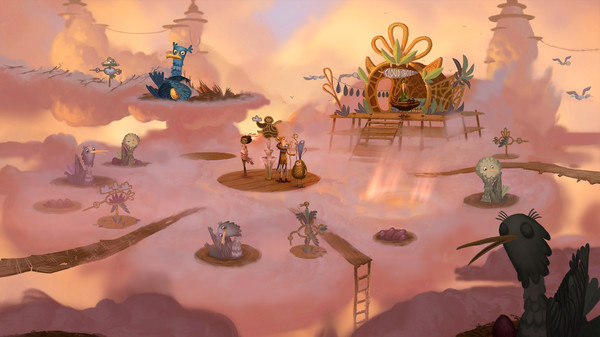 A village floating in a pink sea of clouds seen from above, with wooden walkways, scattered small figures, a gold-trimmed building at right and a large black bird statue at lower right — Steam store screenshot
Sources
Written by reading the Steam user review pool as of 2026-08-02. No review text is quoted directly; typical claims are reconstructed.
- Steam: Broken Age (Very Positive — 6,840 positive and 1,341 negative of 8,181 reviews; 4,587 Steam-purchaser reviews; 82% of 3,477 in English; 82% of 17 in the last 30 days; the 372 Russian reviews are also Very Positive)
- Read in full: the top 10 most helpful English reviews (all time), the top 10 most helpful negatives, and 4 from the recent view (July–August 2026) — 24 in total
- TheSixthAxis: Broken Age Act 2 Review (7/10; notes the reuse of Act 1's locations and cast, the increase in backtracking, and the abrupt finale)
- SteamDB: Broken Age (release date 2014-01-28; developed by Double Fine Productions; published by Double Fine Productions and Xbox Game Studios; asset listing cross-checked)
- Figures: ten candidate images were pulled from Steam's official screenshots API, displayed and inspected one by one, and the five whose contents were legible were assigned to sections. Captions describe only what was actually visible.
Closing
Against Steam's 82% I put 7.4 on design grounds. Two credits: the hand-painted screen and the voice performances have not aged in twelve years, and the structure of switching between two leads still works as an attempt to run story and mechanism through a single action. One deduction, and it is specific: no teaching level sits between the grammar taught in Act 1 and the grammar demanded in Act 2. Nearly all of the pool's disagreement circles that point.
Completion times cluster at roughly ten to twelve hours across review text and hours on record, with Act 1 alone around four — a figure on which the developer's description and the reviewers agree. There is, however, a gap between the store's 'family friendly' framing and what the helpful reviews say about Act 2. The art and voices are indeed family friendly; the second half's puzzles are not. Buying on the store copy and stalling in Act 2 is the core shape of twelve years of negative reviews.
Who it fits is legible straight from the pool. It strongly suits anyone willing to take the feel of a LucasArts-era adventure along with that era's unhelpfulness. It does not suit a player who wants to finish unaided, or who wants a cue for diagnosing why they are stuck. That is a matter of design scope rather than quality — but it is worth recording that the game never offers those players a single sentence. Given that Machinarium shipped a built-in hint book around the same period, this was a choice rather than a limitation.
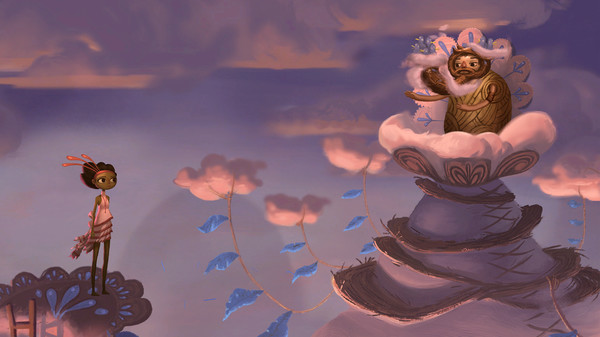 Purple dusk sky and clouds: a girl in a striped shirt stands on a narrow ledge at left, a large brown bird-like creature sits on a cloud pedestal at right — Steam store screenshot
Where are you with this game?
Press one and the game goes on your shelf. You can see it on your account page.
Reactions (no login)
Anonymous • one of each per visitor per day
Read next

Related reviews
Lumino City
A hand-built point-and-click adventure whose entire city was constructed from paper and card, then photographed to become the screen. You climb a tower-like town looking for your grandfather, fixing windmills, gears and fuse boxes to bring the power back. Made by State of Play, the British studio behind Lume.
Day of the Tentacle Remastered
Double Fine's redraw of the 1993 LucasArts game: a broken time machine scatters three friends into the past, present and future of the same motel, and you switch between them, mailing objects across the centuries to stop a purple tentacle from taking over the world.
Grim Fandango Remastered
A 3D point-and-click adventure in which you play Manny Calavera, a skeletal travel agent in the Land of the Dead, following a journey and a conspiracy told across four years. Double Fine's rebuild of a film-noir-meets-Day-of-the-Dead world, with repainted textures, dynamic lighting and a re-recorded live score.


