REVIEW · 2014-12-02
Lumino City
A city built from paper and card, photographed and handed over as a game
First Impressions
Both sides of the review pool open the same way: this city was really built by hand. The studio says the whole town was assembled from paper and card, then photographed to become the screen. The store page calls it a BAFTA winner, and it did take Artistic Achievement at the 11th British Academy Games Awards.
The aggregate is 1,212 positive out of 1,398, or 87%, labelled Very Positive (snapshot 2026-09-18). The interesting part sits outside that number. The top negative review by helpful votes (115) and a top positive one (75) name exactly the same flaw.
That flaw is the walk animation you cannot cancel. The positive side gives it one line as its only complaint; the negative side withdraws its recommendation over it. The disagreement is not about whether the flaw exists. It is about how much it weighs.
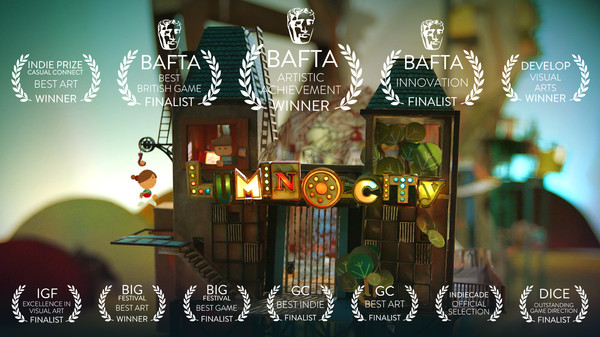 Lumino City in play — screenshot 1 as listed on the Steam store page (Steam store screenshot)
The World
The positive vocabulary clusters on sight: handmade, beautiful, unique, adorable. The metaphors are dollhouse, LittleBigPlanet, Pleasantville. And one phrase keeps returning — Rube Goldberg machine. Many reviewers describe the town itself as one large contraption.
Read as environmental observation, this is unusual. In most games the background is a drawn sign. Here it is paper that was actually cut and glued, so detail does not split cleanly into meaningful and decorative. The ceiling on observation is simply gone.
The negative side calls the same thing an interactive art exhibit. Lovely to look at, they say, but nothing answers when you touch it. The affection people feel for the painted backdrops of Machinarium is close but not identical. That one is a picture; this one is an object.
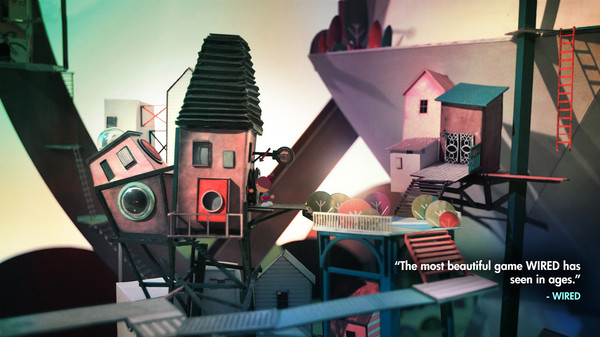 Lumino City in play — screenshot 3 as listed on the Steam store page (Steam store screenshot)
Feel of the Controls
The negative verbs line up neatly: drag, crawl, grind, and fighting the game. The favourite metaphor is glacial pace. The concrete complaints reduce to three. The walk animation cannot be stopped, clickable spots are invisible, and clicks sometimes fail to register.
None of those are puzzle complaints. They are input complaints, and each follows from the material. You cannot add a highlight to a photograph after the fact; the light and shadow were fixed when the shutter closed. Outline a clickable object and that outline stops being paper.
Movement works the same way. The walk is pre-recorded footage, so cutting it short would break the picture, and it plays to the end. What the positive side calls unfussy and the negative side calls waiting is one single constraint. The old point-and-click manners meet a new inconvenience that comes from the material.
Some reviewers infer from the low frame rate and thin options menu that the game was built for handhelds first. That is their inference, not a claim the studio has made.
 Lumino City in play — screenshot 5 as listed on the Steam store page (Steam store screenshot)
Teaching
The game hands you a thick manual you carry inside the world. Controls and hints live in that book rather than in a menu, and the positive side rates it highly. The recurring words are ingenious and effective.
As design, this is subtraction applied to teaching. Tutorial screens, hint buttons, objective markers — everything that normally sits outside the frame is removed and folded into one object inside it. Gorogoa points the same way by carrying no text at all; the difference is that this game gives you something to consult.
Recent reviews complain about granularity, though. Open the book and the answer is more or less written out, with no intermediate step before it. The hint scale has only 0 and 1. A stuck player wants to know where to look next, and instead receives the procedure.
Refusing to highlight clickable spots belongs to the same subtraction. The positive side calls it old-school; the negative side calls it dated. Both are right. It is the opposite bet to The Room, which sculpts every touchable thing until it looks touchable.
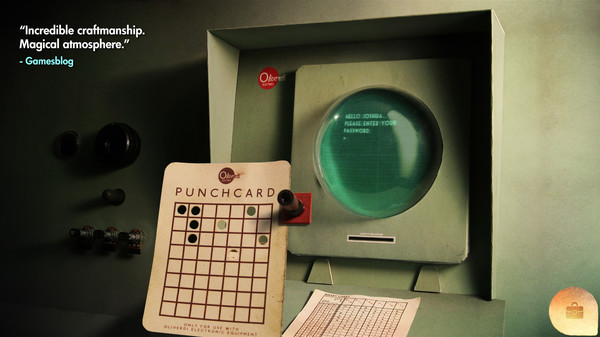 Lumino City in play — screenshot 7 as listed on the Steam store page (Steam store screenshot)
Sources
This article was written from the Steam user reviews as they stood on 2026-09-18.
・Steam: Lumino City (87% positive overall — 1,212 of 1,398 reviews, labelled Very Positive)
・36 reviews read in full: the top 14 positive and top 12 negative by helpfulness, plus the 10 most recent. Developer, release date and awards were checked against Steam's appdetails API and the awards section on Wikipedia.
・Every image here is a screenshot from the official Steam store page, and each URL was checked individually. In this run, however, the environment could not open the image files themselves. Captions and alt text therefore describe no content and give only the position of each image in the store listing.
Closing
Steam's overall figure is 87%; my own score, read as design, is 7.4. The gap has a clear cause. The value of this game lives in its material, and so does its debt — and the debt lands on the input layer rather than the puzzle layer.
Once you decide to build a city out of paper, almost every courtesy of interface goes away: highlighting, interrupting, rewinding. In most games the look is a skin laid over the system. Here the look came first and the system followed. Most of the complaints in the review pool are the price of that order.
Reviewers report finishing in roughly five to eight hours, and both sides mention the short length. Opinions on difficulty split cleanly, with a real share calling it satisfying and a real share calling it brute force, so I have set difficulty at 3, standard.
Recommended for anyone who enjoys looking at a made object through a screen. Not recommended for anyone who wants responsiveness first. That is not a verdict on quality but a question of design reach. State of Play chose to build the city, and in the same move chose what to give up.
 Lumino City in play — screenshot 10 as listed on the Steam store page (Steam store screenshot)
Where are you with this game?
Press one and the game goes on your shelf. You can see it on your account page.
Reactions (no login)
Anonymous • one of each per visitor per day
Read next

Related reviews
Broken Age
A village girl chosen as a sacrifice and a boy aboard a spaceship run by an overprotective computer. Switch freely between their two stories, combining objects to solve puzzles, in a hand-painted point-and-click adventure — built in two acts by Tim Schafer's Double Fine on crowdfunded money.
Primordia
A 2D point-and-click adventure in which a robot called Horatio and his small companion Crispin lose their power core and descend into the city of Metropol. You combine salvaged parts to restart broken machines, and read the ruins for traces of who built you. Made by Wormwood Studios and published by Wadjet Eye Games.
Deponia
A hand-drawn point-and-click adventure set on a planet that has been turned into one enormous rubbish tip, where the self-absorbed Rufus dreams only of escaping to the floating paradise of Elysium above. You combine scavenged junk, talk residents into things they should not agree to, and lever a way out of the scrap. The first of Daedalic Entertainment's three-part series.


