REVIEW · 2012-08-06
Deponia
The critics called the puzzles too tame and the players called them unguessable — reading the inside of an 86.5%
First Impressions
I did not play this one; I am reading how its verdicts stacked up. The numbers first. Steambase counts 14,149 Steam reviews, 12,244 positive against 1,905 negative — 86.5% positive, sitting in the 'Very Positive' band (snapshot taken 2026-08-17). The critics' side, meanwhile, holds a Metacritic PC score of 74, filed under 'mixed or average'.
That asymmetry is the exact inverse of the one I followed the other day in Return to Monkey Island. There the critics were near-unanimous and roughly three in ten players withheld approval. Here nearly nine in ten players recommend it and the critics are the ones hedging. Same genre, same decade, opposite twist.
The shape of the disagreement is stranger still. Sort the professional complaints and they land on 'the puzzles are too tame' and 'the contraptions are ordinary next to the setting'. Sort the player complaints and they land on 'the solutions are unguessable and I needed a walkthrough'. One side finds the same puzzles undercooked; the other finds them wildly overcooked. That contradiction is the line I want to follow.
 Deponia — Steam store asset
Putting the Mechanics into Words
The interaction model is classic point-and-click. No verb list along the bottom of the screen: touch a thing and the contextually appropriate action happens, and beyond that you combine inventory with inventory, or inventory with scenery. The verb axis has been folded down to roughly one.
And yet the single most repeated line on the negative side is that the inventory keeps swelling while nothing tells you what to do next. In Puzzlebyrinth terms, what is happening here is not subtraction of verbs but proliferation of objects. Fold the verbs to one and the object-times-object multiplication survives untouched. The combinatorial explosion has simply moved from the verb axis to the object axis.
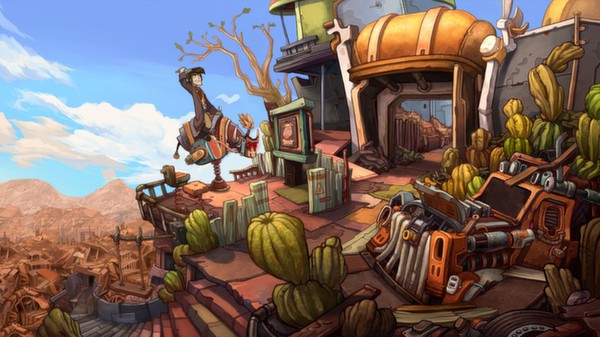
What the positive reviews call 'inventive' and the negative ones call 'moon logic' are two locations in that same search space. The thing separating them is not the amount of difficulty but the resolution of observation — how narrowly the game marks out which things on screen are the relevant ones. Where that marking is loose, a hit reads as invention and a miss reads as nonsense.
 Deponia — Steam store asset
The Texture of Difficulty
What stands out is that the people recommending it talk about walkthroughs too. 'Love the 2D style, look up a guide for the hard ones.' 'Not a puzzle person, still enjoyed it, but I did need help.' Japanese-language reviews with high helpful counts say much the same: the hints are stingy, and between that and the language barrier you will not get far without a guide. Completion times quoted in reviews cluster around seven to thirteen hours, with some first runs reported at five to eight.
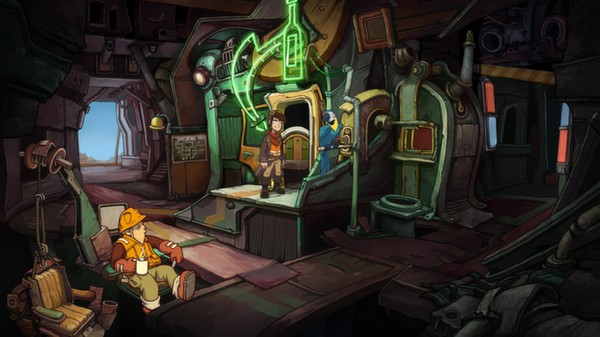
Collect the accounts of getting stuck and the difficulty sorts into three kinds. First, absent signposting — the next goal itself is never stated. Second, single-path execution: you have the idea, but the game wants it performed one specific way, such as clicking the same spot several times. Third, unstated objectives; the forum keeps naming the post office stretch. All three are 'I cannot see the route to the answer' rather than 'the answer is hard to conceive'.
As I argued in Is Difficulty Unkind? The Philosophy of Fairness, fairness is decided by how a game notifies, not by how much difficulty it holds. Almost every stall reported here is a notification problem, which is why it evaporates the moment a walkthrough is opened. Difficulty that evaporates like that is, structurally, occlusion rather than difficulty.
 Deponia — Steam store asset
The Feel of the Story
The proper noun that appears even more often than the puzzles on the negative side is Rufus, the protagonist. 'An irredeemable ass with zero narrative accountability.' 'He laughs at the misery he causes.' 'You play as a prick.' The professional press agrees on this point: GameCritics, scoring it 6.0, writes that it is genuinely unpleasant to help him succeed. Several reviews on both sides also object to how Goal, the love interest, is treated as an object to be carried around.
The positive side reads exactly the same trait the other way. 'A protagonist deliberately built to be disliked.' 'Point-and-click adventure at its purest.' For them Rufus's awfulness is not a defect but a specification, and the engine of the comedy. One element, taken by one group as a design flaw and by the other as a design intention.
As design, this is a problem specific to a genre where the reasoning subject and the acting subject are split. The player solves the puzzle; the protagonist performs the solution and profits by it. The wider that gap, the more the reward for an insight is collected not as 'I was clever' but as 'that man got one over on somebody again'. An unlikeable lead looks like a matter of narrative taste, and is in fact a matter of reward design.
 Deponia — Steam store asset
Place in the Lineage
The proper nouns the reviews reach for are almost fixed. Monkey Island, Grim Fandango, Day of the Tentacle. The negative reviews say go and play those instead; the positive ones say this is their successor. Both are measuring against the same yardstick and disagreeing about whether it passes.
What is interesting is that the yardstick flips by generation. One forum reply defends the game on the grounds that its puzzles are far more logical than the old point-and-click adventures were. To players who came through the unfairness of the 1990s this is a moderate design; to players raised on the gentler conventions that followed, it is a rough one. The same work sits in two different places depending on which past you compare it to.
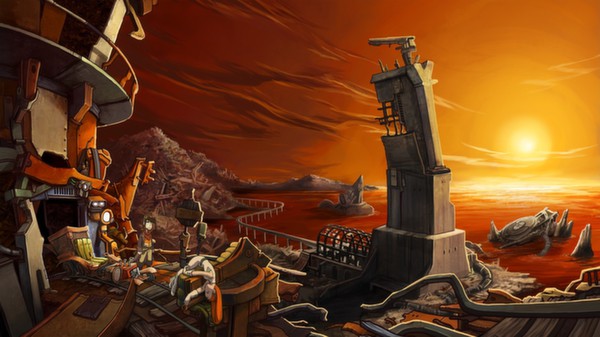
And here the contradiction from the opening resolves. 'Not enough madcap machinery' from the critics and 'the steps are too madcap' from the players hold at once if the eccentricity has been allocated to the procedures rather than to the contraptions. There are few spectacular junk machines; the strangeness has pooled instead in the sequence of actions. The rubbish-heap setting was spent on the size of the search space, not on the design of the devices.
 Deponia — Steam community asset
Reviews Consulted
This piece was written from the Steam user reviews, forum threads and press coverage available on 2026-08-17. No review text is quoted directly; recurring claims have been reconstructed instead.
· Steam: Deponia (86.5% positive of 14,149 reviews per Steambase, 'Very Positive' label, snapshot 2026-08-17)
· Steam Community review listing under the toprated, mostrecent and Japanese-language filters, plus the top negative reviews of the past year and individual review permalinks — around 45 reviews read in total
· the General Discussions thread on the puzzles, and the top reviews of Deponia: The Complete Journey for voices discussing the trilogy as a whole
· Press: the GameCritics review (6.0) and Metacritic PC 74 ('mixed or average'), with the critical summary checked via the Reception section on Wikipedia
· Note: at the time of writing Steam is running Daedalic Days (2026-08-13 to 08-27) and the game is free to keep until 08-20. The recent review feed is accordingly full of very short play sessions and should be read with that in mind.
Closing
One last thing the aggregate hides. Over the past year the top negative reviews are not about the puzzles or the protagonist at all: they are reports of a progression-breaking bug about an hour in. Their helpful counts — 133, 127 — are an order of magnitude above the other complaints. Reviewers say in chorus that the developer abandoned support while continuing to sell the game (that is the reviewers' claim, which I record as such; I have not verified it against any statement from the developer). Fourteen years of accumulated approval barely registers this recent breakage.
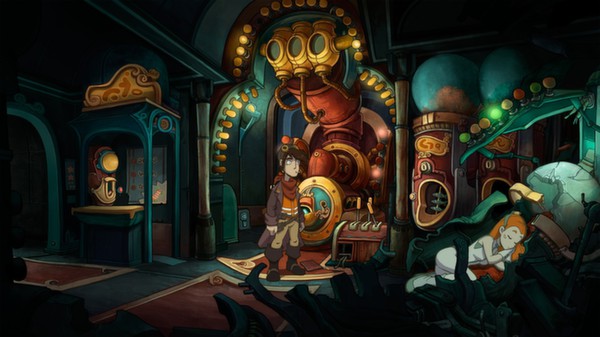
From a design standpoint I put it at 7.2, harsher than Steam's 86.5%. The deduction is not for the amount of difficulty but for the notification design. Praise for the hand-drawn world, the quality of the animation and the voice work is near-universal, and deservedly so. But having widened the search space along the object axis without narrowing down where to look, the game hands the resulting debt to walkthrough sites.
It suits players who can feel fond of 1990s adventure unfairness, or who will forgive a stall for the sake of the jokes and the art. It does not suit players who want to blame their own observation when they fail. When you get stuck here, the thing to doubt is usually not your observation but the screen. Go down into the rubbish heap knowing that, and the heap is well made.
 Deponia — Steam store asset
Where are you with this game?
Press one and the game goes on your shelf. You can see it on your account page.
Reactions (no login)
Anonymous • one of each per visitor per day
Read next

Related reviews
Primordia
A 2D point-and-click adventure in which a robot called Horatio and his small companion Crispin lose their power core and descend into the city of Metropol. You combine salvaged parts to restart broken machines, and read the ruins for traces of who built you. Made by Wormwood Studios and published by Wadjet Eye Games.
Botanicula
A hand-drawn point-and-click adventure from Amanita Design in which five small tree creatures carry the last seed out of their home tree, now infested by parasites. There is no dialogue: you poke at more than 150 locations and pick your way forward by the sounds and movements that come back. Music by the Czech band DVA.
Return to Monkey Island
A point-and-click adventure in which series creator Ron Gilbert returns, three decades on, to the pirate comedy he left unfinished. It replaces the old verb menu with a single context-sensitive interaction, adds an in-world hint book that opens solutions in stages, and sends Guybrush Threepwood after the Secret of Monkey Island once more.

