REVIEW · 2012-12-05
Primordia
A machine in a rusted world goes looking for its own origin
First Impressions
Across all languages and all purchase types, Steam counts 3,323 positive out of 3,444 reviews: 96%, labelled Overwhelmingly Positive (snapshot 2026-09-18). The store page itself shows 97% of 2,407. For a small 2012 adventure that is close to a perfect score.
Read the 121 negative reviews, though, and they collapse into a single complaint. The puzzles are unfair. Pixel hunting, brute force, hints that do not help. Even the wording repeats.
Here is the interesting part. The positive side does not dispute any of it. They write that some puzzles make no sense, and then give a thumbs up anyway. So this 96% is not a number that won an argument. It is a number where no argument took place.
The recent reviews line up the same way: positive, with Beneath a Steel Sky as the usual point of comparison. More than a decade after release, the way people talk about it has barely shifted. The verdict settled early and has not moved since.
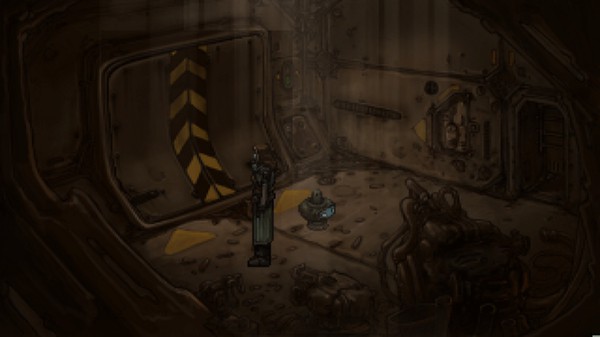 Primordia in play — screenshot 1 as listed on the Steam store page (Steam store screenshot)
The World
Rust and ruin are the words the positive reviews reach for most. Humanity is long gone, and only machines are still running, badly. The store blurb opens the same way: life has ceased, man is but a myth.
Reviewers call this world lived-in. Almost all of them admit the pixel backgrounds are low resolution, and then say it does not matter. What holds the world up is not detail density but the history attached to every object.
In Puzzlebyrinth terms this is a design for observational resolution. It does not raise the information on screen; it raises the resolution of the person looking. Machinarium got there through drawing. This game gets there through fiction and prose.
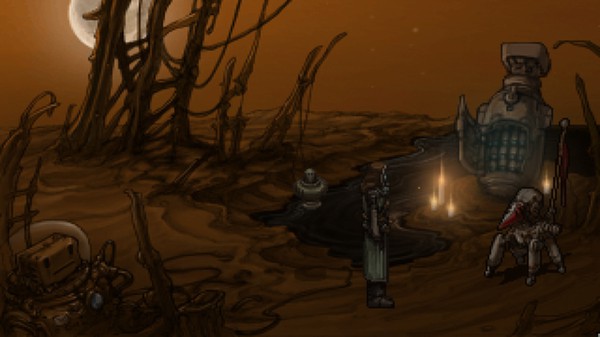 Primordia in play — screenshot 2 as listed on the Steam store page (Steam store screenshot)
The Feel of the Story
The protagonist is Horatio Nullbuilt, a machine looking for the record of whoever assembled him. His companion is Crispin, a small drone who never shuts up. The store page states that Logan Cunningham provides voice work.
What the positive reviews come back to is the double act. One reviewer compared finishing it to closing a book you did not want to end. Faith, makers, the individual against the collective: heavy subjects, light talk. The gap between the two is what people praise.
The negative side names the same gap and calls it a failure. The buddy-comedy register, they say, undercuts the ending of the world. A tonal contrast the game clearly chose on purpose is exactly where the reviews split.
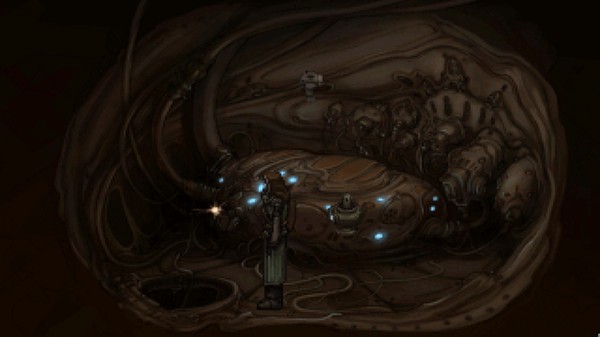 Primordia in play — screenshot 3 as listed on the Steam store page (Steam store screenshot)
Design Craft
The most argued-over piece of design is Crispin's double role. He is a companion character and he is the hint system, at the same time. Talk to him when you are stuck and he nudges you toward the next thing.
The positive reviews call this a hint dissolved into the story: guidance that does not break the world, because a character is the one giving it. Set beside the menu-style hints of Thimbleweed Park, hiding the hint inside the fiction reads as a deliberate choice.
The negative reviews describe the same feature and call it useless. Too vague, they say, to become an actual next move. Both are right, and that is the point. The more a hint dissolves into story, the less precise it is as an instruction. Crispin is that trade-off, made into a character.
There is also a gap between how the developers describe the game and what reviewers report. The store text says optional puzzles deepen the worldbuilding. What reviews actually talk about is getting stuck on the critical path. The optional layer only reaches the players who never stalled.
 Primordia in play — screenshot 4 as listed on the Steam store page (Steam store screenshot)
The Texture of Difficulty
The negative reviews name three ways of getting stuck. Not spotting a small object hidden in the background. Being reduced to trying every item on every object. And being told an item is useless, only for it to become useful later.
The third is the worst, as I read it. The game teaches you that something is a dead end, then quietly changes the premise. The learning curve runs backwards. Players fall back on brute force not because they search badly, but because the evidence the game handed them stops being valid.
So the difficulty here is a question of quality, not quantity. By importing the old manners of point-and-click wholesale, the logic of the world and the logic of the inventory end up running on separate tracks. However careful the writing is, that care never becomes a clue.
Some positive reviews insist the opposite: that the puzzles are logical and never forced them into brute force. The gap is probably explained by how often a player talked to Crispin. Pull the hints and you see the design; skip them and you only meet the wall. The same puzzle becomes a different object depending on how the hint system is used.
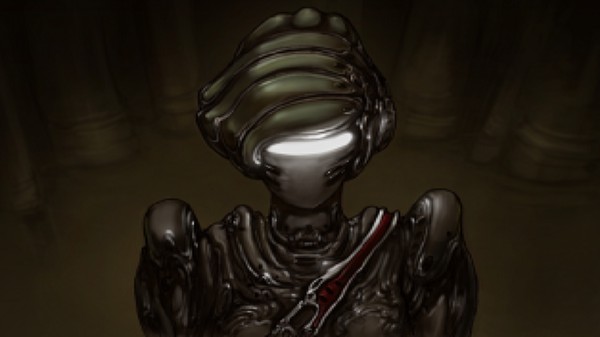 Primordia in play — screenshot 5 as listed on the Steam store page (Steam store screenshot)
Sources
This piece was written from the Steam store page and the Steam review API as of 2026-09-18.
・Steam: Primordia (the store page shows 97% of 2,407; counting all languages and all purchase types gives 3,323 of 3,444 = 96%, labelled Overwhelmingly Positive)
・32 reviews read in total: 12 positive and 12 negative sorted by helpfulness, plus 8 recent. Playtime records were counted across 20 of them.
・Developer, publisher, release date and voice credit follow the Steam store listing.
・Images are screenshot URLs returned by Steam's appdetails API, copied verbatim. This session's network could not open the image files themselves, so only the existence of each URL was verified and the captions deliberately make no claim about what is shown.
Closing
I give it 8.0, which is harder than Steam's 96%. Every point I withhold is withheld from the puzzles. The writing and the world are close to the ceiling for a game this size.
Playtime records in the reviews run from 5 hours to 25, with a median around 12. That spread reads as a difference in how much optional material people picked up. I put the difficulty at the hard end, though many walls fall if you keep talking to Crispin.
Back to where this started. The 96% does not mean the puzzles are good. It means the writing is covering for them. What is unusual is not the score but the honesty: the positive reviews never hide the flaw, and still give a thumbs up. That honesty is the part worth trusting.
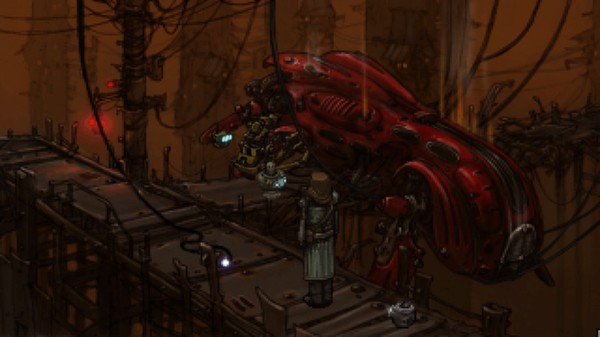 Primordia in play — screenshot 6 as listed on the Steam store page (Steam store screenshot)
Where are you with this game?
Press one and the game goes on your shelf. You can see it on your account page.
Reactions (no login)
Anonymous • one of each per visitor per day
Read next

Related reviews
Deponia
A hand-drawn point-and-click adventure set on a planet that has been turned into one enormous rubbish tip, where the self-absorbed Rufus dreams only of escaping to the floating paradise of Elysium above. You combine scavenged junk, talk residents into things they should not agree to, and lever a way out of the scrap. The first of Daedalic Entertainment's three-part series.
Lumino City
A hand-built point-and-click adventure whose entire city was constructed from paper and card, then photographed to become the screen. You climb a tower-like town looking for your grandfather, fixing windmills, gears and fuse boxes to bring the power back. Made by State of Play, the British studio behind Lume.
Return to Monkey Island
A point-and-click adventure in which series creator Ron Gilbert returns, three decades on, to the pirate comedy he left unfinished. It replaces the old verb menu with a single context-sensitive interaction, adds an in-world hint book that opens solutions in stages, and sends Guybrush Threepwood after the Secret of Monkey Island once more.

