REVIEW · 2015-07-09
The Magic Circle
Rewriting your way out of an unfinished game — reading the review pool
First Impressions
Steam reads Very Positive: 1,389 of 1,502 reviews are positive, 92% (snapshot 2026-09-12). Count English alone and it is 1,189 of 1,290 — 92% again. Splitting by language changes nothing here.
What is striking is how closely the remaining tenth agrees with itself. The complaint is price and length. The most upvoted negative review, at 273 votes, says it ends in four hours without asking you to think, and that the price does not survive that.
The most upvoted positive review, at 890 votes, barely talks about the game at all. It hit a progression-breaking bug near the end, the developers answered within minutes and shipped a fix within the hour, and that is the whole review.
Those two reviews sitting side by side tell you most of what this game sells. The player is trapped inside a fantasy game that has been twenty years in development and is still not done. The subject matter is unfinishedness itself.
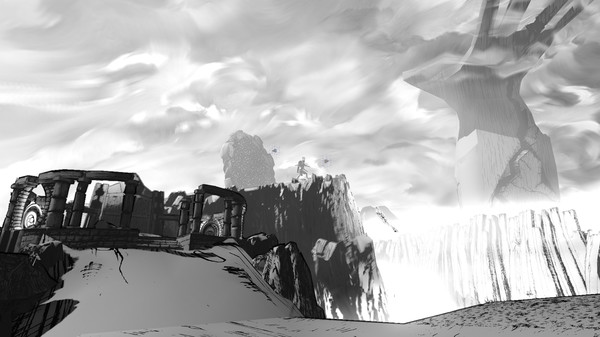 The Magic Circle in play — Steam store screenshot, 1st in the store gallery
Putting the Mechanics into Words
There are two verbs: trap and swap. You take a behaviour off a creature or object and paste it onto something else. In the words of the reviews: give a legless dog the ability to breathe fire, give a key the ability to fly.
The praise that repeats is that solutions are not single. Two players in front of the same door build completely different tools. In our vocabulary, the author left combinatorial explosion in rather than pruning it away.
Baba Is You also makes rewriting a verb, but each board there has an intended answer and the explosion is cut back hard. This game does not cut. It keeps the editing open and loosens the condition for opening the door instead.
So the review pool fills with people reporting what they built: a fire-breathing key, a self-loathing dog with no legs, a mushroom wizard with helicopter blades. What the game wants you to carry away is not a solution but a combination.
 The Magic Circle in play — Steam store screenshot, 2nd in the store gallery
Design Craft
Open editing comes with a cost: the author loses the ability to place difficulty. Close the side routes and freedom shrinks; leave them open and resistance disappears. The negative side's no challenge lands squarely on that.
The developers seem to have known it, and moved the resistance elsewhere. You start able to steal nothing. The load sits in the order you acquire your powers and in noticing which parts of the world are unfinished. You are made to search rather than to stall.
Even positive reviews note a stiff entrance — the early dialogue is awkward. You have to sit through a quantity of satire before the editing gets interesting, and some of the shortest negative reviews are from people who left during that stretch.
One negative review says the endgame turns into a Mario Maker. Editing opens all the way at the very end, so the character of the play visibly changes. A game that begins in subtraction closes in addition.
 The Magic Circle in play — Steam store screenshot, 3rd in the store gallery
The Feel of the Story
The sharpest division is over the satire itself. A director whose game will not finish keeps rebuilding his own cast to protect his vision. Both camps praise the voice work; that part is not contested.
What the negative side dislikes is the tone. Ceaselessly bitter and mean-spirited. A game supposedly about enthusiasm for making games that spends its time sneering at it. Dialogue melodramatic enough to lose people. Those three complaints cover most of it.
Read in recency order and something shifts. A positive review from 2025 treats the game as commentary on early-2010s blockbuster culture, says it no longer bites the way it did, and recommends it as a record of its moment. The satire's reach has shortened with time.
Where Pony Island and There Is No Game: Wrong Dimension mock the form of games, this one aims at how real studios behave. A specific target ages faster than a general one.
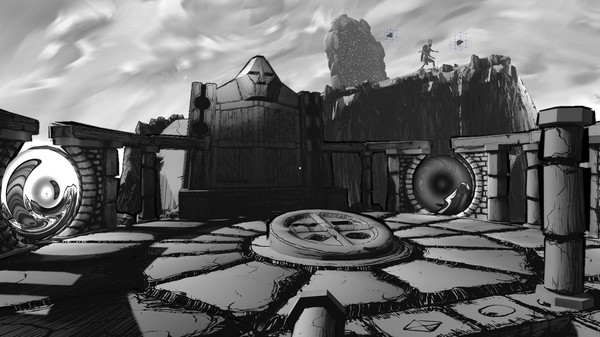 The Magic Circle in play — Steam store screenshot, 4th in the store gallery
The Texture of Difficulty
Both camps agree the difficulty is low. The argument is only over whether that is a fault.
The negative case is concrete: four hours, twenty dollars, watch a Let's Play instead. Across the reviews I read, playtimes scattered between two and nine hours, with the middle sitting around five.
Sort difficulty into three kinds — inference you cannot reach, execution you cannot manage, material you cannot find — and only the third is present. The load is in locating the parts to edit, not in stalling in front of a board.
One positive review reaches for Antichamber, but Antichamber is built to stall you and this is built not to. What they share is only the entrance: being dropped somewhere your assumptions do not hold.
 The Magic Circle in play — Steam store screenshot, 5th in the store gallery
Sources
This piece was written from the Steam review pool as it stood on 2026-09-12. No review text is quoted directly; recurring claims are reconstructed.
・Steam: The Magic Circle (Very Positive; 1,389 of 1,502 reviews across all languages = 92%. English only: 1,189 of 1,290 = 92%)
・Read in full: the top 10 helpful positive reviews, the top 10 helpful negative reviews, and the top 8 sorted by recency, all in English.
・Developer, publisher, release date, store description and screenshot URLs come from Steam's appdetails API, retrieved 2026-09-12. The Thief / BioShock credits are reported by reviewers and have not been checked against a primary source.
Closing
My score is 7.6. It sits below Steam's 92% because the play offers little resistance. Editing freedom and difficulty do not sit easily on the same board, and the authors knowingly took freedom.
What this game leaves behind, though, is not on the difficulty side. It made editing itself — peeling a behaviour off one thing and pasting it onto another — the verb, and it refused to narrow the answer to one. Both still work.
It suits anyone curious about how games get made, and anyone who enjoys assembling something absurd and laughing at it. Around five hours. Buy it on sale is the bass note running under the whole pool, and ten years on that advice still holds.
It will not suit players who want to be stalled, or readers who dislike a sneer. And without some interest in how big-budget games were made in 2015, half the satire passes by. That is not decay; it is the price a work pays for choosing a specific target.
 The Magic Circle in play — Steam store screenshot, 6th in the store gallery
Where are you with this game?
Press one and the game goes on your shelf. You can see it on your account page.
Reactions (no login)
Anonymous • one of each per visitor per day
Read next

Related reviews
Event[0]
A first-person narrative exploration game aboard a retrofuturist spaceship, where you type your own sentences into the ship's terminals to talk with its AI, Kaizen-85, and look for a way back to Earth. Free text rather than dialogue options is the central mechanism, and how you speak changes the AI's attitude and your ending. A 2016 work by Ocelot Society.
OneShot
A top-down puzzle adventure: guide a child through a world whose sun has died, carrying a single lightbulb toward the top of it. Between the item-combining, a handful of puzzles reach out into the player's own computer. From Future Cat.
Grim Fandango Remastered
A 3D point-and-click adventure in which you play Manny Calavera, a skeletal travel agent in the Land of the Dead, following a journey and a conspiracy told across four years. Double Fine's rebuild of a film-noir-meets-Day-of-the-Dead world, with repainted textures, dynamic lighting and a re-recorded live score.


