REVIEW · 2021-07-28
The Forgotten City
Solving a doomed city through a time loop and conversation
First Impressions
I did not walk these streets as a player. What I read is the stack of Steam reviews for The Forgotten City — 96% of 7,112 English reviews positive, labelled "Overwhelmingly Positive," over 10,722 across all languages (as of 2026-07-12).
Across the helpful reviews one instruction repeats: go in blind. The warning against spoilers is itself the praise. Without meaning to, the reviewers keep telling us the game runs on not-knowing.
The other refrain is provenance: many note it began as a Skyrim mod before going standalone, built by a tiny team. My interest is where the positive and negative camps read the very same feature backwards.
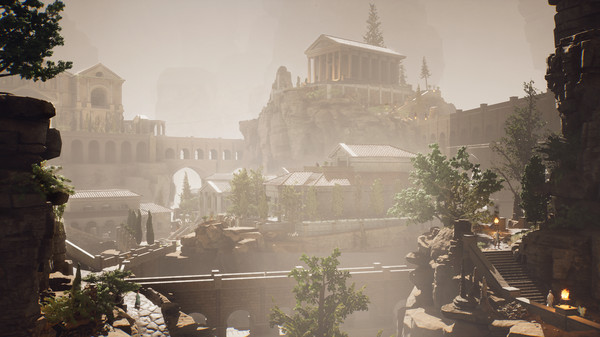 The buried Roman city reviewers insist you enter unspoiled — Steam store
Putting the Mechanics into Words
The positive reviews keep circling one feeling: the loop removes the fear of failure. When the day resets, only your knowledge carries over. They call it "a detective game you can run without a death penalty."
In Puzzlebyrinth's terms, the loop is not a verb but a resolution dial. What you carry across runs is information, not tools; each pass sharpens the same city. It is a puzzle of attention, not of hands.
The single rule binding the city — if one sins, all die — is what they call "elegant." Subtracted to one line, every resident's act becomes a variable against it. Where Twelve Minutes looped a single room, this loops a whole town under one line.
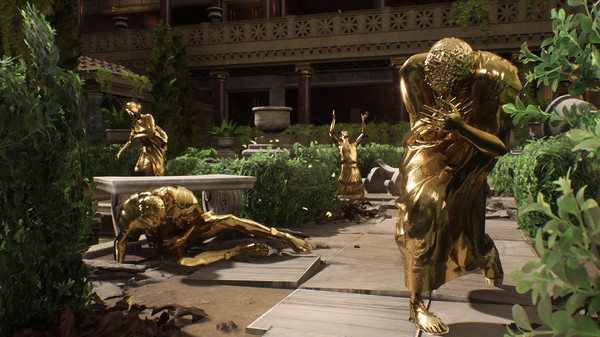 The loop resets the day; only what you know carries over — Steam store
The Feel of the Story
Both camps agree the game is, at heart, conversation. They split on the axis. The positive side calls the writing "witty, philosophical, better than AAA," some likening it to an ethics course, and praises the Roman detail.
The negative side repeats the boredom of "walk, talk, walk back to report," and a discomfort with "modern voices in ancient Rome." The same lines read as clever to one reader and preachy to another.
I read this as reach, not quality. The game puts the pleasure of solving into listening, not deduction. Where Return of the Obra Dinn hits through observation, this advances through dialogue. The more you want to use your hands, the further outside its design you stand.
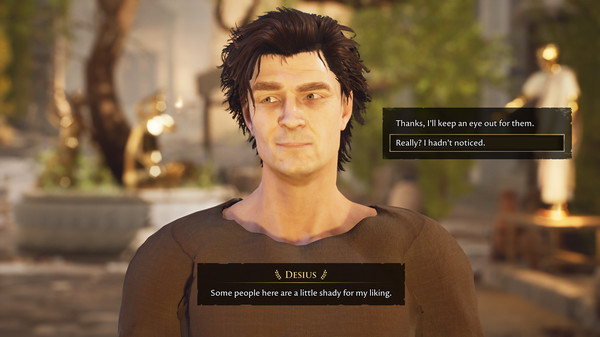
 Questioning the residents — the puzzle lives in listening, not deduction — Steam store
Design Craft
The negatives cluster on two concrete points. One is combat — a late statue-and-bow sequence called "clunky and overlong." The other is rigidity: "effectively four approved endings," and "leaps of faith" required to move on.
The combat echoes the mod-era controls. Even positive reviews are cold on it; here the vote is near-unanimous — a verb the game did not need, lowering the resolution of an otherwise careful experience.
The rigidity runs deeper. The price of binding the loop to one line is a narrow path to the solution. Positive reads it as clear signposting, negative as a tight rail. The same subtraction looks like restraint to one side and confinement to the other — an author's choice, not simply a flaw.
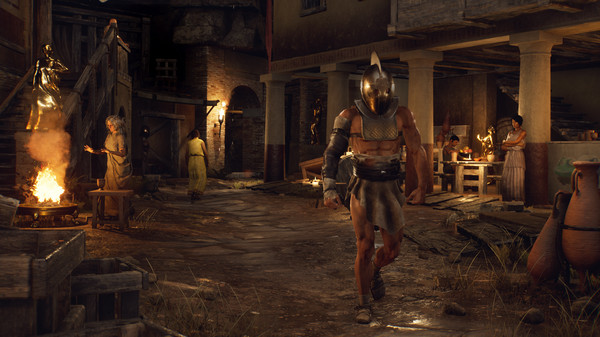 The late bow sequence both camps agree the game didn't need — Steam store
Sources
This piece was assembled from The Forgotten City's Steam store page and user reviews as of 2026-07-12. No review text is quoted directly; typical claims are reconstructed.
・Steam: The Forgotten City (English 96% positive of 7,112; 10,722 all-language "Overwhelmingly Positive"; recent 30 days 85% of 70)
・Read the top 10 helpful positive, top 10 helpful negative, and several recent reviews.
・Metacritic (metascore 85) consulted as a secondary reference.
Closing
My score is 8.5 — below Steam's 96%. The listening design is superb, but the grafted-on combat and the narrow path lower the resolution of the whole. The beauty of subtraction and the confinement it breeds live in the same game.
Recent 30-day reviews sit at 85% (70). A sale likely widened the door to players who did not expect "walk and talk." The game did not change; its audience did.
If you want a puzzle for your hands, this may not look like one. But as a design that runs on not-knowing and solves a city through the resolution of attention alone, its reach is clear. If Outer Wilds moved you, the same organ should respond here.
 A single day of a doomed city, solved by attention alone — Steam store
Where are you with this game?
Press one and the game goes on your shelf. You can see it on your account page.
Reactions (no login)
Anonymous • one of each per visitor per day
Read next

Related reviews
Lacuna – A Sci-Fi Noir Adventure
A pixel-art science-fiction detective game about a murder, a hack, and a bombing that could plunge the solar system into war. By DigiTales Interactive.
The Centennial Case: A Shijima Story
A mystery adventure told in live action, following a chain of killings that has haunted one family for a century. You collect clue words from each scene and slot them into hypothesis sentences, tying four cases across four eras into a single thread. From Square Enix.
The Last Campfire
A 3D puzzle adventure in which Ember, a small lost flame, walks an underground world and works through the small contraptions blocking the stranded souls it finds there. A storybook-shaped project from Hello Games, the studio behind No Man's Sky.


