REVIEW · 2022-05-12
The Centennial Case: A Shijima Story
One game, three different scores
First Impressions
The first thing you notice in this game's Steam reviews is that there is no single score. Across all languages, 898 of 1,130 reviews are positive — 79%, labelled Mostly Positive.
Pull out the English reviews alone and it becomes 171 of 198, or 86%, labelled Very Positive. Pull out the Japanese reviews alone and it becomes 94 of 137, or 69%, labelled Mixed. All figures as of 2026-09-22.
Same live-action footage, same deduction system, same ending. The numbers still split. I read that gap not as a verdict on the game but as a difference in the shelf each reviewer put it on.
The critics split too. OpenCritic's top-critic average sits at 73 across 45 reviews, with exactly 50% recommending. An 8 and a 2 sit side by side on one game.
 The Centennial Case in play — image 1 as listed on the Steam store page (Steam store screenshot)
Putting the Mechanics into Words
Count the verbs and the verb here is not "deduce". It is "arrange". You watch a live-action scene, pick up clue words, and at the end of a chapter you slot those words into a hypothesis sentence.
The negative side keeps coming back to exactly this. They call it dragging clues around, pattern-matching rather than logic. What they are reporting is that no thinking step sits between picking up and putting down.
The binary check is what does it. A placed word comes back either right or wrong, nothing more. The more candidates there are, the more brute force becomes the shortest path. The combinatorics grow, but nothing comes back to narrow the search.
The positive side does not treat this as a problem. They use the hypothesis board as a quiz after the footage. The same board looks like busywork to one group and like a chapter summary to the other.
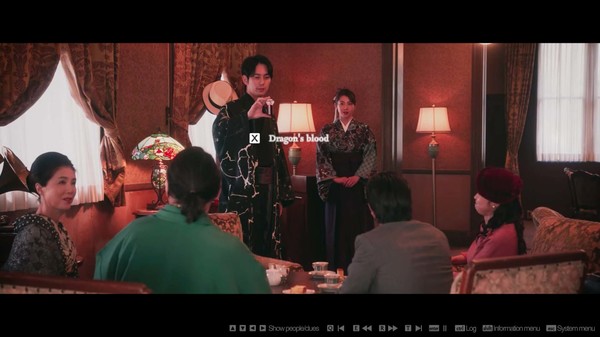 The Centennial Case in play — image 2 as listed on the Steam store page (Steam store screenshot)
The Feel of the Story
The positive vocabulary is remarkably uniform. A game that comes along once every ten or twenty years. A mystery like this barely exists. The production is on another scale. What they praise is less the story than the sheer amount of footage.
They are responding to the labour of it — a lead actress carrying a century of separate roles. Jon Bailes, writing for the Washington Post, likewise noted that the writing and performances sit clearly above the live-action-game average.
The negative side praises the first half too. The split happens late. Twists arrive in an avalanche; the game breaks rules it set itself. In the Japanese pool, the most-upvoted complaint is that a premise the game states out loud is overturned in the final chapter.
So the objection is not that the story is dull. It is that the story overwrote a rule it had already published. Detective fiction calls that a fair-play problem. Puzzle design calls it uniqueness of solution. Two cultures, two names, one constraint.
 The Centennial Case in play — image 3 as listed on the Steam store page (Steam store screenshot)
The Texture of Difficulty
On difficulty the review pool is unusually clear: it is not hard. Both language pools produce some version of "this isn't a mystery, it's just a puzzle". Reports of being stuck are almost absent.
And yet the words "tedious" and "a chore" keep appearing. That is a report of fatigue without difficulty. The cost is not in the search; it is in the handling — transition animations, menu round trips, scene loads.
The recorded hours are worth a look. Many of the negative reviews sit between roughly thirteen and thirty-plus hours. These are not people who bounced off early. They watched the whole thing and got off at the end.
When a game splits opinion without difficulty being the subject, the fault line is usually somewhere outside difficulty. Here it lies in the rules of the final chapter and in the number of motions the board demands.
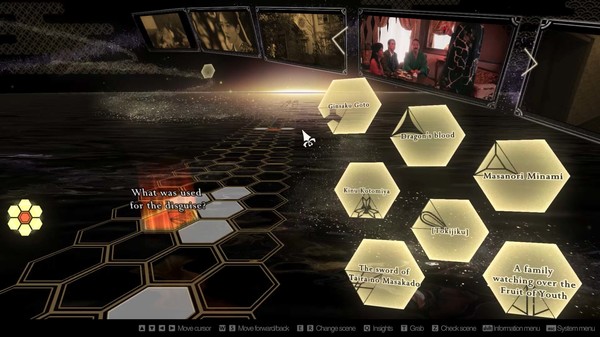 The Centennial Case in play — image 4 as listed on the Steam store page (Steam store screenshot)
Place in the Lineage
Back to the three numbers. The English pool sits at 86%, the Japanese pool at 69%. I read those seventeen points as a difference in what each pool is comparing the game against.
The English-language shelf holds Her Story, Contradiction: Spot the Liar! and The Shapeshifting Detective. Live-action games are normally made on very little. On that shelf, this one's production looks exceptional. "Once every ten years" comes off that shelf.
The Japanese shelf is different. The visual grammar of the two-hour TV suspense drama sits there alongside the mystery adventures that follow Ace Attorney. There, the production volume is a premise rather than a surprise, and judgment moves to how the rules are handled. The harsh phrase — that it cheats as a mystery — only appears on that shelf.
Neither shelf is wrong. The same board is simply being marked against two different rubrics. What lets Return of the Obra Dinn and The Case of the Golden Idol travel across shelves, I think, is that neither of them bends its rules at the end.
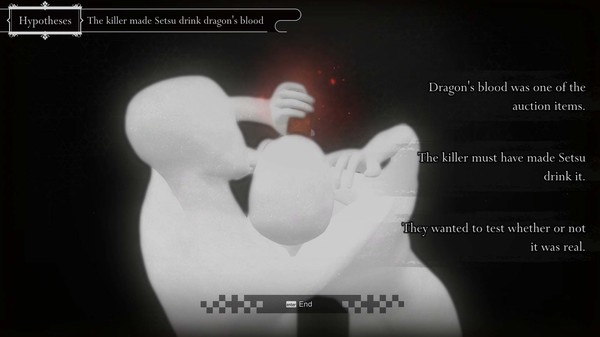 The Centennial Case in play — image 5 as listed on the Steam store page (Steam store screenshot)
Reviews Consulted
This piece was written by reading the user reviews on the Steam store page as of 2026-09-22. No review text is quoted directly; typical claims are reconstructed.
・Steam: The Centennial Case : A Shijima Story (898 of 1,130 reviews positive across all languages = 79%, labelled Mostly Positive; the English pool is 171 of 198 = 86%, Very Positive; the Japanese pool is 94 of 137 = 69%, Mixed)
・Read in full: the 10 most helpful positive reviews, the 20 most helpful negative reviews across both the English and Japanese pools, and 8 recent ones (38 in total). Aggregate figures come from the query_summary returned by Steam's review API.
・The Washington Post: The Centennial Case review (Jon Bailes) / OpenCritic: top-critic average 73 across 45 reviews, 50% recommending
・The images are the store screenshot URLs returned by Steam's appdetails API, used verbatim. This environment could not reach Steam's image hosts, so their contents could not be inspected; the captions therefore do not identify what is depicted.
Closing
From a design standpoint I give it 7.2. That lands close to Steam's 79%, but for different reasons.
Two deductions. First, the verb is "arrange" while the check is binary. Second, the final chapter overwrites a rule stated earlier. The first is a cost problem; the second is a trust problem.
Two credits as well. The sheer volume of footage, and the structure that crosses a century in four cases. A design where the same face returns across cases as different people only works in live action.
What to check before buying is not the score. It is which shelf you will put this on. If it goes on the live-action shelf, it will almost certainly land. If it goes on the fair-play detective shelf, you will have one argument to have, in the final chapter.
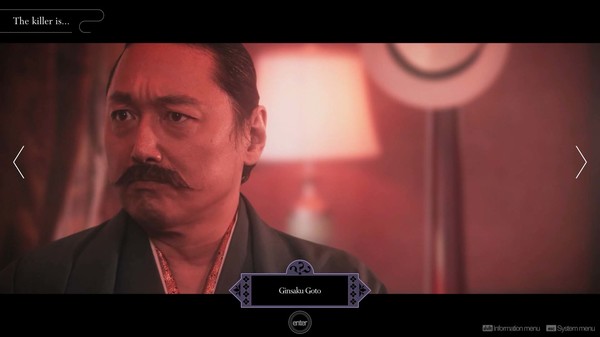 The Centennial Case in play — image 6 as listed on the Steam store page (Steam store screenshot)
Where are you with this game?
Press one and the game goes on your shelf. You can see it on your account page.
Reactions (no login)
Anonymous • one of each per visitor per day
Read next

Related reviews
GNOSIA
A single-player take on Werewolf: find the Gnosia hiding among the crew using nothing but discussion and votes. Up to fifteen crew members are redealt into different roles each loop, and a time loop sends you through the same voyage again and again. From Petit Depotto.
Syberia: The World Before
A third-person adventure in which lawyer Kate Walker moves between two timelines — a girl named Dana in the 1930s and Kate's own present — retracing the history of the city of Vaghen alongside the automaton Oscar. Progress comes through assembling mechanisms and hint-assisted exploration. Microids' fourth entry in the series.
Chinatown Detective Agency
A cybernoir point-and-click set in near-future Singapore, where you run a detective agency and crack international cases by researching real facts in a browser outside the game. General Interactive Co.'s experiment hands the last step of every clue to the live web.


