REVIEW · 2015-07-10
Contradiction: Spot the Liar!
What the notebook forgets, you brute-force - reading 3,243 Steam reviews
First Impressions
I read the Steam review pool for Contradiction: Spot the Liar! as it stood on 2026-08-23. Of 3,243 all-language reviews, 3,084 are positive - about 95%, labelled Overwhelmingly Positive. Metacritic shows 72 from four critics and a user score of 8.2 from 42 ratings.
The premise first. A woman has drowned in the small English village of Edenton, and Detective Inspector Frederick Jenks spends one evening, 5pm to midnight, deciding whether it was suicide. Everything is live-action video, and new places and events open as the hours pass. Baggy Cat developed and published it; Tim Follin designed it and wrote the music. The iPad release is dated 14 January 2015, the Steam release 10 July 2015.
Across the helpful positive reviews, the recurring subject is not the puzzle. It is Jenks's acting, the village atmosphere, the deliberate camp, and watching it on a television with family. The most-upvoted positive review lists narrow choices, uneven performances and a guided-tour structure, and still recommends it.
The negative side converges on one point instead: the game refuses contradictions that are logically sound. Both columns are looking at the same evening from different heights, and this piece reads that difference as design.
 Screenshot #1 as published on the Steam store page
Putting the Mechanics into Words
There is only one verb here: pick two statements and pair them. What people say accumulates in a notebook, and you choose two entries from it. Land the pair and the character starts explaining themselves, which opens a new topic. Instead of pushing or carrying, you point.
The grammar of that verb is the problem. Even positive reviewers note that some contradictions are a stretch, and that a pair will not form unless you happened to raise a specific topic first. The negative column presses harder: obviously clashing statements are simply not accepted. DarkZero gave it 8/10 and still wrote that the developer's internal logic collides with player intuition, turning deduction into guessing.
So the verb is checked by matching, not by inference. One authored pair is correct, and the rest of your reasoning is invisible to the game. In Puzzlebyrinth's terms, raising your observation resolution earns you nothing. Return of the Obra Dinn confirming only in threes, and The Case of the Golden Idol handing you a finite word bank, exist precisely to stop that slide into guessing.
 Screenshot #2 as published on the Steam store page
The Texture of Difficulty
The most concrete report in the negative column is about the shape of the work. You get one new topic from one resident, then take it round the other five in turn. Then you get another, and go round again. Several reviews describe that loop wearing them out.
Why is the loop the shortest path? Both columns say the notebook misses things, and you cannot confront anyone about a topic you never raised. The externalisation of memory stops halfway, so the player fills the gap with their own head and legs. Where a mystery keeps its memory is the subject of our article on in-game notebook design.
Three kinds of wall are worth separating: noticing, covering, and reverse-engineering the author's logic. The stuck moments in this pool are almost all the second and third. Reviewers on both sides say the culprit is guessable early, so the first wall barely does any work.
A hint button and a phone call to the chief were in the game from the start, which reads like the author knowing about the third wall. But a hint only automates coverage; it does not repair the notebook.
 Screenshot #3 as published on the Steam store page
The Feel of the Story
What the positive column really values is probably the performance. Jenks's oversized gestures are read as calculated camp rather than failure, and many reviews describe hooking up a television and watching with other people in the room. It is consumed less as a puzzle than as a mystery play you are allowed to interrupt.
The negative column's strongest charge is the ending. Threads are dropped, the motive deflates, the story stops in a way that assumes a sequel. One review says ninety-five per cent of the investigation turned out to be irrelevant to the resolution.
No sequel arrived. Follin is recorded as saying in 2023 that he still wants one but does not have an ending he is happy with. The loose threads look like a shipping decision rather than an accident - but ten years on, the gap has hardened into part of the verdict. Her Story, released the same year, closed its fragments into a finished object, and the contrast is not small.
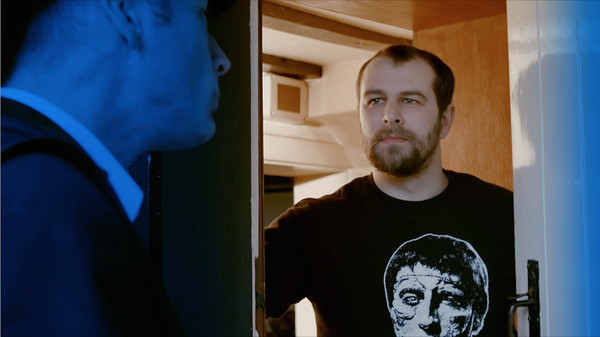 Screenshot #4 as published on the Steam store page
Sources
This piece is written from the Steam user reviews as they stood on 2026-08-23. No review text is quoted; recurring claims are reconstructed instead.
- Steam: Contradiction: Spot The Liar! (3,084 positive of 3,243 all-language reviews, about 95%, labelled Overwhelmingly Positive)
- 34 reviews read in full: the top 12 helpful positive, the top 12 helpful negative, and the 10 most recent
- Metacritic (72 from 4 critics; user score 8.2 from 42 ratings; Multiplayer.it 85, Gamer.nl 80, DarkZero 80, PC Gamer 58), of which DarkZero (8/10) and AppUnwrapper were read in full
- Credits, release dates and reception come from the Wikipedia entry
- The images are store screenshots returned by Steam's official API. The image CDN is unreachable from where this was written, so they were not inspected; captions state only the asset type and its position on the store page.
Closing
The aggregate once more: Overwhelmingly Positive, roughly 95% of 3,243 all-language reviews (2026-08-23 snapshot). Metacritic averages 72 across four critics, the lowest being PC Gamer at 58, with a user score of 8.2 from 42 ratings. Small samples, but the gap between 95 and 72 is legible in the review text itself.
From a design standpoint I give it 7.2. Credit for building a whole evening on a single verb - point at the lie - and for the amount of information a real human face carries. Two deductions: the correct pair is authored and unique, and the notebook does not take on the whole burden of memory. Together they move the object of thought from who lied to which combinations I have not tried yet.
Playtimes shown in the review pool cluster around seven to nine hours. I put the difficulty in the middle: the wall of understanding is low, the work of covering everything is heavy. I would recommend it not to someone who wants to assemble a deduction, but to someone who wants to spend an evening with an odd detective - ideally with another person beside them, talking at the screen. That is probably the seat the 95% was voted from.
 Screenshot #5 as published on the Steam store page
Where are you with this game?
Press one and the game goes on your shelf. You can see it on your account page.
Reactions (no login)
Anonymous • one of each per visitor per day
Read next

Related reviews
Else Heart.Break()
A Swedish adventure set in the electric town of Dorisburg, where you carry a device that opens up the insides of almost anything. Coffee makers, doors and buses all run on source code written in the game's own language, and you edit it directly. Led by Erik Svedäng and released in 2015.
Phoenix Wright: Ace Attorney Trilogy
A courtroom adventure in which you play defense attorney Phoenix Wright, matching one line of testimony against one piece of evidence to break a lie. Capcom's collection gathers all fourteen episodes of the three games first released between 2001 and 2004, with the art redrawn frame by frame.
Thimbleweed Park
A point-and-click adventure about a 1987 small-town murder, switching between five characters — two FBI agents, a ghost, a foul-mouthed clown and an aspiring game developer. Its nine-verb SCUMM-style interface was rebuilt for modern machines by the creators of Maniac Mansion and Monkey Island.


