REVIEW · 2015-09-24
Else Heart.Break()
The four hours before the verb arrives
First Impressions
Steam's label reads "Mixed." Across all languages and purchase types, 563 of 843 reviews are positive — 67% as of 2026-09-28. Narrow it to English and it is 425 of 656, or 65%; the label does not move. The game shipped in September 2015.
The shape of the split is unusual, though. The two sides are not describing different games. They point at the same spot in the same design. There is only one fault line: for the first few hours, this game hides its own verb.
The numbers show it. Line up the most recent reviews and the negative ones carry playtimes of 9, 14, 52, 54 and 88 minutes. The positive ones read 775, 1,138, 1,907 and 3,425. The distribution of opinion looks less like a distribution of taste than a distribution of how far people got.
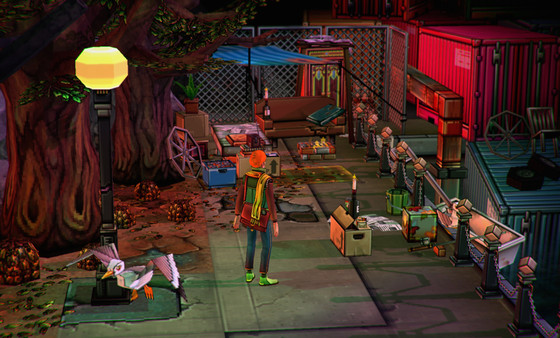 Else Heart.Break() in play — image 1 as listed on the Steam store page (Steam store screenshot)
Teaching
The complaint the negative side repeats most is about time thrown away. "Walked around lost for an hour." "It took me 4 hours of just wandering around, not knowing what I was supposed to be doing." "2+ hours into the game to introduce the main gimmick." And then: never even reached the programming at all.
What is striking is that the positive side does not deny that stretch exists. They write "endure the first few hours." "Starting slow." "Quite hard to get started, but." Both sides are looking at the same slope. The only difference is whether they got to the top.
Put in design terms, the game delays handing out its verb. Human Resource Machine and TIS-100 give you the verb on the first screen and then add grammar. Here the verb itself is left somewhere in the town, and finding it is the opening problem.
As a wager it makes sense: a tool you found yourself feels stronger than a tool you were handed. But a wager leaves the people who lose it holding nothing. Placing no signpost at all is, to my reading, subtraction taken one step too far. Without planting an arrow, the town could still have spoken up once.
 Else Heart.Break() in play — image 3 as listed on the Steam store page (Steam store screenshot)
Putting the Mechanics into Words
Once the tool is in hand, the tone of the reviews changes outright. "Dorisburg became my sandbox." "A fully programmable world." "A surprising range of objects have working source code." Even people who voted the game down stop to add that the hacking system is excellent.
There is one verb: read the insides, then rewrite them. What matters is that it does not discriminate. Coffee makers, doors, phone lines, people — all open the same way. Instead of grammar accumulating, the scope jumps to world-sized in a single step.
In Puzzlebyrinth terms, this puts combinatorial explosion at the centre of the design. Where Quadrilateral Cowboy let you touch the world only through the window of a terminal, this takes the window away. When a reviewer writes that your imagination is the ceiling, it is not hyperbole.
The cost comes from the same place. "The game didn't acknowledge most of my actions." "The triggers stopped triggering." "You can softlock yourself pretty easily." The single path the author drew is a thin line inside an exploded solution space, and a good share of the bug reports read as reports of having stepped off it.
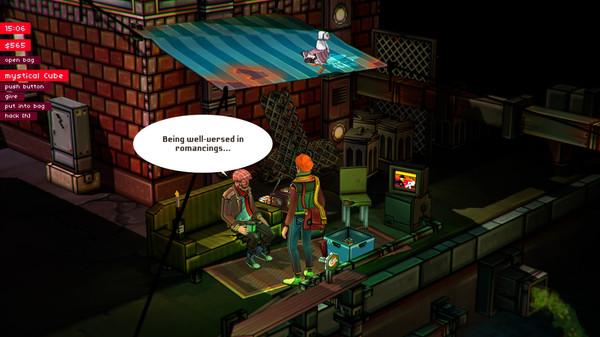 Else Heart.Break() in play — image 5 as listed on the Steam store page (Steam store screenshot)
The World
On the town itself, the two sides invert neatly. The positive reviews call it "a colorful, weird and dense town" whose inhabitants "have their own lives and routines." The negative ones call those same inhabitants "theme park robots."
They are looking at the same thing. It is precisely because the routines really run that the characters look robotic wherever no script was written. The more hand-written responses you add, the more visible the gaps between them become. That seems to be the tax on a dense world.
On the dialogue and the story, the two sides barely disagree at all. The positive reviews also say the writing is stiff, that the relationships feel forced, that the endings land flat. Several name the handling of the protagonist's romance directly. What is actually split is not the quality of the story but whether the sandbox pays for it.
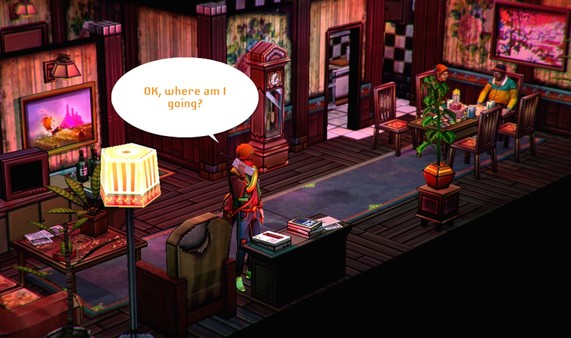 Else Heart.Break() in play — image 7 as listed on the Steam store page (Steam store screenshot)
Place in the Lineage
The titles reviewers reach for come from two different shelves. On one: TIS-100, Human Resource Machine, Quadrilateral Cowboy, the Zachtronics catalogue. On the other: Deus Ex, Shenmue, Majora's Mask, Watch Dogs. The programming shelf and the walk-around-a-city shelf.
What separates the shelves is scoring. On the TIS-100 side the problems are closed, and whether you solved one is always adjudicated. On the city side nothing is closed and nothing is adjudicated. Else Heart.Break() takes the tool from the first shelf and puts it down in the second place.
That is why the reception splits. Arrive expecting a puzzle game and you find it not very challenging; arrive expecting an adventure and you find it tells you nothing. Neither reading is wrong. Nauticrawl and Duskers built a similar tension by handing you a machine with no manual — but those machines were small, and so was the space you could get lost in.
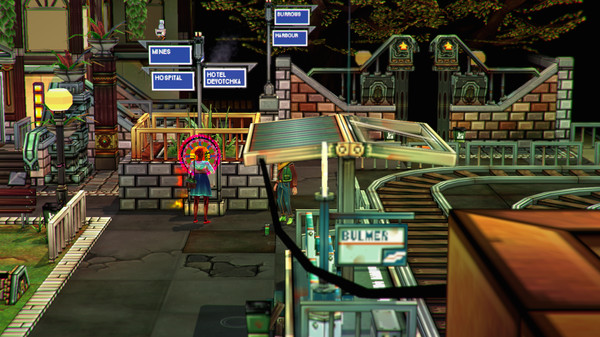 Else Heart.Break() in play — image 9 as listed on the Steam store page (Steam store screenshot)
Reviews I Read
This piece was written from the user reviews on the Steam store page as of 2026-09-28. Nothing is quoted directly; recurring claims are reconstructed.
・Steam: Else Heart.Break() (all languages: 563 of 843 positive = 67%, labelled "Mixed"; English pool: 425 of 656 positive = 65%, also "Mixed")
・Read the top 15 helpful positive, top 12 helpful negative, and 10 most recent reviews — 37 in all. Aggregate figures and playtimes come from the query_summary and playtime_forever (minutes) returned by Steam's review API.
・For the developers' own framing I used the store description: "A game about friendship, love and technology in a place where bits have replaced atoms." No specialist-press review is cited; I could not find a reliable one this time.
・The images are the store screenshot URLs returned by Steam's appdetails API, used as-is. This run could not reach Steam's image hosts, so I could not look at the pictures themselves; the captions therefore do not identify what is shown.
Closing
Against Steam's 67%, I land on 7.0 on design grounds. That is not the average of a high idea and a rough build. The tool has not aged in ten years, but the hours before the tool arrives cut down the audience the game can reach. The reception is not so much divided as thinned at the door.
Playtime varies widely. The positive reviews scatter somewhere between 12 and 60 hours, too loosely for a median to mean much. I have set 15 hours as a marker; expect it to move depending on where you get stuck.
It suits players who enjoy poking at a tool that came with no manual. For them, this town still has no real substitute. It does not suit players who cannot enjoy time without a stated goal. Knowing in advance that the empty first hours are design rather than breakage makes the slope a little gentler.
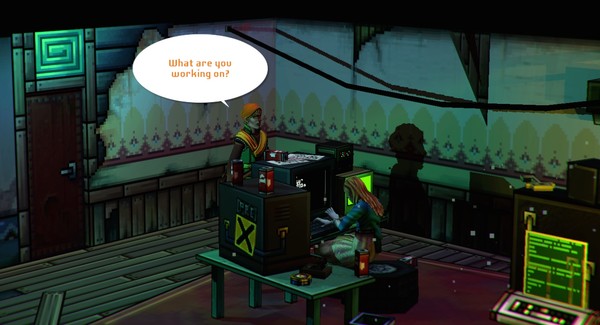 Else Heart.Break() in play — image 11 as listed on the Steam store page (Steam store screenshot)
Where are you with this game?
Press one and the game goes on your shelf. You can see it on your account page.
Reactions (no login)
Anonymous • one of each per visitor per day
Read next
Related reviews
Grim Fandango Remastered
A 3D point-and-click adventure in which you play Manny Calavera, a skeletal travel agent in the Land of the Dead, following a journey and a conspiracy told across four years. Double Fine's rebuild of a film-noir-meets-Day-of-the-Dead world, with repainted textures, dynamic lighting and a re-recorded live score.
The Magic Circle
A first-person meta-puzzle set inside a fantasy game that has been in development for twenty years and is still unfinished. You steal behaviours from creatures and objects, paste them onto other things, and rewrite your way toward the exit. Puzzles have no single intended answer. Released in 2015 by Question, a studio whose members are credited with work on Thief and BioShock.
OneShot
A top-down puzzle adventure: guide a child through a world whose sun has died, carrying a single lightbulb toward the top of it. Between the item-combining, a handful of puzzles reach out into the player's own computer. From Future Cat.


