REVIEW · 2016-07-25
Quadrilateral Cowboy
A first-person hacking heist puzzle you solve by typing commands
Introduction
You type commands into a laptop to hijack doors, cameras, turrets and a little robot, pulling off heists with a crew. A first-person hacking puzzle, made in 2016 by Blendo Games (Brendon Chung) of Thirty Flights of Loving, published with Klei, set in a retro-future cyberpunk world.
I write this from the Steam review pool. The label is 'Very Positive,' 92% of 891 reviews (snapshot 2026-07-27), and after nearly a decade it barely moves. Metacritic 81; Game Informer 9.5, GameSpot 9. It won the IGF Grand Prize. On the numbers, a near-unanimous classic.
Yet under the applause sits one stubborn caveat: 'wonderful material, but it never develops into the puzzle it could be.' I will read that small complaint-inside-the-praise in design terms.
 Quadrilateral Cowboy — Steam store key art
First Impressions
Line up the helpful positive reviews and the words rhyme: stylish, chunky, and above all 'it makes you feel like a real hacker.' Most reserve their highest praise for the moment you set the laptop down and start typing.
The recurring word is flow: build one long command, fire it on perfect timing, watch the world obey. Unlike the auto-hacking of a Watchdogs, you write the orders yourself, and everyone agrees that touch is the heart of it.
The qualified and negative reviews answer with one phrase: 'it feels like one long tutorial.' Tellingly, praise and complaint point at the same thing — one reader's 'respects my time' is another's 'too short for $20.' My job is to translate where the split happens, not to stage it as a fight.
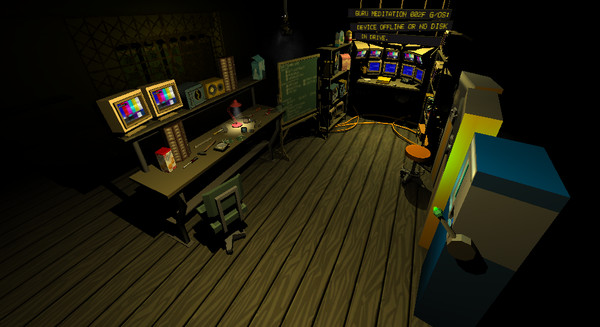 Quadrilateral Cowboy — Steam community image
Putting the Mechanics into Words
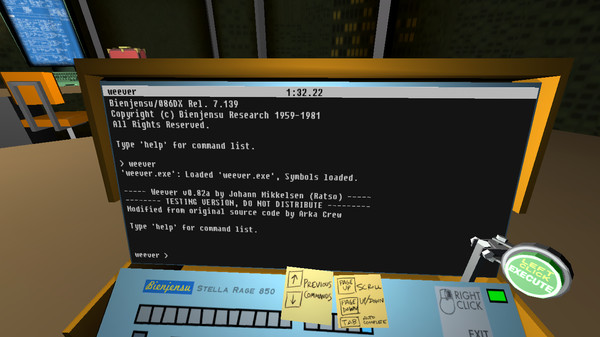
What everyone praises is the smallness of the core. Set down the laptop and type a line like door2.open(4) — open the door for four seconds. Stop a camera, swing a turret, drive the little weevil robot: all reduce to one verb, 'type a command.' In Puzzlebyrinth terms, the verb is subtracted to the bone.
One verb, but a deep grammar. The 'flow' reviewers love is chaining commands into a line and firing them against the world's clock. Many cite TIS-100-style programming puzzles for that write-and-run feel. The syntax is gentle and the vocabulary small, so the learning curve is unusually shallow for the genre.
Here is the root of the stubborn caveat. The negative side keeps saying each level hands you a new tool, uses it once, then drops it — the tools never combine. In our terms, the verb was subtracted, but no stage lets the verbs pile up into a combinatorial explosion. So difficulty never climbs and later levels feel like going through the motions. That is a critique of the learning curve's design, not of anyone's skill.
 Quadrilateral Cowboy — Steam community image
The Feel of the Story
On story, the pool splits cleanest. One camp writes 'there is hardly any narrative, and what's there is fragmentary'; the other writes 'it is about reckless days with close friends, remembered in old age,' and 'it unexpectedly made me cry.' Same game: empty to one, beautiful to the other.
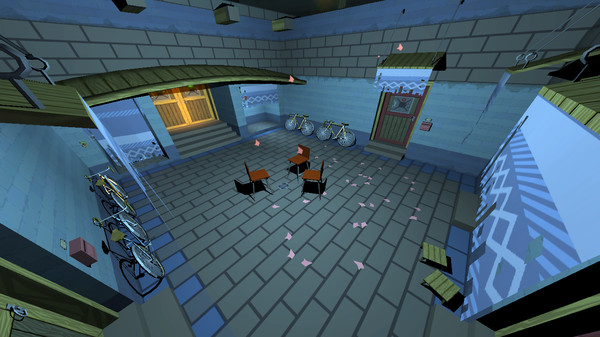
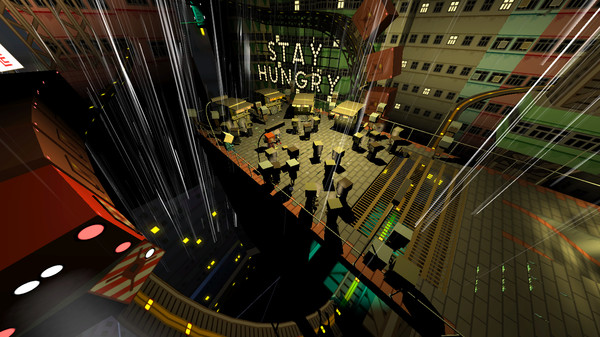
The split comes from Blendo's method: subtract dialogue and exposition, and lodge the story in the environment and the gaps — environmental storytelling. A bike chasing a steam train while Clair de Lune plays is a scene many name as unforgettable. Come expecting the explicit plotting of a Gunpoint and it can look like nothing is there.
So this is a question of observation resolution. Read the gaps and a dense story rises; wait to be told and a blank remains. The gap between the critics' high marks and the 'thin story' complaint is just the inside and outside of that reach — the reach the author drew by deciding not to explain.
 Quadrilateral Cowboy — Steam community image
The Texture of Difficulty
Sort the pool and the friction comes in two kinds. One is the puzzle logic itself, mostly called 'too easy' and 'not enough bite.' The other is the controls and timing — what reviewers call jank.
The named complaints are the awkward ledge-grab, occasional bugs and restarts, and the fuss of the timed sections. The final level especially draws 'it made me restart again and again,' and a few gave up. Ironically, that same final level is praised as 'the one place all your tools are finally tested.'
That is the design in miniature. The complaint is not 'too hard' but 'too easy, yet unfair exactly where it snags' — a twist of kind, not amount. Instead of building bite through combination, the game spent its pages on handing out tools and telling a story. Only the last level demands combination, and there many say 'I wanted more of this.' The shape of the complaint traces the shape of the author's choice.
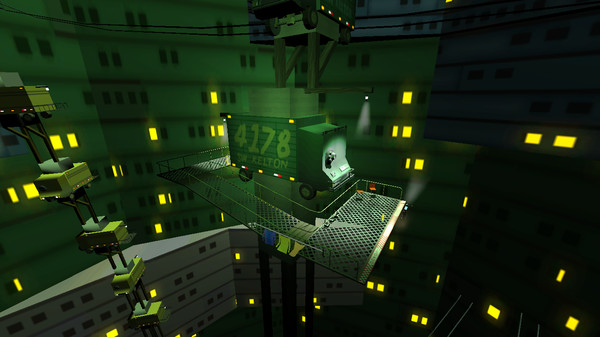 Quadrilateral Cowboy — Steam community image
Reviews Consulted
This piece was written by reading the user reviews on the Steam store page as of 2026-07-27. No review text is quoted directly; typical claims are reconstructed.
- Steam: Quadrilateral Cowboy (Very Positive, 92% of 891 reviews)
- Read via WebFetch: the top ~10 helpful positive reviews, representative negative complaints, and several recent reviews
- Press: Metacritic 81, Game Informer 9.5, GameSpot 9, Destructoid 8, and the game's IGF Grand Prize
Closing
Steam reads 92% positive; my design-critique score is 8.0. The core one-verb 'type a command' is clear, and the craft that turns it into the feel of a real hacker is first-rate. The marks come off for never building the stage where those verbs pile into a combinatorial explosion — the bite the final level briefly shows.
The pool's advice does not split: 'the material is real, but buy it on sale, and know it is short.' For a ~5-hour game with ~2 hours of commentary, that is fair. Outside its reach for anyone who wants escalating puzzles; well worth it for anyone after the touch, the atmosphere, and a wordless story that has not faded in a decade. The small complaint under the consensus is not an accusation — it is an accurate map of what this game chose, and chose not, to be.
Quadrilateral Cowboy — Steam store key art
Where are you with this game?
Press one and the game goes on your shelf. You can see it on your account page.
Reactions (no login)
Anonymous • one of each per visitor per day
Read next
Related reviews
Lara Croft GO
A turn-based puzzle adventure that walks Lara down isometric ruins one tile at a time. You slip past snakes and spear traps, pull levers, and count the turns left on a cracking floor. Square Enix Montréal folded Tomb Raider's jumping, climbing and shooting into single board moves, in the second game of their GO series.
Pony Island
A meta-puzzle in which you are trapped in a deliberately shoddy arcade cabinet built by the devil, alternating between a pony side-scroller and puzzles that reorder instruction blocks inside the machine itself. Daniel Mullins's first commercial release turns the window and the UI into the mechanism.
The Room Two
A first-person escape puzzler in which you peer at, rotate, and pry open strange clockwork boxes, using a special lens to reveal hidden marks. The second Room game widens from a single box to several interlocking contraptions, from the UK studio Fireproof Games.


