REVIEW · 2016-12-04
Lara Croft GO
Most of the negative reviewers quit within ninety minutes — what decided 1,384 verdicts was not the board
First Impressions
Line up the ten most helpful positive reviews against the ten most helpful negative ones and the first column that catches the eye is hours played. The positive side reads 5.2, 7.6, 11.4, 19.7, 35.6. The negative side reads 0.1, 0.3, 0.5, 1.0, 1.1, 1.3 — six of the ten stop inside the first hour or so.
So most of the negative reviewers were gone inside ninety minutes. And what they wrote is remarkably uniform. Almost none of it is about the puzzles. It is about the mouse.
This is a turn-based game. Thinking costs nothing; no clock runs while you plan. Yet nearly the whole volume of complaint gathers around the act of moving one tile.
So the sign on each verdict is being set before the board is reached — in the first ten minutes, at the door. That is the axis I want to follow through these 1,384 reviews.
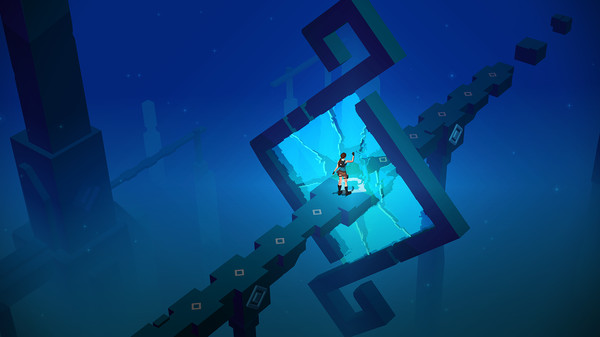 Lara Croft GO — Steam store screenshot #1
Putting the Mechanics into Words
The board is a set of isometric paths and junctions. Lara steps from node to node along the lines, one tile per turn, and the snakes and spear traps move on the same beat. Full information, nothing hidden, a finite number of moves.
The positive reviews keep reaching for the word puzzle in its strictest sense — several say the solution is essentially singular, and the Japanese pool twice compares it to tsume shogi, the endgame problems where one line of play is correct. The board is read as a composed problem, not a search space.
In design terms this is verb subtraction. Tomb Raider's continuous vocabulary — jump, climb, shoot, dodge — has been folded into a countable set: step to the next node, throw the spear, pull the lever. Toki's piece on the 2015 release describes that fold as distilling a remembered feel rather than replaying the originals.
The cracking floors are the interesting part. The published record indicates the team avoided reflex prompts and instead let floors fissure with each successive turn to create urgency. Counting remaining moves rather than seconds is the same instinct as Into the Breach.
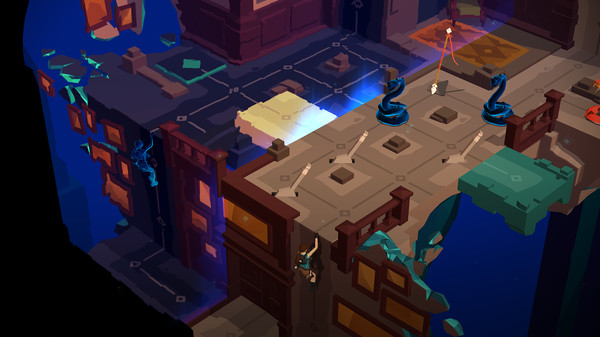 Lara Croft GO — Steam store screenshot #2
Feel of the Controls
Eight of the ten most helpful negative reviews point at one thing. Moving a single tile requires dragging the mouse. You cannot click a destination, and the keyboard does nothing.
A phone game wrapped in an executable. Tablet controls that ruin the experience. Dragging tile by tile on a laptop until your hand aches. From the nine-vote posts to the ninety-vote post, the claim barely varies.
What deserves attention is that the same complaint stands inside the recommendations. The positive side also writes that the mouse feels awkward at first and that a gamepad is advisable. They simply add a clause: it takes about ten minutes. Two reports about one wall — one of passage, one of retreat.
Open the store's discussion board and threads asking about keyboard support run back to December 2016, the week of release. One replier shrugs that it is a phone game; another says it took a little while but the controls do work well. No developer post appears. This is the textbook case of a control scheme setting the difficulty — and it is the one thing this game never teaches.
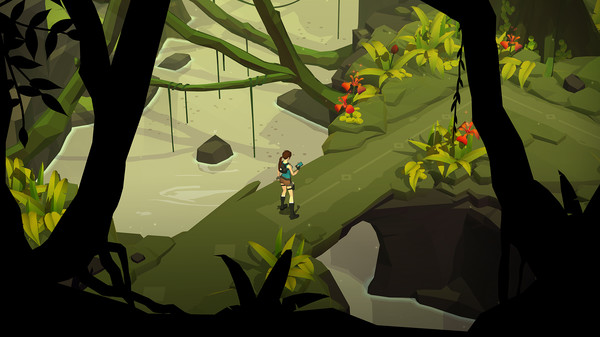 Lara Croft GO — Steam store screenshot #3
The Texture of Difficulty
On difficulty the pool splits cleanly. One group says it is far too gentle and that they finished in about two and a half hours without getting stuck. Another says the back half genuinely makes you think and that the extra chapter has real bite.
Read them side by side and the split falls on a chapter boundary. The main campaign is a mild slope that adds one device at a time; the chapter delivered by a free update in 2017 puts a steeper step after it. Two learning curves, drawn separately.
The hint system divides people the same way. One Japanese reviewer calls it an answer key in practice; another says it is what keeps you from walking away. It is the familiar question of what to show and what to withhold.
And the ten top-rated Japanese reviews barely mention the thing the English pool fought about. Rather than tolerating the controls, several call them stress-free. What they argue about instead is price: wait for a sale, and if you get stuck easily wait for a deep one. The board is the same; the complaint relocates when the language changes.
 Lara Croft GO — Steam store screenshot #4
Sources
This piece was written from the Steam store page and the Steam Community review pool as they stood on 26 August 2026.
・Steam: Lara Croft GO (Very Positive; 92% of 1,384 reviews. No thirty-day panel is shown.)
・SteamDB (roughly 4,000 reviews across all languages, 89.5% positive) and Metacritic (iOS: 83 from 39 critics, user score 7.2 from 92 ratings; the PC version has three critic reviews and no score).
・Read in full: the ten most helpful positive reviews, the ten most helpful negative ones, the five most recent, and the ten top-rated Japanese-language reviews, plus a store discussion thread about the controls. Background facts were checked against the Wikipedia article and the 2017 announcement post.
・The images are screenshots published on the Steam store page. This session could not reach the image CDN directly, so their contents could not be inspected; the captions therefore give only the store ordering rather than describing what is shown.
Closing
The tallies, for the record. As of 26 August 2026 Steam's label is Very Positive: 92% of 1,384 reviews. Across all languages SteamDB has roughly 4,000 reviews at 89.5%. Critics gave the 2015 phone version an 83 from 39 reviews; the 2016 PC release has three critic reviews and no score. The iOS user score is 7.2 from 92 ratings.
I give it 7.4. The gap against 92% is not doubt about the board. It is that I am counting the design in front of the board with the same weight.
Sliding a finger for every single move quietly erodes the best property a turn-based puzzle has — that you may think as long as you like. Other isometric puzzles arrived from touch screens too, like Monument Valley, and others work the same grid, like Golf Peaks. What this one skipped was not the board but the translation of the doorway.
Who it suits is clear. Someone with a gamepad who wants to walk down a quiet ruin one move at a time. Who it does not suit is anyone who expects to touch the board with a keyboard and a click. That is not a question of difficulty. It is a question of range.
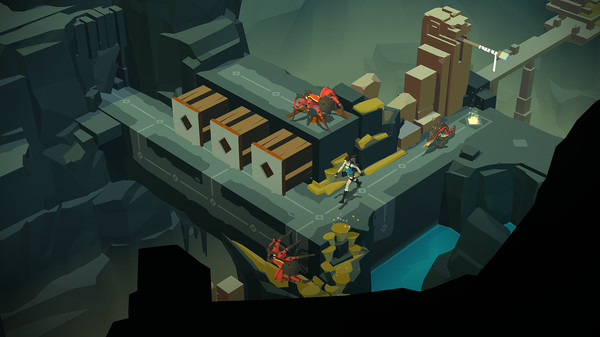 Lara Croft GO — Steam store screenshot #5
Where are you with this game?
Press one and the game goes on your shelf. You can see it on your account page.
Reactions (no login)
Anonymous • one of each per visitor per day
Read next
Related reviews
Pony Island
A meta-puzzle in which you are trapped in a deliberately shoddy arcade cabinet built by the devil, alternating between a pony side-scroller and puzzles that reorder instruction blocks inside the machine itself. Daniel Mullins's first commercial release turns the window and the UI into the mechanism.
The Turing Test
A first-person sci-fi puzzle on a moon of Jupiter: redirect energy orbs between sockets to open doors and cross a series of test chambers, wrapped in a story about machine and human judgment.
Lost in Play
A hand-drawn point-and-click adventure told entirely without words. The siblings Toto and Gal make their way home through fifteen scenes built out of a child's imagination, picking things up, combining them, and solving a different little minigame in almost every room. From Happy Juice Games.


