RETRO-REVIEW · 2026-08-15
Lara Croft GO (2015) — A Board Where Distilled Memory Still Moves
How Square Enix Montreal dug out only the "feeling" of an old game without replaying it — and what became of that method
Introduction
On August 27, 2015, a puzzle game arrived on iOS and Android: Lara Croft GO. Where Hitman GO (2014) had been Square Enix Montreal's first completed release, this was its second — proof that the studio's approach wasn't a one-off success but a repeatable method. The stage was a board of nodes and lines, and the piece moving across it was, in effect, the memory of an adventurer born in 1996.
What I want to dig up here isn't just the story of a follow-up. The development team chose not to replay the original game and reproduce it faithfully, but instead to extract only the idealized feeling remembered from it and translate that alone into board logic — a rather bold way of handling history. This is neither a faithful recreation of the original hardware nor a string of nostalgia. It is a kind of archaeology built from memory, and this piece follows that record all the way to how much of it survives today.
 A nameless piece standing among ruins (illustration, AI-generated)
The Context of Its Time
Square Enix Montreal was founded in November 2011 with a mandate to build AAA console titles. In June 2013, however, a directive from its parent company forced a pivot to mobile development, and the console Hitman project already underway collapsed. Hitman GO grew out of that upheaval, and this game followed on the strength of its success — the challenge being how to reconstruct the low-polygon aesthetic of the original 1996 Tomb Raider on a 2015 touchscreen.
In 2015, premium (pay-once) mobile games were still living through what would be their last commercially viable era. This game swept honors soon after release — Apple's iPhone Game of the Year, The Game Awards 2015's Best Mobile/Handheld Game, the 2016 Apple Design Award, and IGN's Mobile Game of the Year among them — and was critically well received (Metacritic: 83 on iOS, later 84 on PS4). But as the later sections trace, that critical acclaim did not translate into commercial sustainability.
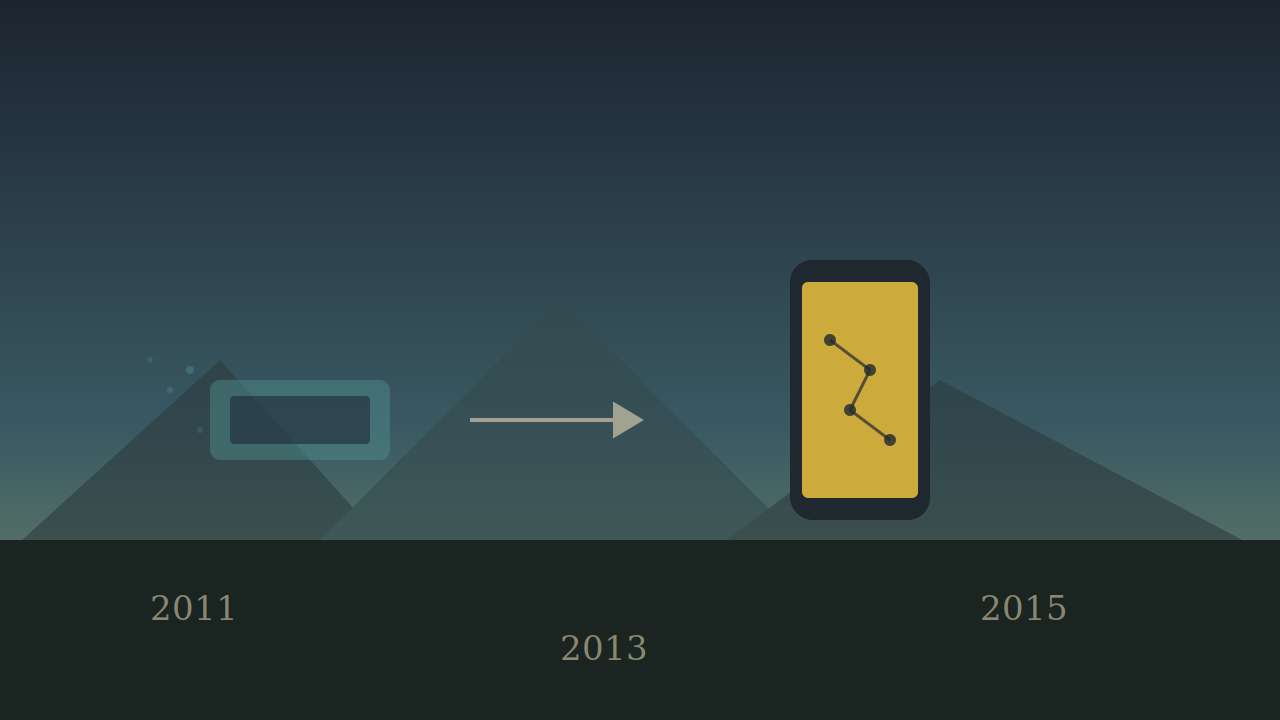 The years 2011 to 2015, when the studio's direction turned (illustration, AI-generated)
Mechanics
Lead engineer Antoine Routon described the method this way: "A Go game is a process of trying to boil down those old games." The team wrote memorable moments from the original game on Post-it notes, then narrowed them down to what a team of five in pre-production — peaking at fifteen — could actually build. Routon went further, saying, "I didn't replay those old games because I feel the best version of the first Tomb Raider is in my heart." He worried that revisiting the aged original would expose flaws that could contaminate the idealized version held in memory.
In execution, the team deliberately dropped the board-game look that had defined Hitman GO and removed human enemies entirely. In their place came threats drawn from the environment itself — snakes, lizards, spiders — along with rolling boulders and spinning blades. The camera also changed, from Hitman GO's voyeuristic overhead view to a following camera that discovers the environment alongside the protagonist. Across five chapters and forty levels, leaping between cliffs and working levers to shift platforms became the way the feeling of a 1996 "adventure" was translated into board logic.
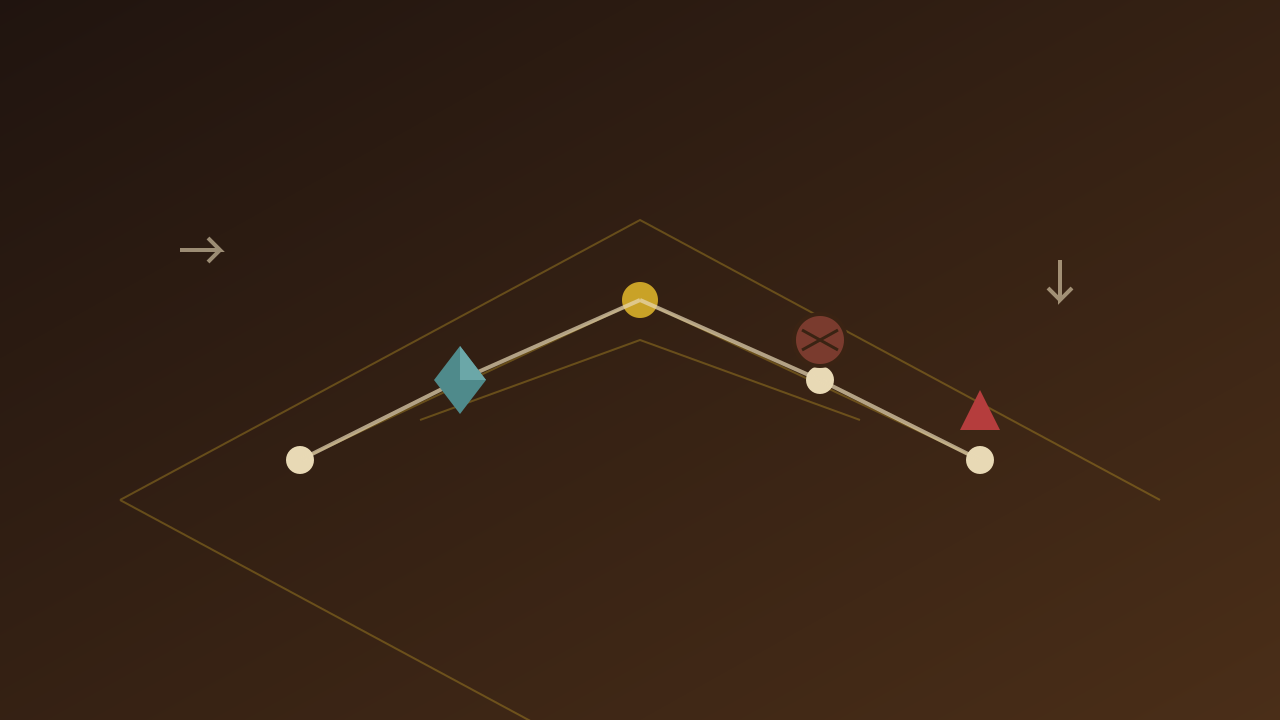 Nodes and lines, a boulder and blades closing in (illustration, AI-generated)
Lineage to the Present
This game sits in the middle of Square Enix Montreal's Go series — Hitman GO (2014), this title (2015), and Deus Ex GO (2016). What's notable is that when the PlayStation 4/Vita version shipped in December 2016, its exclusive bonus levels, "Mirror of Spirits," were not made in-house but by an independent studio, KO_OP — an indie puzzle designer invited into the margins of a AAA brand.
But the "distillation" method itself didn't last. In 2018, studio head Patrick Naud acknowledged the end of new Go titles, saying, "The premium mobile market is diminishing. You've got more and more high-quality free titles, so there are even fewer people inclined to try something that will not be free." In August 2022, the parent company sold the studio to Embracer Group; after a rebrand to "Onoma" in October, it was shut down that November. The following January 2023, the sibling title Deus Ex GO and the live-service Hitman Sniper: The Shadows became completely unplayable. This game and Hitman GO, however, being offline software with no server dependency, remained available on Steam and other storefronts as of this writing — even after the studio and company that made them had vanished. The very format that carried this "distilled memory" is what decided which titles survived.
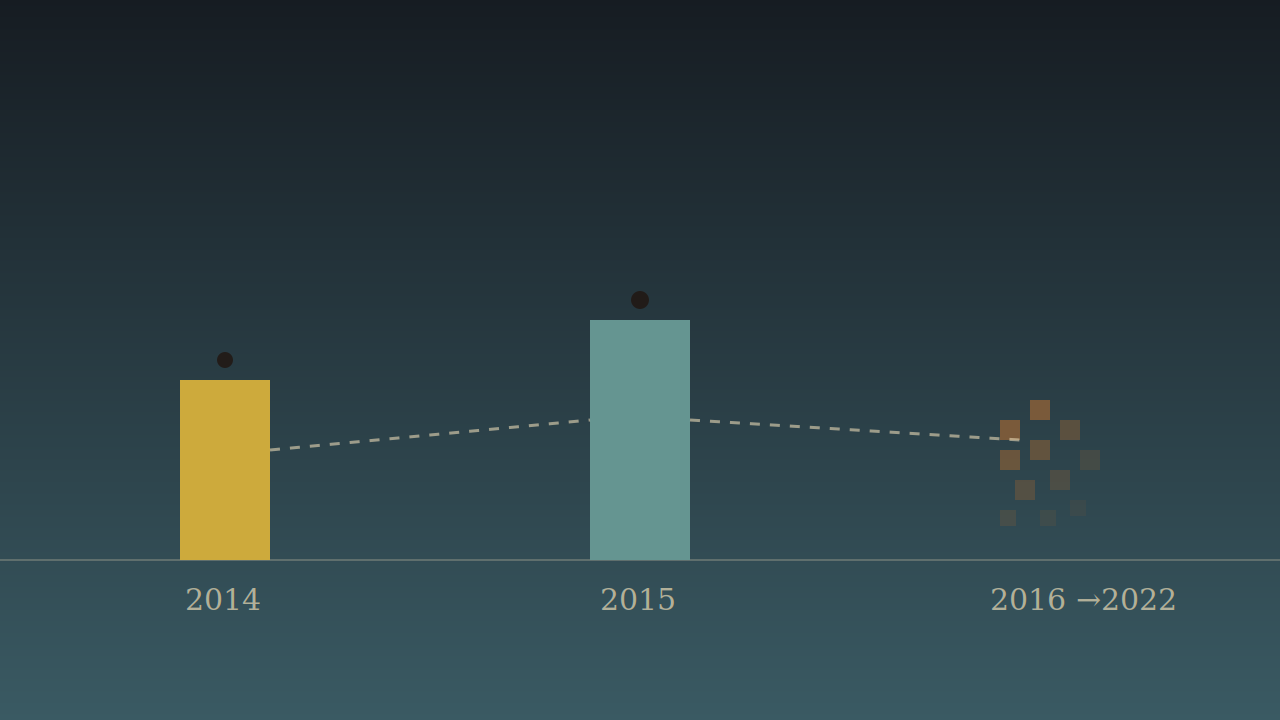 Three monoliths spanning 2014 to 2022, one dissolving into dust (illustration, AI-generated)
Sources
Sources referenced in this article:
・Wikipedia: Square Enix Montreal
・PocketGamer.biz, "An athletic aesthetic: The making of Lara Croft GO"
・PocketGamer.biz, "Square Enix Montreal no longer working on the Go series," 2018
Closing
The developers are gone. Even the studio's final name, Onoma, vanished in 2022. And yet, on the board, that piece still quietly advances one square at a time. This is not a precise recreation of the original hardware — it is a copy someone later carved, guided only by a memory held in the heart. That, I think, is exactly what makes this piece interesting as history. Preserving a game doesn't only mean preserving its code or its disc. Someone's memory of "how it felt" gets carved again, in a different form, by someone else — and that act, repeated again and again within the puzzle genre, remains here on the board as one specimen of it.
 A quiet board with only a single piece left behind (illustration, AI-generated)
Reactions (no login)
Anonymous • one of each per visitor per day
Part of these series
Retro RevisitedEpisode 31 of 43
